
Table of Contents:
How to Interpret a Reverse Osmosis System Diagram
Reverse Osmosis Flow Restrictors: What They Are and Why the System Needs One
What Is a Permeate Pump and How Does a Permeate Pump Work?
Reverse Osmosis Permeate Pump Systems: When Is One Worth Adding?
RO Tank Valves: Which Are Most Reliable and Easy to Install?
What Maintenance Is Required for a Reverse Osmosis System?
How GlacierFresh RO Systems Approach These Components
FAQs
Conclusion
Your RO tank takes forever to refill, and the system sends more water down the drain than the label promised. Nine times out of ten, the cause is one of two small parts most owners have never heard of.
Most reverse osmosis guides stop at filters and membranes. Flow restrictors and permeate pumps work a level deeper, at the hydraulics, and they decide how efficient your system actually is. If you've ever wondered what a permeate pump is or why your drain line runs more than it should, this is where those answers live.
How to Interpret a Reverse Osmosis System Diagram
 Before the parts make sense, trace the water. Cold water leaves the supply through a saddle valve, passes sediment and carbon pre-filters, then meets the auto shut-off valve (ASOV), which halts production once the tank is full.
At the RO membrane, water splits into permeate (the clean stream) and brine (the reject stream). A flow restrictor sits on the brine line to the drain, a check valve blocks backflow toward the membrane, and the permeate runs to the tank, a post-carbon polishing filter, and the dedicated faucet. A permeate pump, when fitted, sits between membrane and tank, straddling the brine and permeate lines, and replaces the standard check valve.
One habit prevents most installation and diagnosis errors: reading the tubing colors right.
-
Red or blue tubing is the feed line.
-
Black tubing is the drain or brine line, where the flow restrictor lives.
-
White or clear tubing is the permeate, your filtered water.
Reverse Osmosis Flow Restrictors: What They Are and Why the System Needs One
A flow restrictor is a small device in the brine line that deliberately creates hydraulic back pressure. That back pressure isn't a flaw; it's the precondition for filtration.
Why Back Pressure Is Essential to RO Filtration
RO needs sustained pressure across the membrane to push water through. If the drain ran wide open, membrane pressure would collapse, production would crater, and the waste ratio would balloon. The restrictor holds the membrane at its rated operating pressure so filtration can happen at all.
What Are the Best Types of Flow Restrictors for RO Systems?
Three types cover almost every residential system:
-
Barrel (orifice) restrictors are the most common under 150 GPD: a fixed orifice, simple, cheap, and reliable, rated in mL/min.
-
Capillary restrictors use a long narrow tube that resists clogging, suit 150 GPD and up, and can be trimmed to fine-tune flow.
-
Needle valves are manually adjustable, for variable pressure or owners who want precise control.
The restrictor has to match both the membrane's GPD rating and your incoming pressure. Match it to the membrane spec sheet's GPD and test pressure. Too loose wastes water; too tight strains the membrane.
What Is a Permeate Pump and How Does a Permeate Pump Work?
So what is a permeate pump? It's a non-electric, hydraulically powered accessory for tank-based RO systems. It is not a booster pump, which raises feed pressure; it solves a different problem.
The Problem a Permeate Pump Solves: Storage Tank Back Pressure
As the storage tank fills, its rising pressure pushes back against the membrane, cutting net driving pressure and slowing production. At roughly two-thirds of line pressure, the ASOV shuts the system off, so the last third of the tank often goes unused.
That falling pressure also weakens the membrane's TDS rejection, so water quality dips as the tank nears full.
How a Permeate Pump Works: The Hydraulic Mechanism
Here's how a permeate pump works: it borrows energy from the brine stream that would otherwise go to waste and uses it to push permeate into the tank, isolating the membrane from tank back pressure. In sequence:
-
Brine entering the 'Brine In' port drives an internal piston or diaphragm.
-
That piston pushes permeate from 'Permeate In' into the tank through 'Permeate Out'.
-
The membrane sees near-zero back pressure for the whole fill cycle.
The payoff is real: up to 80% less water to drain, a tank that fills up to 65% faster, and steady TDS rejection from empty to full. It also uses no electricity, doesn't raise feed pressure, and doesn't improve filtration on its own.
Permeate Pump Diagram: Component and Connection Overview
A permeate pump diagram comes down to four ports: Brine In from the membrane's brine outlet, Brine Out to the drain, Permeate In from the membrane's permeate outlet, and Permeate Out to the tank.
The flow restrictor is still required and works alongside the pump, not instead of it, and the pump takes the place of the standard check valve.
Reverse Osmosis Permeate Pump Systems: When Is One Worth Adding?
Clear Benefits
A permeate pump pays off most when the incoming pressure is low. Below 50 PSI it makes the biggest difference, letting a 40 PSI system perform close to a 60 PSI one. If your waste ratio is 4:1 or worse, a pump can pull it toward 1:1 or 2:1.
Households that drain the tank often get faster refills, and if TDS climbs as the tank fills, the pump fixes the cause. Adding one turns a basic tank setup into a permeate RO system that wastes far less water.
Little or No Benefit
The gains shrink when incoming pressure is already high, around 70 PSI or more, since back pressure matters less. Tankless RO systems have no storage tank, so tank back pressure never arises. And if you already run an electric booster pump, a permeate pump adds little on top.
RO Tank Valves: Which Are Most Reliable and Easy to Install?
A residential RO system uses three small valves. The ball valve is a manual quarter-turn shutoff on the tank, simple and essentially failure-proof, and most tanks ship with one.
The ASOV senses pressure and stops production when the tank is full; it's also the most common failure point, running continuously if it fails open or stopping production if it fails closed.
The check valve is a one-way valve on the permeate line with a quiet failure mode: no faucet flow despite a full tank usually means it has failed. All three use standard 1/4-inch push-fit (John Guest) fittings, so installation is tool-free.
What Maintenance Is Required for a Reverse Osmosis System?
Maintenance Schedule
Keep it simple and on schedule:
-
Every 6 to 12 months: replace the sediment and carbon pre-filters, sooner in high-sediment or chloramine water.
-
Every 12 months: replace the post-carbon polishing filter and sanitize the system.
-
Every 24 months, or when TDS rejection drops below about 85%: replace the RO membrane.
-
Every 6 to 12 months: check the empty tank's pre-charge, which should read 7 to 8 PSI, and top it up with a bicycle pump if low.
Flow Restrictor and Permeate Pump Maintenance
Both are nearly maintenance-free. A flow restrictor needs no upkeep; if you suspect clogging, replace it rather than clean it. A permeate pump is a passive device with nothing to service; if performance slips, check the connections and the restrictor sizing. The check valve and ASOV are replaced on symptom, not on a schedule.
Troubleshooting Signs
Slow faucet flow points to tank pressure first, then pre-filter condition, then membrane rejection. A change in taste usually means exhausted carbon stages. A system that won't shut off is typically an ASOV failing open. Excessive drain flow means the flow restrictor is clogged, wrong-sized, or missing.
How GlacierFresh RO Systems Approach These Components
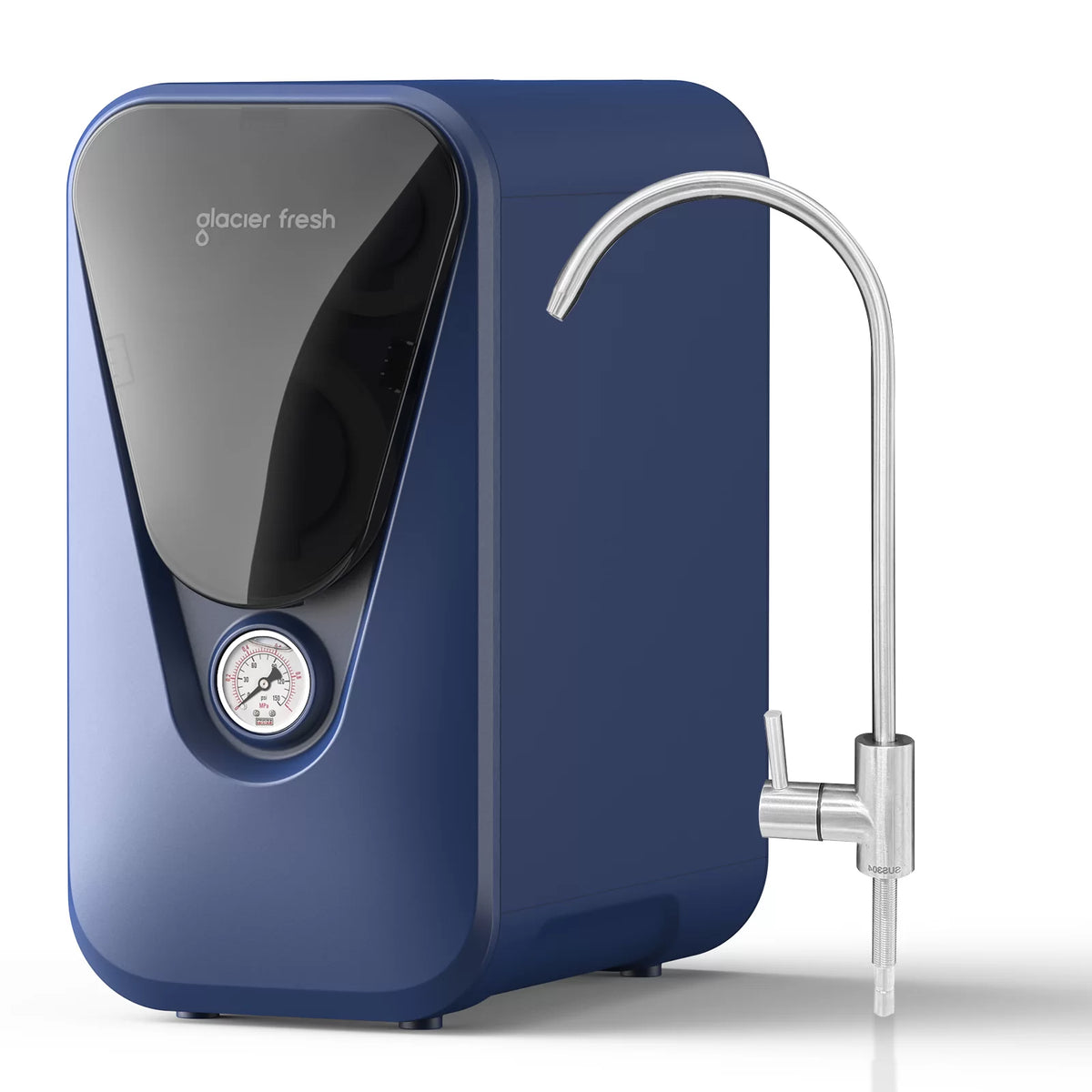
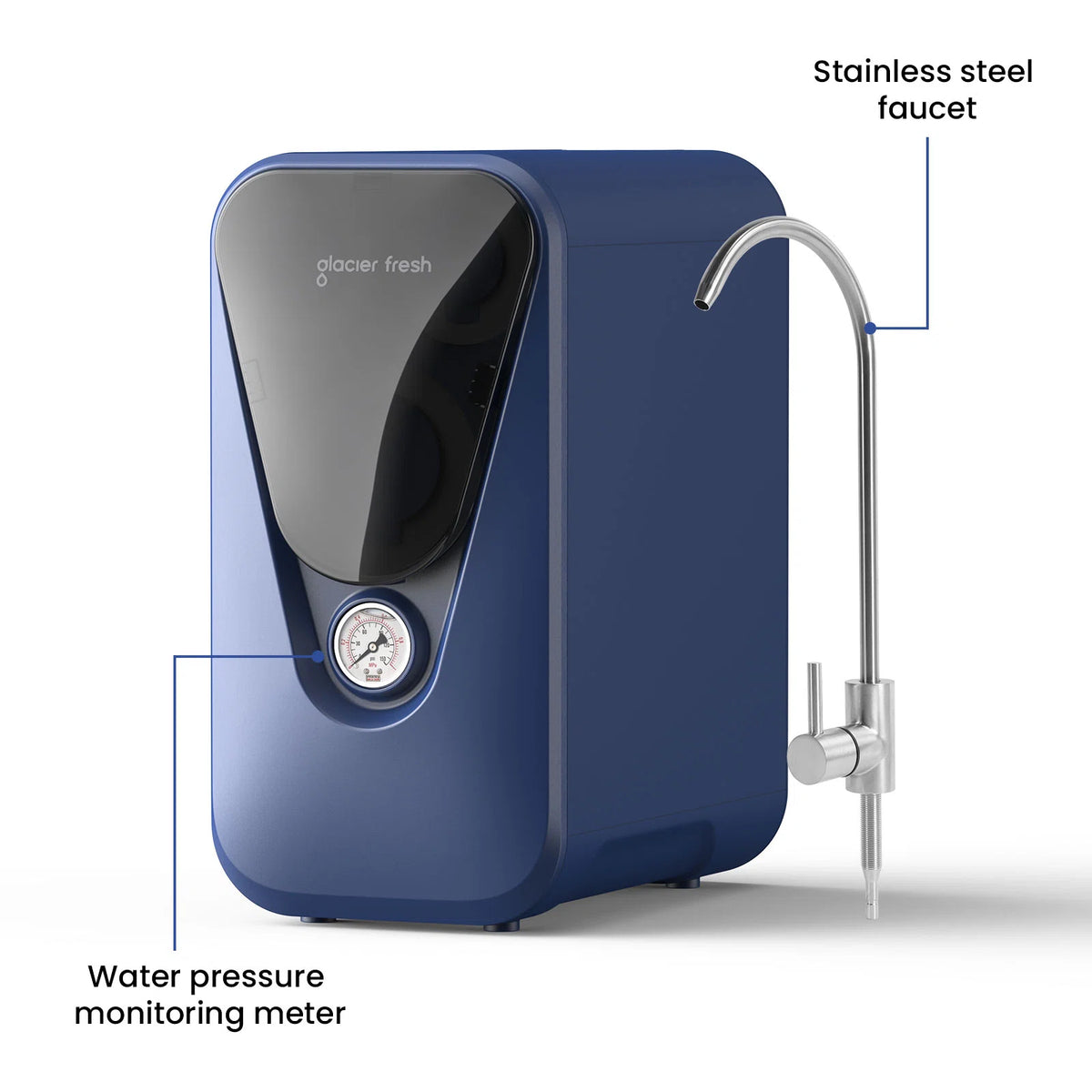
 GlacierFresh takes a different route around the back-pressure problem. The GlacierFresh U03 (GFU03-800G) is a non-electric, tankinside under-sink RO that runs on standard municipal pressure (0.25 to 0.7 MPa, roughly 36 to 100 PSI) with no booster pump.
Because it's tankinside, the storage-tank back pressure a permeate pump exists to fix never arises, so the main efficiency lever is flow restrictor sizing against your incoming pressure.
It's a factory-set 5-stage system, PP cotton, compound carbon, a 16-layer 0.0001-micron RO membrane, particle carbon, and post-carbon, rated at 0.6 GPM with a 3:1 pure-to-drain ratio and certified to NSF/ANSI 58 and SGS, cutting contaminants like PFAS.
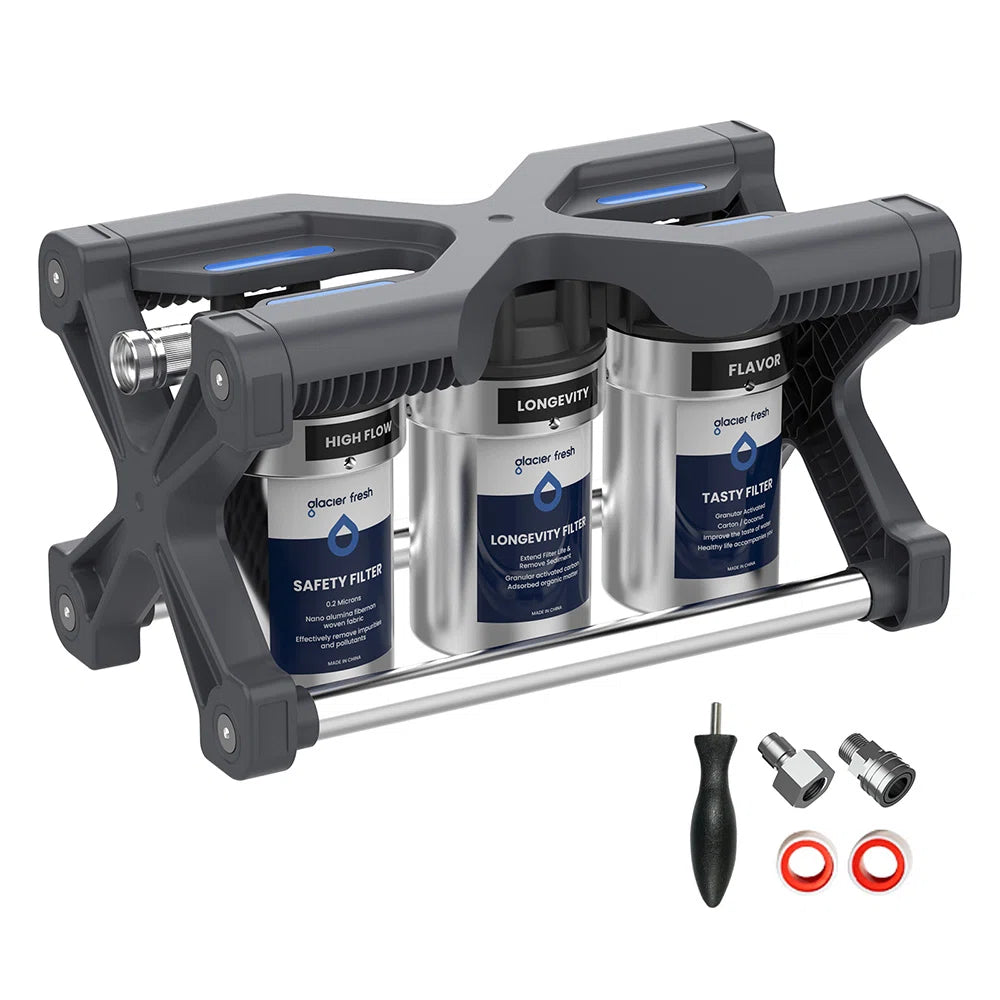
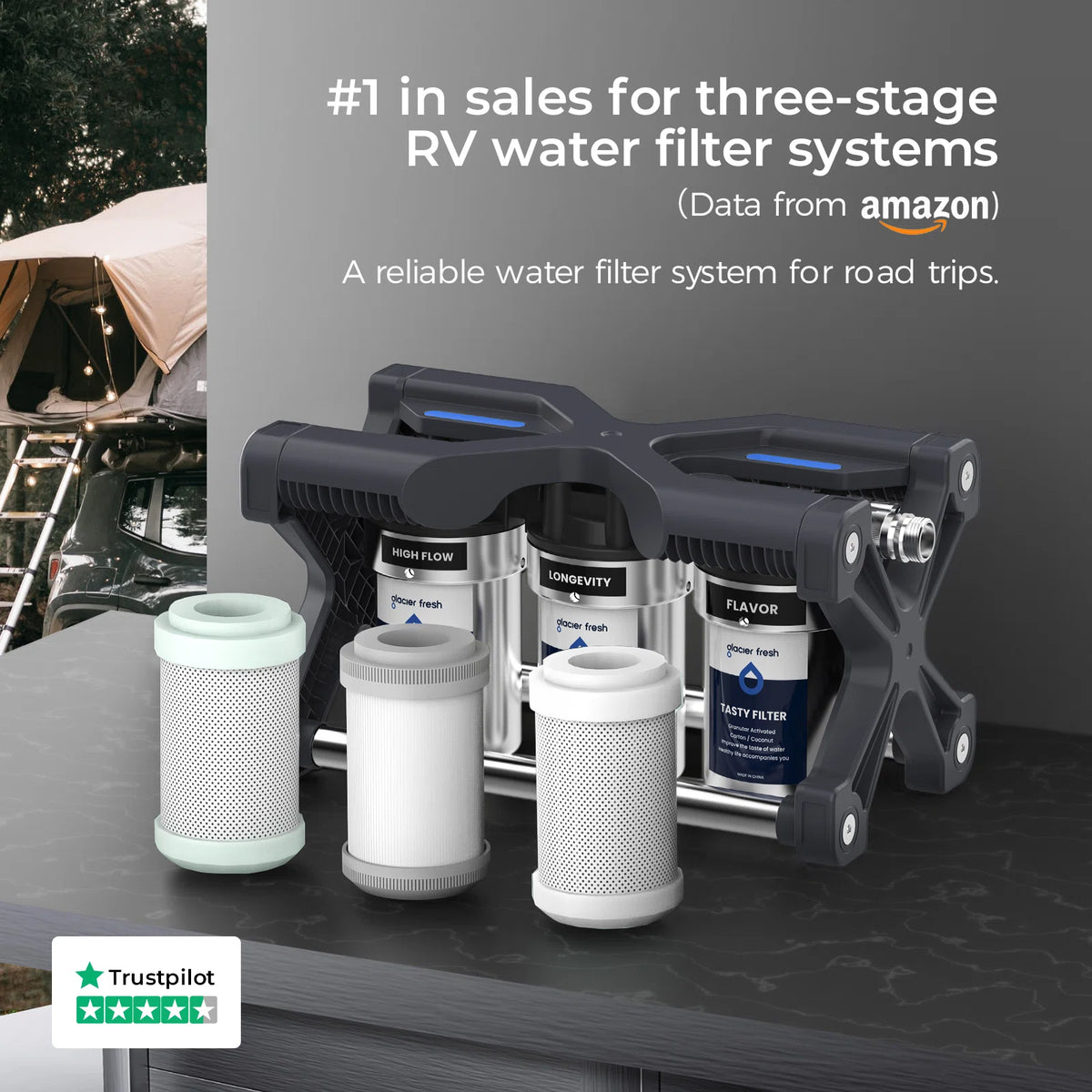
For travel, the GlacierFresh RV RO System (RVRO01) meets the opposite challenge, campground hookups that swing from 20 to 80-plus PSI, exactly where flow restrictor sizing matters most. It adds a smart display and dual power, shore or a 24V power bank.
FAQs
Which RO tank valves are most reliable and easy to install?
The ball valve is the most reliable, a manual shutoff that rarely fails. The ASOV and check valve do more but fail more often. All use tool-free 1/4-inch push-fit fittings, so any swaps out in minutes.
How do I interpret a reverse osmosis system diagram?
Follow the water left to right: supply, pre-filters, membrane, then the split into permeate and brine. Read the tubing colors: red or blue for feed, black for brine and drain, white or clear for permeate.
Does a permeate pump use electricity?
No. A permeate pump is purely hydraulic, powered by the brine stream the system already produces. That's the appeal: it cuts waste and speeds tank refills with no wiring, no outlet, and no added running cost.
Will a permeate pump improve my water quality?
Indirectly. It keeps the membrane at full driving pressure as the tank fills, holding TDS rejection steady. It doesn't add a filtration step, so it improves consistency, not peak quality.
Do I need both a flow restrictor and a permeate pump, or just one?
If you add a permeate pump, you still need the flow restrictor; they work together. The restrictor creates the membrane back pressure that makes filtration possible, while the pump manages tank back pressure. The pump replaces the check valve, not the restrictor.
Conclusion
Filters get the attention, but flow restrictors and permeate pumps decide how efficiently an RO system runs. A correctly sized restrictor keeps the membrane working, and on a low-pressure tank system a permeate pump cuts waste and speeds refills. To skip pressure management entirely, the GlacierFresh U03 runs non-electric at standard household pressure. Explore the full range at glacierfreshfilter.com.
References:
-
United States Environmental Protection Agency. Secondary Drinking Water Standards: Guidance for Nuisance Chemicals. https://www.epa.gov/sdwa/secondary-drinking-water-standards-guidance-nuisance-chemicals
-
NSF International. Certified Drinking Water Treatment Units – Lead Reduction. https://info.nsf.org/Certified/dwtu/listings_leadreduction.asp
-
Safe Drinking Water Foundation. Ultrafiltration, Nanofiltration and Reverse Osmosis. https://www.safewater.org/fact-sheets-1/2017/1/23/ultrafiltrationnanoandro
-
United States Environmental Protection Agency. Identifying Drinking Water Filters Certified to Reduce PFAS. https://www.epa.gov/water-research/identifying-drinking-water-filters-certified-reduce-pfas
-
Centers for Disease Control and Prevention. About Choosing Home Water Filters. https://www.cdc.gov/drinking-water/prevention/about-choosing-home-water-filters.html