Roger Seheult, MD of MedCram explains forever chemicals such as PFAS, PFOA, PFOS, and BPA
The Hidden Threat in Your Drinking Water
PFAS—per- and polyfluoroalkyl substances—are synthetic chemicals found in everything from non-stick cookware to firefighting foam. But the most alarming discovery? They’re in your tap water.
Known as “forever chemicals” because they don’t break down naturally in the environment or the human body, PFAS accumulate over time. Recent studies reveal that over 90% of Americans already have detectable levels of PFAS in their bloodstream.
What Are PFAS?
Attribute
Detail
Full name
Per- and polyfluoroalkyl substances
Commonly known as
“Forever chemicals”
Key property
Carbon-fluorine bond—one of the strongest in chemistry—makes them virtually indestructible
Disruption of estrogen and testosterone regulation
“PFAS are a public health crisis unfolding in real time.” — EPA Administrator (2024)
Regulatory Context – What the EPA Says
Agency
Action / Standard
EPA (2024)
Finalized National Primary Drinking Water Regulation (NPDWR) for PFAS
Maximum Contaminant Levels (MCLs)
PFOA: 4.0 parts per trillion (ppt); PFOS: 4.0 ppt; PFNA, PFHxS, GenX: 10 ppt
Hazard Index
Combined limit for mixtures of PFAS
Enforcement deadline
2027–2029 for public water systems
Current status
Thousands of U.S. water systems still exceed safe levels; many lack PFAS testing entirely
The Gap – Why Municipal Treatment Isn’t Enough
Issue
Explanation
Limited testing
Many utilities do not yet test for PFAS
Treatment gaps
Standard coagulation and sand filtration do not remove PFAS
Legacy contamination
Military bases, industrial sites, and airports remain sources
Point-of-use matters
PFAS can leach from plumbing or enter between the treatment plant and your tap
Bottom line: Even if your city reports “safe” water at the plant, your home’s pipes or aging infrastructure could introduce PFAS before it reaches your glass.
How GlacierFresh® Filters Remove PFAS
Not all water filters are created equal. GlacierFresh uses advanced reverse osmosis (RO) and activated carbon filtration technology specifically engineered to capture and remove PFAS molecules—including both long-chain (PFOA, PFOS) and short-chain (PFBA, GenX) variants.
NSF/ANSI Standard 53 (health effects) and Standard 58 (RO systems)—independently tested for PFAS reduction
PFOA/PFOS removal
Up to 99%
Activated carbon block
Traps long-chain and short-chain PFAS compounds effectively
RO membrane
Pore size 0.0001 microns—filters particles at molecular scale
Filtration stages
3–5 stages depending on model (sediment → carbon → RO → post-carbon → remineralization)
Remineralization
Adds back healthy minerals (calcium, magnesium) for balanced pH and great taste
Contaminants reduced (total)
PFAS + chlorine, lead, mercury, pesticides, VOCs, and over 1,000 other contaminants
How PFAS Removal Works (Simple Analogy)
Think of PFAS molecules like tiny, greasy particles that slip through most filters. Our systems use a two-step trap: activated carbon acts like a sponge that grabs the larger PFAS molecules, while the RO membrane—with pores 100,000× smaller than a human hair—catches the tiny ones that make it through. Together, they catch over 99% of these chemicals in every drop.
Choose Your PFAS Protection – Product Matrix
For Your Home
System
Best For
Key Advantage
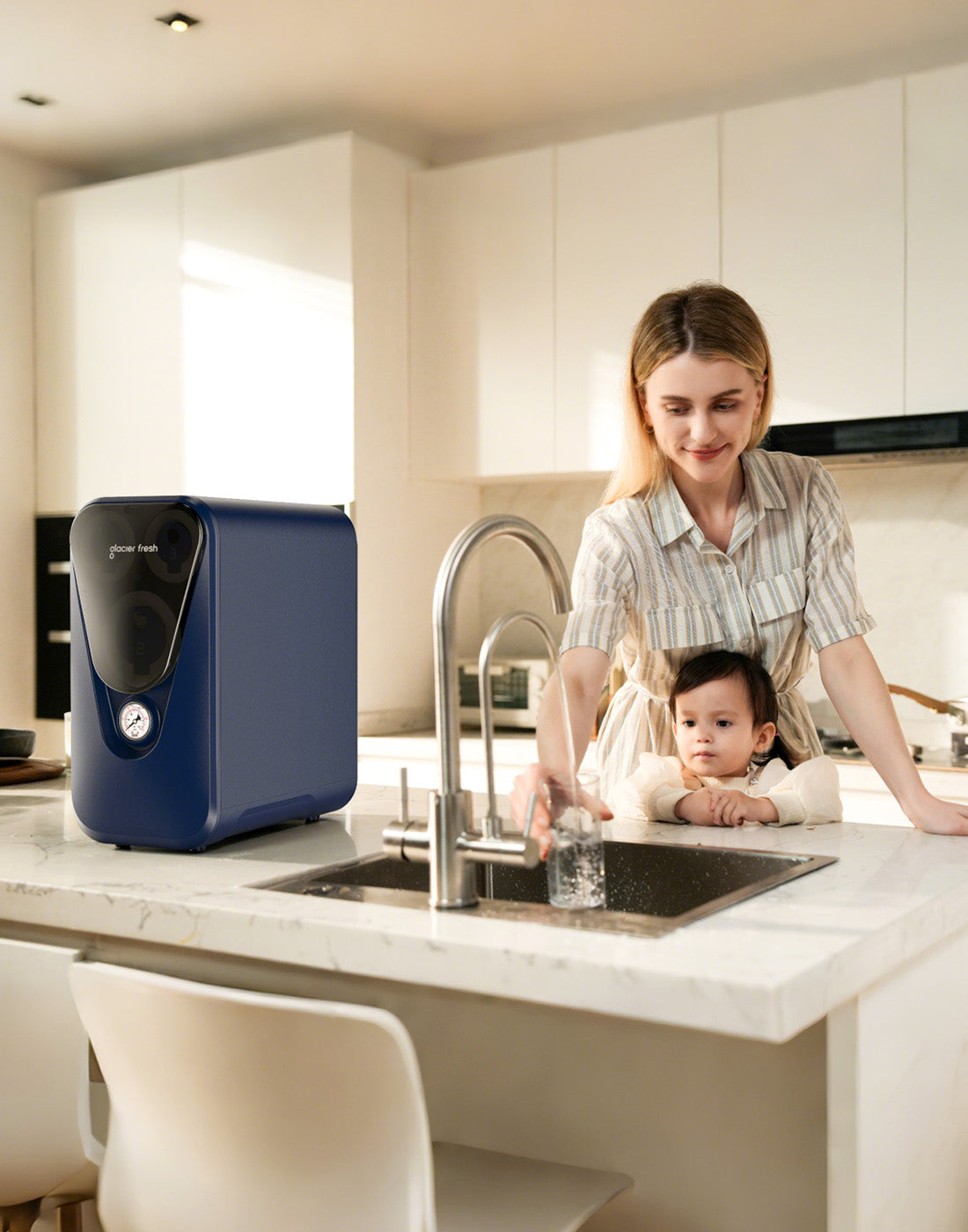
Under-Sink RO
Families, homeowners
Permanent dedicated faucet; maximum filtration volume; whole-kitchen protection
Countertop RO
Renters, small spaces
No installation; portable; moves with you; same RO performance
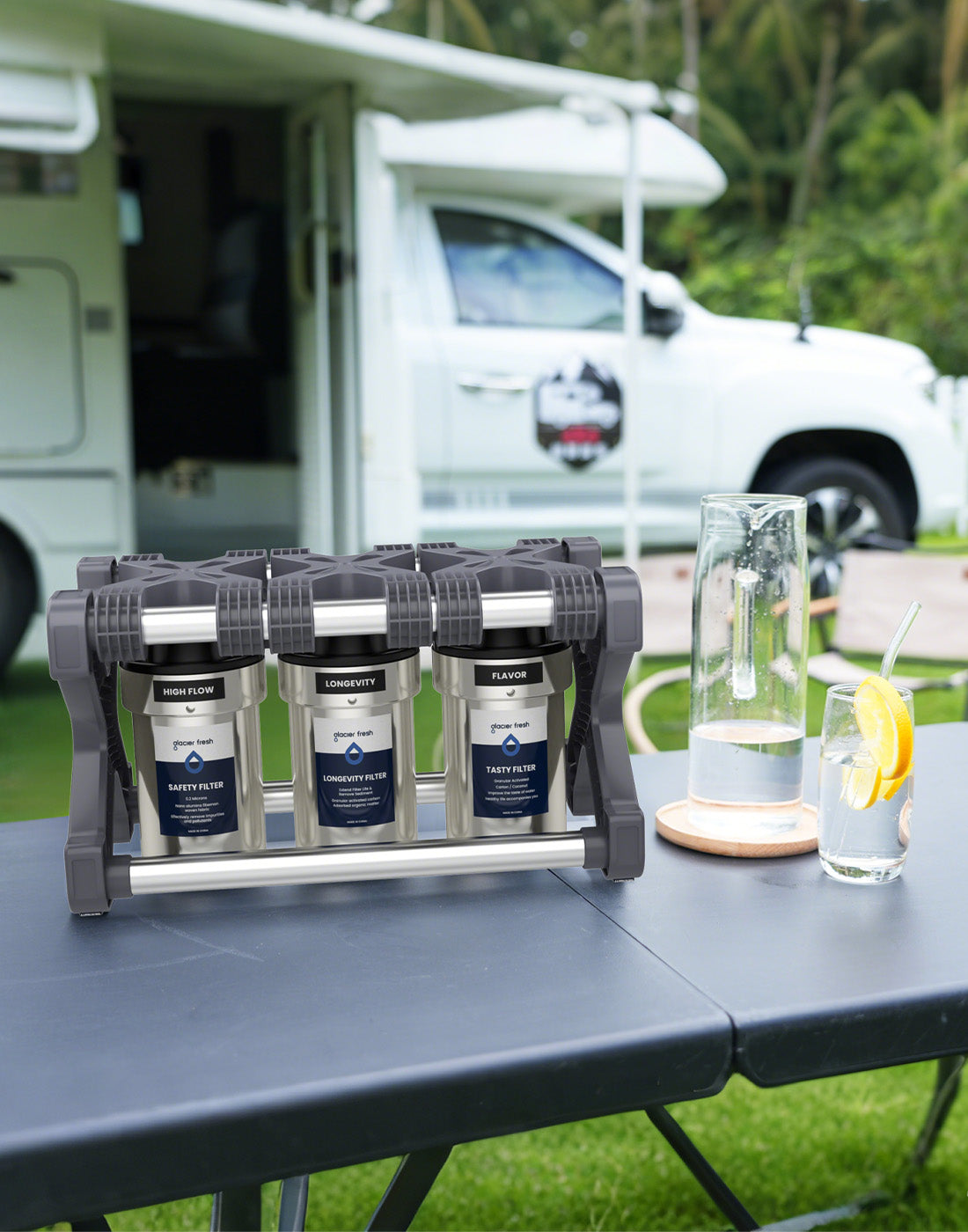
Gravity 5-Stage Carbon
Off-grid, emergency prep
No electricity; multi-stage carbon for PFAS reduction; backup-ready
Certified filtration in a reusable bottle; BPA-free
Why Families Trust GlacierFresh
Trust Factor
What It Means
✅ Certified Performance
Third-party tested to NSF/ANSI 53 & 58 standards
✅ Premium Quality
Food-grade 304 stainless steel; BPA-free components throughout
✅ Easy Maintenance
Simple filter replacements with clear change indicators on select models
✅ Exceptional Value
Lower cost per gallon than bottled water—saves up to 80% over time
✅ Expert Support
Dedicated customer care, installation guidance, and filter reminder service
PFAS Comparison – GlacierFresh vs. Standard Pitchers
Feature
Standard Pitcher
GlacierFresh RO System
PFAS removal
Partial (short-chain often escapes)
Up to 99% (both long & short chain)
NSF 53 certification
Rare
✅ Yes
Heavy metal removal
Some
✅ Comprehensive
TDS reduction
None
Up to 95%
Filter lifespan
1–3 months
6–12 months
Cost per gallon
~$0.15–$0.30
~$0.06–$0.12
Actionable Steps – What You Can Do Today
Check your water – Contact your utility for PFAS test results or use a certified home testing kit.
Know your risk – Homes near military bases, airports, industrial sites, or older plumbing are at higher risk.
Choose certified filtration – Look for NSF/ANSI 53 or 58 certification specifically for PFAS.
Install GlacierFresh – Protect your family with proven, point-of-use technology.
Stay informed – PFAS regulations and health advisories are evolving rapidly.
FAQ
PFAS (per- and polyfluoroalkyl substances) are synthetic chemicals with a carbon-fluorine bond so strong that they resist degradation in the environment and the human body—hence the nickname "forever chemicals."
No. Boiling actually concentrates PFAS, increasing the concentration of these chemicals. Only certified filtration—specifically activated carbon with ion exchange or reverse osmosis—can effectively reduce PFAS levels.
The EPA has set Maximum Contaminant Levels (MCLs) of 4.0 parts per trillion (ppt) for PFOA and PFOS individually, with combined hazard index limits for PFNA, PFHxS, and GenX. These are the strictest standards to date.
Yes. Our advanced activated carbon block combined with RO membrane technology is engineered to capture both long-chain (PFOA/PFOS) and short-chain PFAS compounds, including GenX, effectively reducing them to below detectable limits in certified testing.
Filter lifespan varies by model and usage—typically 6–12 months for carbon stages and 1–2 years for RO membranes. Each system includes clear indicators or replacement schedules to ensure consistent protection.
Bottled water is not guaranteed PFAS-free. Some brands have tested positive for PFAS. GlacierFresh point-of-use filtration gives you direct control over what's in your glass.
Yes. Our multi-stage systems reduce chlorine, lead, mercury, pesticides, VOCs, sediment, and over 1,000 other common water contaminants in addition to PFAS.
The Science of Hydration: Are You Drinking Water "in Vain"? How to Drink Water Correctly in a Day? How to Drink Water Correctly for Specific Needs? Common Mi...
Common 6 Types of Drinking Water in the WorldHow Can You Tell What Is the Healthiest Water to Drink?How to Choose the Drink Water That's Best for You?Common ...
Does Tap Water Quality Change Throughout the Year?Do Refrigerator Water Filters Work in Winter and Summer? Can Water Filters Handle Changes in Water QualityD...
Customer Reviews
Overall rating: 4.8 / 5 from 8107 reviews.
I’ve been using the GlacierFresh Coolon cold water dispenser for a few weeks now, and it’s honestly changed my daily water routine in a way I didn’t expect. The biggest difference is convenience—no more waiting for the fridge to chill water or constantly refilling pitchers. I just fill the tank, press a button, and get consistently cold, clean-tasting water within seconds.
I’ve been using the GlacierFresh Coolon cold water dispenser for a few weeks now, and it’s honestly changed my daily water routine in a way I didn’t expect. The biggest difference is convenience—no more waiting for the fridge to chill water or constantly refilling pitchers. I just fill the tank, press a button, and get consistently cold, clean-tasting water within seconds.
Setup was not too difficult. The guide said it would take 30 minutes, but realistically it took me about 1 1/2 hours. It had been a while since I had done any sort of plumbing, so I was taking it a bit slow. The included instructions were very helpful and easy to follow. This device uses no electricity. Comes with all the adapters and fittings you'll need. Be sure to pop on the retainer clips once the fully insert the tubes into the sharkbite fittings. I managed to get it right on the first try with no leaks.
This has been a game changer. No more lugging around water bottles for drinking. Water through this taste excellent. So glad we purchased this filter system.
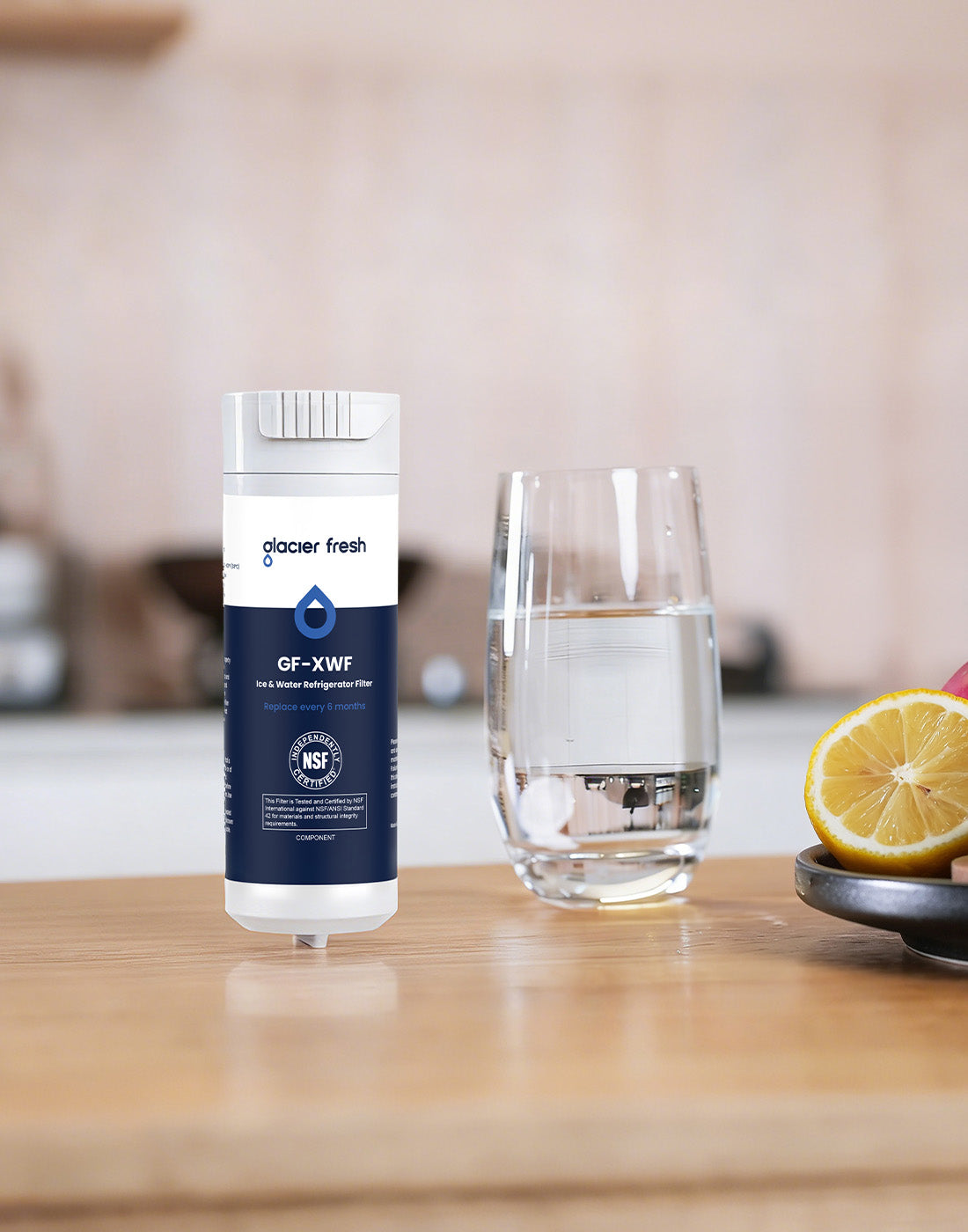
My 10-year-old GE fridge takes the MWF filter, and I refuse to pay $50 for the OEM version anymore. This GlacierFresh one fits perfectly—just twisted right in, no leaks. The water tastes clean and fresh, and my ice cubes don't have that weird plastic taste anymore. For $15 each in the 2-pack, it's a steal. Highly recommend.
I was skeptical about buying a third-party filter because my GE fridge is picky about the chip. But this one works perfectly—installed in 30 seconds, no leaks, and the "change filter" light reset without any hassle.
Setup was not too difficult. The guide said it would take 30 minutes, but realistically it took me about 1 1/2 hours. It had been a while since I had done any sort of plumbing, so I was taking it a bit slow. The included instructions were very helpful and easy to follow. This device uses no electricity. Comes with all the adapters and fittings you'll need. Be sure to pop on the retainer clips once the fully insert the tubes into the sharkbite fittings. I managed to get it right on the first try with no leaks.
This Glacier Fresh water dispenser has been a great addition to my beverage setup. It looks clean and fits perfectly into the drink station. The hot and cold options are super convenient and it heats and cools quickly. The preset sizes (like 12 oz and 20 oz) make it easy to fill cups without guessing and the flow is smooth and consistent. Overall, a great combo if convenience and performance. If you’re looking to upgrade your drink station or want an all-in-one water solution, this is definitely worth the investment and cost.
Really solid replacement for the original GE RPWFE filter. It installed easily and the built-in chip was recognized by my fridge right away—no error messages at all. Water tastes clean and fresh, just like the OEM filter, but at a much better price. I’ll definitely keep using this instead of paying extra for the GE brand.
This has changed how we use water in our camper. We love having filtered water in our fresh tank and our city lines. Either way has made a big difference in our camping. Not worried about the water supply as much.
I haven’t noticed any difference in water quality compared to the original filter—just crisp, good-tasting water. Definitely a solid budget-friendly alternative.
We were so happy to get our replacement filters. We were on the road for over 3 months and a couple parks had really hard water. Amazed how the filters performed keeping our water clean coming in. But the filters needed replaced before we start our next month out. Quick delivery of replacements and great water set up over all.
Will be sure to take photos of filters next change out
What I do really like is the convenience. Having purified water upstairs without needing to go downstairs all the time is a big plus. I also love that it doesn’t need to be connected to a water line, so it’s portable and something you can take with you if needed. The filtration is great and ranks better than the water connected to the refrigerator. I like knowing it’s purifying tap water. The water taste good.
What I do really like is the convenience. Having purified water upstairs without needing to go downstairs all the time is a big plus. I also love that it doesn’t need to be connected to a water line, so it’s portable and something you can take with you if needed. The filtration is great and ranks better than the water connected to the refrigerator. I like knowing it’s purifying tap water. The water taste good.
Haven’t took it camping yet but this setup is perfect. We set it up to test it out before camping. The water quality was great. I used quick connects all around for easy set up and tear down. The hose that came with it wasn’t very sturdy. It kept leaking. I had a short hose of my own I used. Can’t wait to make tea and coffee.
This is a very high quality water filtration system for the countertop. I am very impressed by how easy this was to set up and the taste of the filtered water. The directions are thorough and it takes less than 5 minutes to set up. The water filtration is excellent. The water is crystal clear and the taste is great. There are no odors, no minerals present, just crystal clear water.
I’ve been using the GlacierFresh Coolon Countertop Cold Water Purifier for a few weeks now, and the best thing about it is how incredibly easy it is to set up and use. There’s no complicated installation—just fill the tank, plug it in, and it’s ready to go. The controls are simple and intuitive, so anyone in the family can use it without figuring out confusing settings. It’s been a great addition to our kitchen, especially when we want quick, cold filtered water without the hassle of plumbing or tools.
This is a very high quality water filtration system for the countertop. I am very impressed by how easy this was to set up and the taste of the filtered water. The directions are thorough and it takes less than 5 minutes to set up. The water filtration is excellent. The water is crystal clear and the taste is great. There are no odors, no minerals present, just crystal clear water. There are two water dispensing choices. One is chilled water and one is immediate dispensing of water. Both are excellent.
I have been really wanting to add some water filtration to my house. I have the water out of the fridge but I'm not a big fan of just having one filter for that. Water these days anywhere you go has chemicals and other stuff in it, so the more you can filter water the better. First off this system was very easy to install and they give you everything you need to install this, minus a drill bit if you have to drill a whole for the spout. That being said though it is very easy to install and this actually comes with some very good and clear instructions on how to install it. The filters are all very easy to replace when the time comes. This thing is also very compact. It takes up almost no room under my sink so it's great if you have a very cluttered cabinet under your sink. Once installed I noticed a huge difference in the water quality compared to what comes out of my fridge. This is a great water filtration system and you cannot go wrong getting this for your house. It is a great value for your money.
Using the Coolon Countertop Water Purifier is straightforward and the fully illustrated user manual is easy to follow; a quick start guide is also included.
Installing this under the sink drinking water filtration system was relatively easy. They said it would take about 30 minutes and I think that would have been true for me except that I did not have a hole in my sink to mount the faucet. I’ll be honest my sink was rather thick and I didn’t have the right drill bits so it took me almost an hour and some creative thinking to get the whole big enough to pass the faucet through it. It really wasn’t that big. It was just that I didn’t have the tools or the hole needed.
Connecting everything together was straightforward and explained rather well in the included manual. Everything was what I like to call push fit or push to connect and when I didn’t put the hose where I wanted it, it was easy to disconnect it and reconnect it. I installed their included T fitting with the valve on it, and it fit perfectly with what I already had. I didn’t need any of their adapters. Most importantly, I didn’t have any weeks and haven’t had any weeks since installing this.
Installing this under the sink drinking water filtration system was relatively easy. They said it would take about 30 minutes and I think that would have been true for me except that I did not have a hole in my sink to mount the faucet. I’ll be honest my sink was rather thick and I didn’t have the right drill bits so it took me almost an hour and some creative thinking to get the whole big enough to pass the faucet through it. It really wasn’t that big. It was just that I didn’t have the tools or the hole needed.
Connecting everything together was straightforward and explained rather well in the included manual. Everything was what I like to call push fit or push to connect and when I didn’t put the hose where I wanted it, it was easy to disconnect it and reconnect it. I installed their included T fitting with the valve on it, and it fit perfectly with what I already had. I didn’t need any of their adapters. Most importantly, I didn’t have any weeks and haven’t had any weeks since installing this.
Install was simple — no power, no drain line, no tank, no noise. Flow rate is surprisingly strong for a fine‑filtration system. The big win for us is taste. This took that mineral‑heavy, slightly metallic well‑water flavor and smoothed it out without stripping everything down to flat, empty water. It keeps the good minerals and skips the TDS‑chasing gimmicks.
I’ve been using the GLACIER FRESH GFU06 under-sink water filter, and I can definitely tell the difference in my water. It completely gets rid of that weird taste and leaves it tasting clean and fresh. I also love that it doesn’t require electricity or produce waste water, which makes it super convenient and efficient.