Reverse Osmosis, Nanofiber & Ultrafiltration: Which One is Right for You?
From Glacier to Your Glass
Understanding Water Filtration Technologies
Not all water filters are created equal. At GlacierFresh, we offer three advanced filtration technologies—each designed to address different water quality needs and lifestyle preferences. Whether you’re concerned about heavy metals, bacteria, or simply want better-tasting water, understanding these technologies will help you make the right choice for your home.
Reverse Osmosis (RO): The Gold Standard
How It Works
Reverse osmosis uses a semi-permeable membrane to remove up to 99% of dissolved solids, contaminants, and impurities from your water. Water is forced through microscopic pores that block particles as small as 0.0001 microns—including heavy metals, fluoride, arsenic, nitrates, and more.
Best For
Homes with hard water or high TDS (total dissolved solids)
Families concerned about heavy metals, fluoride, or chemical contaminants
Those seeking the purest possible drinking water
Under-sink or countertop installations
Key Benefits
Removes 99%+ of contaminants including lead, arsenic, chromium-6, and PFAS
Significantly improves taste and odor
Ideal for cooking, drinking, and baby formula preparation
Long filter lifespan with minimal maintenance
Considerations
RO systems produce a small amount of wastewater during filtration and require adequate water pressure. They’re perfect for households prioritizing maximum purification.
Nanofiber Filtration: Advanced & Efficient
How It Works
Nanofiber technology uses electrospun fibers thousands of times thinner than a human hair to create an ultra-fine filtration matrix. This innovative material captures contaminants through both mechanical filtration and electrostatic attraction, delivering exceptional performance with faster flow rates.
Best For
Households wanting high-performance filtration without wastewater
Removes bacteria, cysts, sediment, chlorine, and many organic contaminants
Zero wastewater—every drop is filtered and usable
Faster flow rates compared to traditional carbon filters
Compact and versatile for multiple applications
Considerations
While highly effective for bacteria and particulates, nanofiber filters may not remove dissolved salts or heavy metals as thoroughly as RO systems. Ideal for municipal water sources or situations where portability matters.
Ultrafiltration (UF): Reliable & Low-Maintenance
How It Works
Ultrafiltration uses hollow fiber membranes with pore sizes around 0.01 microns to physically block bacteria, viruses, cysts, and suspended solids while allowing beneficial minerals to pass through. UF operates without electricity and produces no wastewater.
Best For
Homes with microbiologically safe but turbid or sediment-heavy water
Gravity-fed and countertop filter systems
Families who want to retain healthy minerals like calcium and magnesium
Removes 99.99% of bacteria, cysts, and suspended particles
Retains beneficial minerals for healthier, better-tasting water
No electricity or wastewater required
Simple maintenance and long-lasting filters
Considerations
UF does not remove dissolved chemicals, heavy metals, or salts. It’s best suited for treating municipally treated water or sources where microbial contamination is the primary concern.
Quick Comparison Guide
Technology
Pore Size
PFAS Removal
Minerals Retained
Electricity Needed
Best For
Reverse Osmosis
0.0001 μm
>99%
No
Some models
Highest purity drinking water
Nanofiber
0.01–0.1 μm
>95%
Yes
No
Daily use, mineral retention, portability
Ultrafiltration
0.01 μm
>95%
Yes
No
Under-sink convenience, bacteria + PFAS removal
Contaminant Removal
Contaminant
RO
Nanofiber
UF
PFAS/PFOA/PFOS
>99%
>95%
>95%
Bacteria
>99.9%
>99.9%
>99.9%
Viruses
>99%
Variable
>99%
Lead
>99%
>95%
>95%
Chlorine
>99%
>99%
>99%
Fluoride
>95%
Partial
Partial
TDS (Dissolved Solids)
>90%
<20%
<20%
User Experience
Aspect
RO
Nanofiber
UF
Installation
Under sink / Portable
Countertop / Gravity
Under sink
Electricity
Some models need
None
None
Flow Rate
Fast (600–800 GPD)
Moderate
Fast
Wastewater
Yes (1:1 to 3:1)
None
None
Mineral Retention
No
Yes
Yes
Portability
Low to Medium
High
Low
Which Technology is Right for You?
Choose Reverse Osmosis if:
You want the highest level of purification, have concerns about heavy metals or chemical contaminants, or live in an area with poor water quality. Perfect for under-sink systems and families prioritizing health.
Choose Nanofiber if:
You need a versatile, eco-friendly solution with zero waste, want faster filtration for on-the-go use, or prefer a gravity-fed or portable system. Ideal for active lifestyles and sustainable living.
Choose Ultrafiltration if:
You want to retain healthy minerals, have municipally treated water that needs polishing, or prefer a simple, low-maintenance system. Great for countertop and gravity filters.
GlacierFresh Water Filter Comparison
Reverse Osmosis(RO)
Pore size: 0.0001 microns — 100x smaller than a PFAS molecule
RO systems use a semi-permeable membrane that physically blocks virtually all contaminants. Water is forced through multiple stages:
Pore size: 0.01- 0.1 microns — balanced for purity + mineral retention
Nanofiber technology uses electrospun fibers to create a dense mat that physically traps contaminants while allowing beneficial minerals to pass through. Combined with activated carbon, it achieves:
· Physical filtration of bacteria and microplastics.
Nanofiber gravity systems require zero installation—just assemble and use. Ultrafiltration systems need under-sink installation (DIY-friendly or professional). RO systems vary: our U03 model is DIY-friendly, while models with booster pumps may benefit from professional installation.
Nanofiber systems don't require any plumbing. UF and RO under-sink systems connect to your cold water line and require a dedicated faucet, but installation kits include everything you need.
Environmental & Efficiency:
Only RO systems produce wastewater (typically 1-3 gallons per gallon filtered, depending on the model). Nanofiber and UF systems produce zero wastewater, making them more water-efficient.
UF systems offer the fastest flow rate for on-demand filtered water. RO systems with storage tanks provide quick access but slower filtration. Nanofiber gravity systems filter at a slower rate but require no pressure or electricity.
.
Maintenance & Cost:
Filter life varies by usage and water quality. Typically: RO systems need filter changes every 6-12 months (membrane every 2-3 years), UF filters every 12-18 months, and Nanofiber filters every 6-12 months depending on capacity.
Nanofiber and UF systems typically have lower ongoing costs since they don't use electricity or produce wastewater. RO systems may have slightly higher filter costs but offer the highest purification level.
Performance & Water Quality:
Yes, all three technologies include activated carbon filtration that effectively removes chlorine, improving taste and odor.
Absolutely! We offer remineralizer filters that add back beneficial minerals like calcium and magnesium to RO-purified water, giving you both maximum purity and healthy minerals.
For well water, RO provides the most comprehensive protection against bacteria, heavy metals, and dissolved contaminants. UF is excellent for bacteria removal while retaining minerals. We recommend testing your well water first to determine which system matches your specific needs.
Lifestyle & Use Cases:
Nanofiber gravity systems are ideal for renters—they're portable, require no installation, and can move with you. No landlord permission needed.
Yes! Nanofiber gravity systems are perfect for camping, RVs, and off-grid use since they need no electricity or plumbing. Some compact RO models can work in RVs with appropriate water pressure.
Still Not Sure?
Our team is here to help you find the perfect filtration solution for your home. Explore our full range of water filtration systems or contact us with questions about your specific water quality needs.
Free shipping on all US orders
Easy Return and 30 Days Money Back
24/7 Online Customer Service
Directly From the Manufacturer
Customer Reviews
Overall rating: 4.8 / 5 from 8272 reviews.
I’ve been using the GlacierFresh Coolon cold water dispenser for a few weeks now, and it’s honestly changed my daily water routine in a way I didn’t expect. The biggest difference is convenience—no more waiting for the fridge to chill water or constantly refilling pitchers. I just fill the tank, press a button, and get consistently cold, clean-tasting water within seconds.
I’ve been using the GlacierFresh Coolon cold water dispenser for a few weeks now, and it’s honestly changed my daily water routine in a way I didn’t expect. The biggest difference is convenience—no more waiting for the fridge to chill water or constantly refilling pitchers. I just fill the tank, press a button, and get consistently cold, clean-tasting water within seconds.
Setup was not too difficult. The guide said it would take 30 minutes, but realistically it took me about 1 1/2 hours. It had been a while since I had done any sort of plumbing, so I was taking it a bit slow. The included instructions were very helpful and easy to follow. This device uses no electricity. Comes with all the adapters and fittings you'll need. Be sure to pop on the retainer clips once the fully insert the tubes into the sharkbite fittings. I managed to get it right on the first try with no leaks.
This has been a game changer. No more lugging around water bottles for drinking. Water through this taste excellent. So glad we purchased this filter system.
My 10-year-old GE fridge takes the MWF filter, and I refuse to pay $50 for the OEM version anymore. This GlacierFresh one fits perfectly—just twisted right in, no leaks. The water tastes clean and fresh, and my ice cubes don't have that weird plastic taste anymore. For $15 each in the 2-pack, it's a steal. Highly recommend.
I was skeptical about buying a third-party filter because my GE fridge is picky about the chip. But this one works perfectly—installed in 30 seconds, no leaks, and the "change filter" light reset without any hassle.
Setup was not too difficult. The guide said it would take 30 minutes, but realistically it took me about 1 1/2 hours. It had been a while since I had done any sort of plumbing, so I was taking it a bit slow. The included instructions were very helpful and easy to follow. This device uses no electricity. Comes with all the adapters and fittings you'll need. Be sure to pop on the retainer clips once the fully insert the tubes into the sharkbite fittings. I managed to get it right on the first try with no leaks.
This Glacier Fresh water dispenser has been a great addition to my beverage setup. It looks clean and fits perfectly into the drink station. The hot and cold options are super convenient and it heats and cools quickly. The preset sizes (like 12 oz and 20 oz) make it easy to fill cups without guessing and the flow is smooth and consistent. Overall, a great combo if convenience and performance. If you’re looking to upgrade your drink station or want an all-in-one water solution, this is definitely worth the investment and cost.
Really solid replacement for the original GE RPWFE filter. It installed easily and the built-in chip was recognized by my fridge right away—no error messages at all. Water tastes clean and fresh, just like the OEM filter, but at a much better price. I’ll definitely keep using this instead of paying extra for the GE brand.
This has changed how we use water in our camper. We love having filtered water in our fresh tank and our city lines. Either way has made a big difference in our camping. Not worried about the water supply as much.
I haven’t noticed any difference in water quality compared to the original filter—just crisp, good-tasting water. Definitely a solid budget-friendly alternative.
We were so happy to get our replacement filters. We were on the road for over 3 months and a couple parks had really hard water. Amazed how the filters performed keeping our water clean coming in. But the filters needed replaced before we start our next month out. Quick delivery of replacements and great water set up over all.
Will be sure to take photos of filters next change out
What I do really like is the convenience. Having purified water upstairs without needing to go downstairs all the time is a big plus. I also love that it doesn’t need to be connected to a water line, so it’s portable and something you can take with you if needed. The filtration is great and ranks better than the water connected to the refrigerator. I like knowing it’s purifying tap water. The water taste good.
What I do really like is the convenience. Having purified water upstairs without needing to go downstairs all the time is a big plus. I also love that it doesn’t need to be connected to a water line, so it’s portable and something you can take with you if needed. The filtration is great and ranks better than the water connected to the refrigerator. I like knowing it’s purifying tap water. The water taste good.
Haven’t took it camping yet but this setup is perfect. We set it up to test it out before camping. The water quality was great. I used quick connects all around for easy set up and tear down. The hose that came with it wasn’t very sturdy. It kept leaking. I had a short hose of my own I used. Can’t wait to make tea and coffee.
This is a very high quality water filtration system for the countertop. I am very impressed by how easy this was to set up and the taste of the filtered water. The directions are thorough and it takes less than 5 minutes to set up. The water filtration is excellent. The water is crystal clear and the taste is great. There are no odors, no minerals present, just crystal clear water.
I’ve been using the GlacierFresh Coolon Countertop Cold Water Purifier for a few weeks now, and the best thing about it is how incredibly easy it is to set up and use. There’s no complicated installation—just fill the tank, plug it in, and it’s ready to go. The controls are simple and intuitive, so anyone in the family can use it without figuring out confusing settings. It’s been a great addition to our kitchen, especially when we want quick, cold filtered water without the hassle of plumbing or tools.
This is a very high quality water filtration system for the countertop. I am very impressed by how easy this was to set up and the taste of the filtered water. The directions are thorough and it takes less than 5 minutes to set up. The water filtration is excellent. The water is crystal clear and the taste is great. There are no odors, no minerals present, just crystal clear water. There are two water dispensing choices. One is chilled water and one is immediate dispensing of water. Both are excellent.
I have been really wanting to add some water filtration to my house. I have the water out of the fridge but I'm not a big fan of just having one filter for that. Water these days anywhere you go has chemicals and other stuff in it, so the more you can filter water the better. First off this system was very easy to install and they give you everything you need to install this, minus a drill bit if you have to drill a whole for the spout. That being said though it is very easy to install and this actually comes with some very good and clear instructions on how to install it. The filters are all very easy to replace when the time comes. This thing is also very compact. It takes up almost no room under my sink so it's great if you have a very cluttered cabinet under your sink. Once installed I noticed a huge difference in the water quality compared to what comes out of my fridge. This is a great water filtration system and you cannot go wrong getting this for your house. It is a great value for your money.
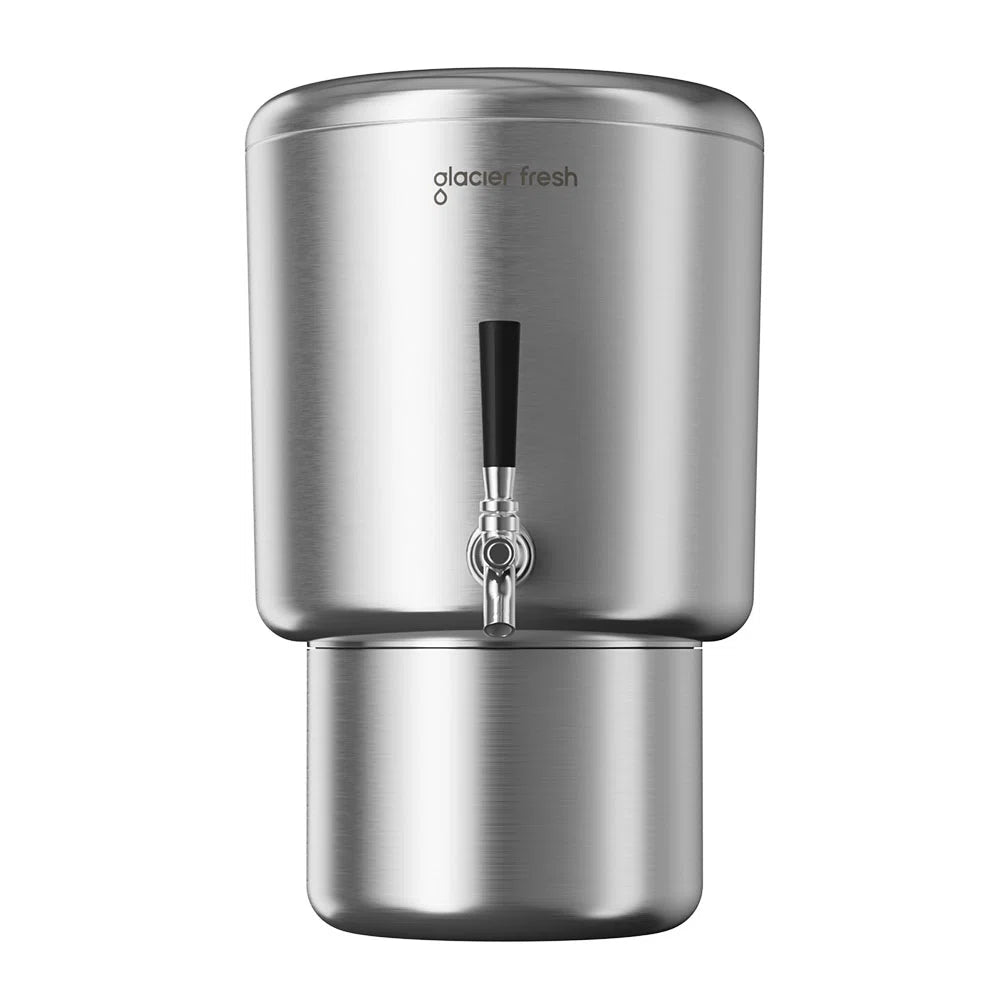
The GlacierFresh Countertop Stainless Steel Gravity Water Filter system was easy to set up and start using. The first run through, the water was a little off, but after that , it was perfectly delicious! Even my two kittens like it better than the tap water. Features I really like include the non slip rubber on the bottom, the spout and handle design, the ease of getting the lid on and off, the brushed stainless steel so that it's not really shiny, and the capacity. The size does not overwhelm everything else in my kitchen.
It came very well packaged. Install was about 30 minutes and requires a basic skill level.
No leaks, good pressure. The water tastes great. It's silent during operation. Very pleased with our purchase.
Using the Coolon Countertop Water Purifier is straightforward and the fully illustrated user manual is easy to follow; a quick start guide is also included.
I had another filter brand that when I tried it in the fridge, the refrigerator would not read the chip. This one worked fine. The price is right and the water tastes good. I still have a spare and I am trusting that one will work when the clock runs out on this one.
Installing this under the sink drinking water filtration system was relatively easy. They said it would take about 30 minutes and I think that would have been true for me except that I did not have a hole in my sink to mount the faucet. I’ll be honest my sink was rather thick and I didn’t have the right drill bits so it took me almost an hour and some creative thinking to get the whole big enough to pass the faucet through it. It really wasn’t that big. It was just that I didn’t have the tools or the hole needed.
Connecting everything together was straightforward and explained rather well in the included manual. Everything was what I like to call push fit or push to connect and when I didn’t put the hose where I wanted it, it was easy to disconnect it and reconnect it. I installed their included T fitting with the valve on it, and it fit perfectly with what I already had. I didn’t need any of their adapters. Most importantly, I didn’t have any weeks and haven’t had any weeks since installing this.
Installing this under the sink drinking water filtration system was relatively easy. They said it would take about 30 minutes and I think that would have been true for me except that I did not have a hole in my sink to mount the faucet. I’ll be honest my sink was rather thick and I didn’t have the right drill bits so it took me almost an hour and some creative thinking to get the whole big enough to pass the faucet through it. It really wasn’t that big. It was just that I didn’t have the tools or the hole needed.
Connecting everything together was straightforward and explained rather well in the included manual. Everything was what I like to call push fit or push to connect and when I didn’t put the hose where I wanted it, it was easy to disconnect it and reconnect it. I installed their included T fitting with the valve on it, and it fit perfectly with what I already had. I didn’t need any of their adapters. Most importantly, I didn’t have any weeks and haven’t had any weeks since installing this.
Store owner replied:
Dear William,
Thank you for your feedback, and I’m very sorry that you only received 2 of the 4 filters you ordered. I also understand your frustration about not hearing back—please accept our sincere apology for the inconvenience.
We did reply on September 15 and arranged a replacement shipment for the missing filters at no additional cost to you. The tracking number was also sent to your email:
Tracking Number: UUS69G1260551948882
Track here: https://www.17track.net/en
It is possible our previous emails went to your spam, junk, or promotions folder. Could you please check those folders for messages from info@glacierfreshfilter.com? If you still cannot find them, please let us know and we will resend the tracking information to you another way.
We sincerely apologize again for the inconvenience and appreciate your patience. If there is anything else we can help with, please do not hesitate to contact us.
Install was simple — no power, no drain line, no tank, no noise. Flow rate is surprisingly strong for a fine‑filtration system. The big win for us is taste. This took that mineral‑heavy, slightly metallic well‑water flavor and smoothed it out without stripping everything down to flat, empty water. It keeps the good minerals and skips the TDS‑chasing gimmicks.
I’ve been using the GLACIER FRESH GFU06 under-sink water filter, and I can definitely tell the difference in my water. It completely gets rid of that weird taste and leaves it tasting clean and fresh. I also love that it doesn’t require electricity or produce waste water, which makes it super convenient and efficient.