
Table of Contents:
Stages of Water Filtration: What Each Level Actually Does
3-Stage Whole House Water Filters: What They Cover and Where They Fall Short
5-Stage Whole House Water Filtration: When the Extra Stages Are Worth It
20-Inch Whole House Water Filters: Size, Flow Rate, and When to Upgrade
What Contaminants Can Water Filtration Systems Remove From Tap Water?
Which Water Filter Is Best for Removing Contaminants in a Household?
FAQs
Conclusion
Filter listings love a big number: 7-stage filtration! 5-stage protection! As if each extra stage automatically buys you safer water. If you've stood in that aisle wondering whether a 3-stage system cuts corners or a 5-stage one is charging you for steps you'll never use, you're asking the right question.
Here's the short version before the detail: the number of stages isn't the variable that matters most. What matters is which stages of water filtration are included and whether they match what's actually in your water.
Stages of Water Filtration: What Each Level Actually Does
 Most home systems, whole-house or under-sink, draw from the same handful of stages of water filtration. Here's what each one targets, and just as important, what it doesn't:
-
Sediment filtration removes physical particles like sand, silt, rust, and dirt, usually at 5 microns. It protects every stage downstream from clogging but does nothing for chemicals, metals, or dissolved solids.
-
Carbon filtration (GAC or carbon block) is the workhorse for chemicals, adsorbing chlorine, VOCs, pesticides, and disinfection byproducts and fixing taste and odor. Catalytic carbon is the version that also handles chloramine, which standard carbon won't reliably remove. Carbon doesn't remove lead, PFAS, arsenic, nitrates, or dissolved solids.
-
KDF media is a copper-zinc alloy that strips chlorine and some heavy metals through electrochemical reactions and slows bacterial growth in the filter. It usually pairs with carbon and shows up in premium whole-house tanks rather than as a standalone cartridge.
-
Specialty media targets one problem, like greensand for iron and manganese or activated alumina for arsenic and fluoride. It's only worth adding when a water test confirms that contaminant is present.
-
UV disinfection inactivates bacteria, viruses, and protozoa without chemicals. It only works on water that's already clear, since sediment and iron block the light, and it's standard for private wells rather than treated city water.
-
The RO membrane is the most comprehensive residential stage. Its 0.0001-micron pores remove dissolved solids, heavy metals, PFAS, nitrates, fluoride, and arsenic. It lives under the kitchen sink as a point-of-use stage, which is why a 5-stage RO system is a different category from a 3-stage carbon one, not just two extra steps.
3-Stage Whole House Water Filters: What They Cover and Where They Fall Short
 A 3-stage whole-house system is the common entry-level point-of-entry setup: a 5-micron sediment pre-filter, an activated or catalytic carbon stage, and a fine sediment or second carbon polish.
Configured well, it handles what city water throws at a whole home: chlorine or chloramine (with catalytic carbon), disinfection byproducts, VOCs and pesticides, sediment and rust, and the taste issues that come with them.
What it can't do matters just as much. Carbon doesn't reliably remove lead or PFAS at the whole-house level, and it does nothing for nitrates, fluoride, arsenic, bacteria, or well-water metals like iron and manganese. Those need point-of-use RO, UV, or specialty media.
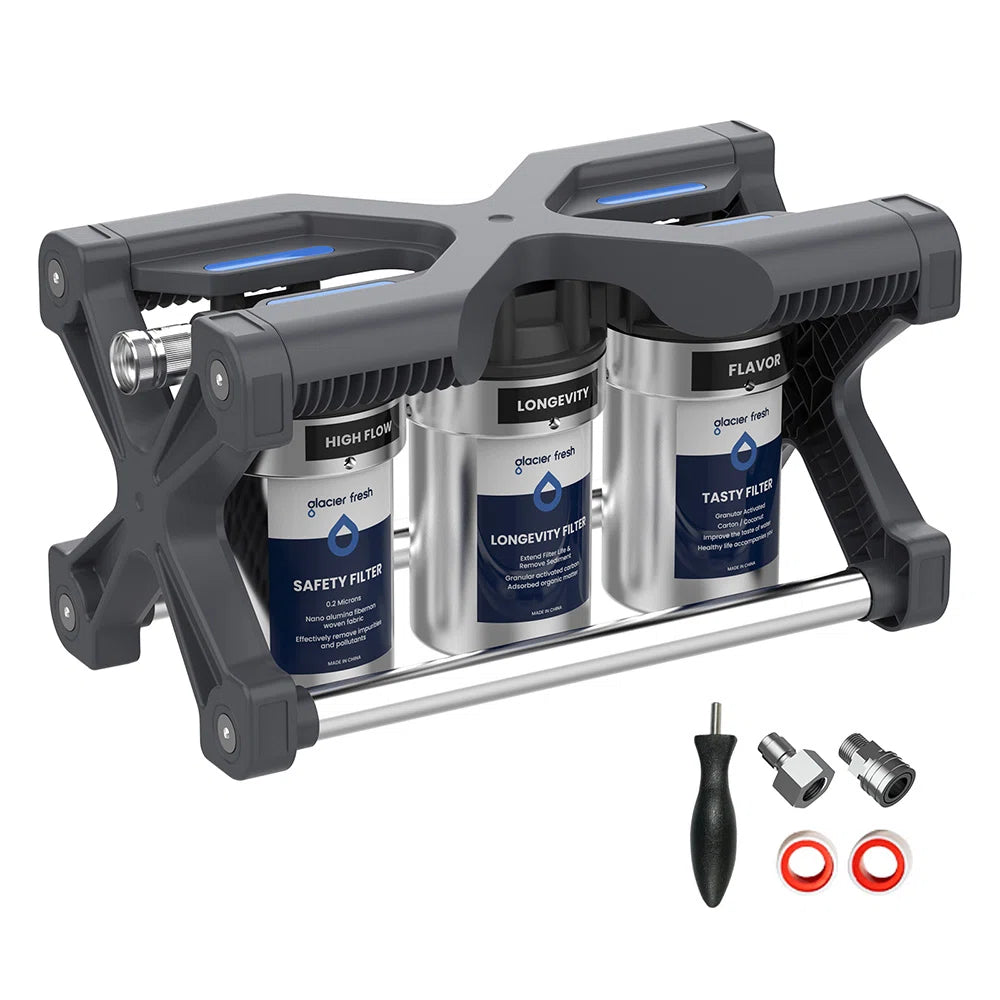
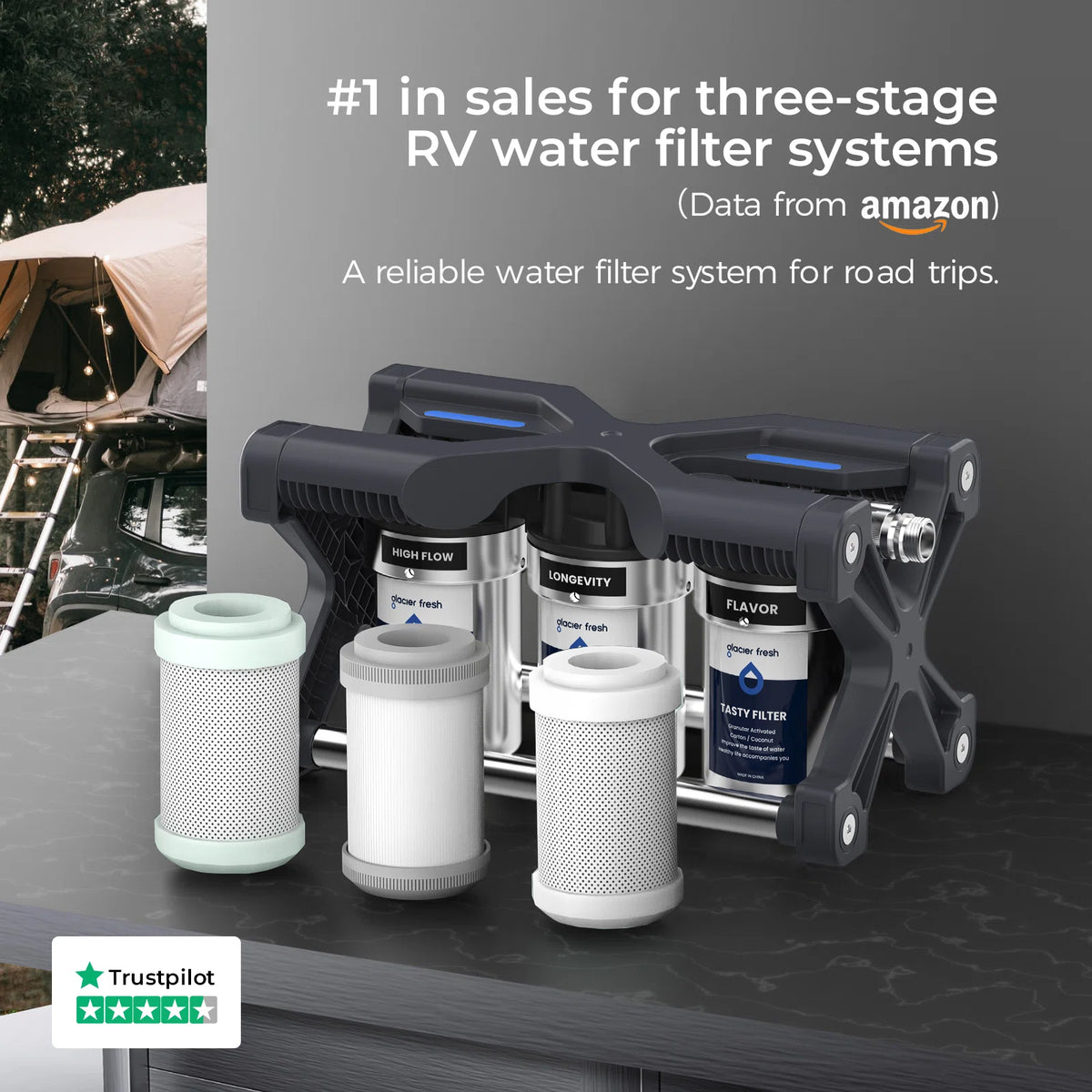
The GlacierFresh AUQAGO 3-Stage RV Water Filtration System shows the architecture in miniature: a 5-micron sediment stage that catches dirt and rust, a carbon block for chlorine and organics, and a 0.2-micron high-flow final filter. It's compact and built for standard water, from RV hookups to portable outdoor use.
5-Stage Whole House Water Filtration: When the Extra Stages Are Worth It
A 5-stage system builds on that foundation by adding higher levels of water filtration aimed at contaminants outside carbon's range, usually some mix of an iron and manganese filter, UV disinfection, KDF media, or specialty arsenic or nitrate media.
The extra stages earn their cost on well water with documented iron, manganese, or bacteria, near farmland where nitrates are confirmed, or where the local aquifer carries arsenic. They don't earn it when the added stages just duplicate the carbon already there, or when they target a contaminant your water doesn't have.
Paying for arsenic media with no arsenic in your water buys nothing. On plain city water whose report shows only chlorine, sediment, and disinfection byproducts, a good 3-stage system already covers all three.
20-Inch Whole House Water Filters: Size, Flow Rate, and When to Upgrade
Cartridge size is a separate spec from stage count, and for a whole-house system it matters just as much. Cartridges come in 10-inch and 20-inch lengths, in slim 2.5-inch and Big Blue 4.5-inch diameters.
Flow Rate and Water Pressure
A 20-inch filter runs about twice the flow of a 10-inch one at the same pressure drop. A 10-inch housing typically suits a 1-to-2-bathroom home, while a 20-inch Big Blue handles 3-plus bathrooms, irrigation, or high peak demand. The practical payoff is that your shower doesn't weaken when the washing machine fills.
Filter Lifespan and Replacement Frequency
More media volume means more capacity. A 20-inch cartridge lasts roughly twice as long as a 10-inch one under the same conditions, which counts for sediment-heavy well or rural water. It costs more per cartridge but less per gallon filtered over its life.
Who Should Choose 20-Inch Whole House Filters
Reach for 20-inch housings if you have three or more bathrooms with high simultaneous demand, well water with heavy sediment, irrigation or a hot tub, or you simply want steady pressure across the whole house.
What Contaminants Can Water Filtration Systems Remove From Tap Water?
It depends entirely on the stages included and whether they're certified for the specific contaminant. Sediment filters catch particles by micron size and nothing dissolved. Standard carbon handles chlorine, taste, odor, VOCs, and pesticides, but not chloramine, lead, PFAS, arsenic, nitrates, or dissolved solids; catalytic carbon adds chloramine.
KDF reduces chlorine and some heavy metals, ion exchange covers hardness and nitrates, and UV kills microbes but removes no chemicals. An RO membrane removes the broadest range of all: lead, PFAS, arsenic, fluoride, nitrates, heavy metals, and dissolved solids.
A 7-stage system built only from sediment and carbon still won't remove lead, while a 3-stage system with a certified RO membrane will. Certifications, not stage count, tell the real story.
Which Water Filter Is Best for Removing Contaminants in a Household?
 The best filter is the one matched to your water, sized for your home, and maintained on schedule. A few frameworks make that concrete.
What Are the Best Water Purification Methods for Home Use?
For the whole house, a multi-stage carbon system sized to your flow rate covers chlorine or chloramine, disinfection byproducts, VOCs, and sediment at every tap.
For drinking and cooking, an under-sink RO is the gold standard, handling what carbon misses: lead, PFAS, nitrates, fluoride, arsenic, and dissolved solids.
For well-water microbes, add UV after sediment and carbon. For hard water, a softener after the sediment stage. The strongest setup layers them, so each handles what the others can't.
3-Stage vs 5-Stage: The Decision Framework
Choose 3-stage when you're on city water with standard disinfection, your report shows no lead, iron, arsenic, nitrates, or bacteria, and you'll pair it with an under-sink RO for drinking.
Choose 5-stage when you're on a well with documented iron, manganese, bacteria, or sulfur, your test flags arsenic or nitrates, you want UV as a safety net, or sediment loading is high enough to need several steps before the water reaches your plumbing.
GlacierFresh Filtration Options
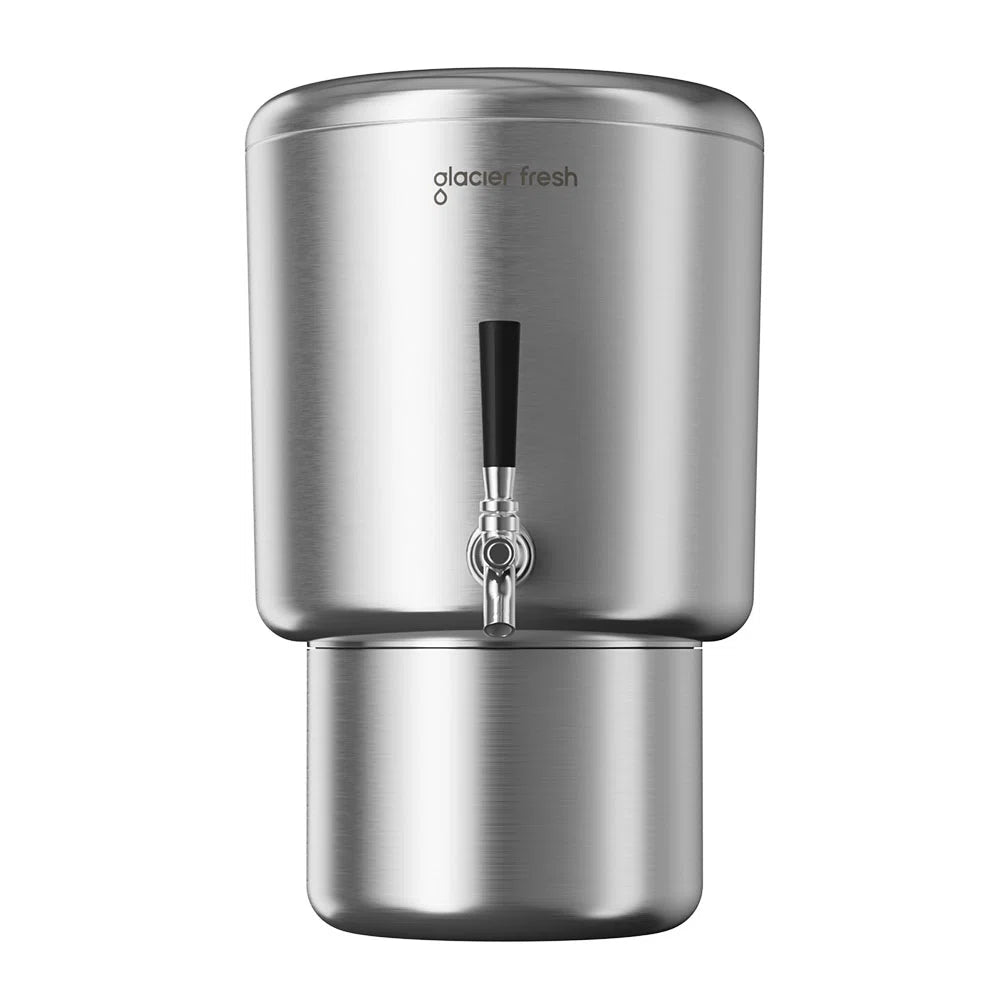
The GlacierFresh 3G Gravity-Fed System (DP001) runs three stages, coconut activated carbon, fluoride-reduction media, and particle carbon, cutting chlorine by up to 98.95%, reducing fluoride, and trapping heavy metals and THMs, all without electricity or plumbing.
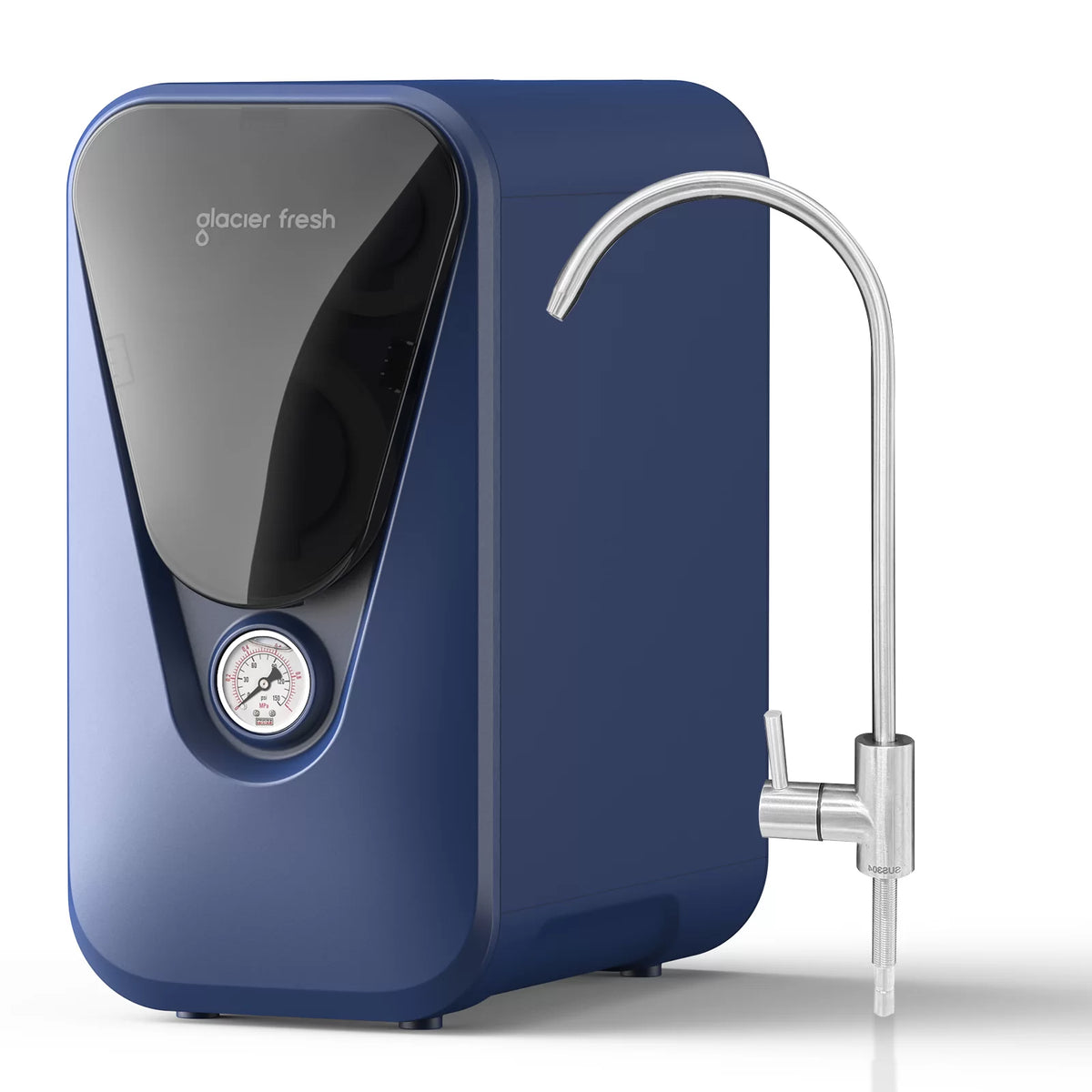
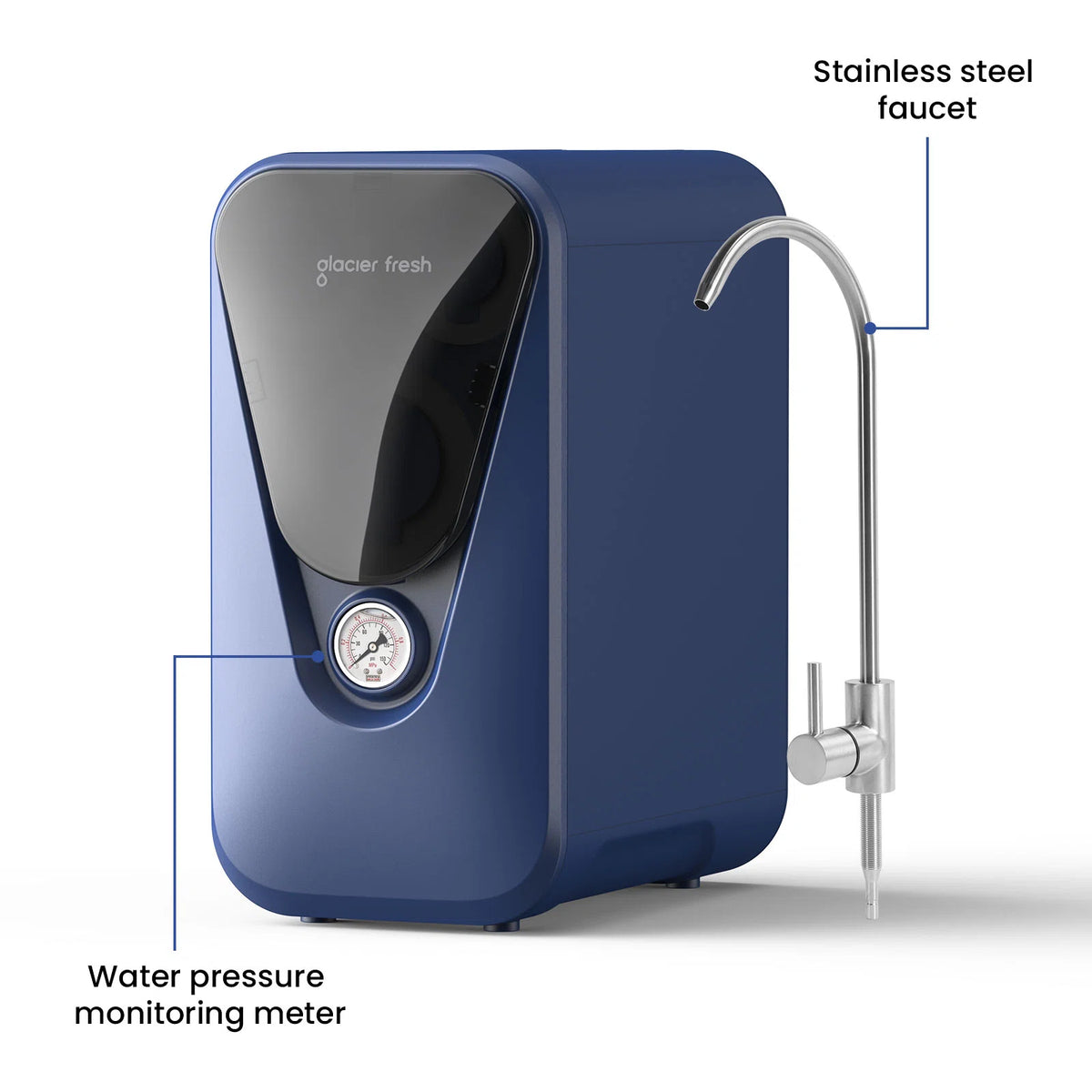
The U03 Undersink RO (GFU03-800G) is the five-stage drinking-water complement to a whole-house carbon pre-filter: PP cotton, compound carbon, a 16-layer 0.0001-micron RO membrane, particle carbon, and post-carbon, certified to NSF/ANSI 58 and SGS, and non-electric.
The PC04 Countertop Filter uses an Elarisey positively-charged nanofiber membrane that traps heavy metals and microplastics by electrochemical attraction, a different mechanism from carbon or RO, with SGS-verified reductions of lead (about 99.87%) and PFAS (about 99.62%). Together they show the mechanism matters as much as the stage count.
FAQs
Is a higher number of filtration stages always better?
No. More stages only help if each one removes something the others don't. Seven carbon-and-sediment stages still won't touch lead or PFAS, while a three-stage system with a certified RO membrane will. Match stages to your water, not to the box's headline number.
How many stages of water filtration do I actually need?
It depends on your water. City water with standard disinfection is well served by a 3-stage carbon system plus an under-sink RO for drinking. Well water with iron, bacteria, or arsenic needs more stages and specialty media, so test first.
What is the difference between 3-stage and 5-stage filtration?
A 3-stage system is usually sediment plus carbon for chlorine, byproducts, and taste. A 5-stage system adds targeted stages like iron removal, UV, or specialty media for contaminants carbon can't handle. The extra stages matter only if your water has those contaminants.
Does reverse osmosis count as one stage or several?
An RO system is usually counted as several stages because it pairs the membrane with carbon and sediment pre- and post-filters. The membrane itself is the stage that removes dissolved solids, PFAS, and heavy metals; the others protect it and polish the taste.
Can a whole-house filter remove lead and PFAS?
Not reliably. Whole-house carbon improves taste and removes chlorine and many chemicals, but lead and PFAS need a certified RO or NSF 53 filter at the point of use. Most homes pair a whole-house filter with an under-sink RO for drinking water.
Conclusion
Stage counts make for easy marketing and poor decisions. What protects your household is the right levels of water filtration for your specific water, certified for the contaminants you actually have, and sized for your home.
GlacierFresh covers the range, from reverse osmosis and countertop systems to outdoor and RV water filter options. Explore the full range at glacierfreshfilter.com.
References:
-
Centers for Disease Control and Prevention. About Choosing Home Water Filters. https://www.cdc.gov/drinking-water/prevention/about-choosing-home-water-filters.html
-
United States Environmental Protection Agency. Point-of-Use Reverse Osmosis Systems. https://www.epa.gov/watersense/point-use-reverse-osmosis-systems
-
NSF International. Certified Drinking Water Treatment Units – Lead Reduction. https://info.nsf.org/Certified/dwtu/listings_leadreduction.asp
-
United States Environmental Protection Agency. Identifying Drinking Water Filters Certified to Reduce PFAS. https://www.epa.gov/water-research/identifying-drinking-water-filters-certified-reduce-pfas
-
Safe Drinking Water Foundation. Ultrafiltration, Nanofiltration and Reverse Osmosis. https://www.safewater.org/fact-sheets-1/2017/1/23/ultrafiltrationnanoandro
-
United States Environmental Protection Agency. Secondary Drinking Water Standards: Guidance for Nuisance Chemicals. https://www.epa.gov/sdwa/secondary-drinking-water-standards-guidance-nuisance-chemicals
-
United States Environmental Protection Agency. Private Drinking Water Wells. https://www.epa.gov/privatewells