
Table of Contents:
Types of RV Water Filters
Factors to Consider When Choosing an RV Water Filter System
RV Water Filter Comparison for 2026: Price, Performance, and Use Case
5 Best RV Water Filters
Installation Tips for RV Water Filters
How to Maintain Your RV Water Filter
FAQs
Conclusion
An RV trip means freedom and adventure, but clean water remains one of the most important safety and comfort concerns on the road. Campground water may contain chlorine, sediment, unpleasant odors, hardness minerals, or source-dependent contaminants that affect taste, cooking, and plumbing performance. This is why RV water filters are a must for travelers who want consistent drinking water from hookups, tanks, or portable outdoor sources.
Types of RV Water Filters

RV water filters are designed around different filtration mechanisms, installation points, and travel scenarios. Understanding each type helps match the system to your water source, risk level, RV storage space, pressure requirements, and maintenance routine instead of choosing only by price.
Inline Filters
The most popular water filter types for RVers are inline filters. They connect directly to the drinking-water-safe hose between the campground spigot and the RV inlet. Many campers searching for the best inline rv water filter want a compact, low-cost option that reduces chlorine taste, odor, and visible sediment without taking up storage space.
Canister Filters
Canister filters use one or more cartridges, often combining sediment and activated carbon media. They are bulkier than inline models but usually provide stronger filtration, higher capacity, and more flexible cartridge replacement for RVers who travel frequently or stay at older campgrounds.
Reverse Osmosis (RO) Systems
RO systems are the highest-purity option in this category. A fine membrane can reduce dissolved solids, heavy metals, microorganisms, PFAS, pesticides, and other difficult contaminants, but RO systems may require power, produce wastewater, and cost more than basic inline or canister filters.
Sediment Filters
Sediment filters trap rust, sand, dirt, and other particles before water enters the RV's plumbing. They are especially useful as a first stage because they protect downstream carbon cartridges, RO membranes, faucets, pumps, and appliances from clogging.
Carbon Filters
Activated carbon filters improve taste and reduce odors by adsorbing chlorine and some organic compounds. They are most effective when combined with sediment pre-filtration or as part of a multi-stage RV system that balances taste, flow rate, and contaminant reduction.
Factors to Consider When Choosing an RV Water Filter System
Before buying an RV water filter, evaluate the water sources you actually use, the health needs of your household, the available storage space, and how much maintenance you are willing to perform. A reliable choice should balance contaminant reduction, flow rate, cartridge life, portability, and verified performance claims.
- Filtration Level: Carbon filters improve taste and smell, while multi-stage or RO systems provide stronger protection for off-grid travel, family use, and uncertain sources.
- Micron Rating: Lower micron ratings capture smaller particles; for example, 0.2 microns can help reduce fine sediment and microorganisms depending on the filter design.
- Filter Lifespan: Cartridge life may be measured by months, gallons, or both. Heavy sediment and frequent travel usually shorten replacement intervals.
- Size & Portability: Compact filters suit weekend trips and limited storage, while multi-stage systems support full-time RVers who prioritize filtration strength.
- Ease of Use: Quick-connect fittings, clear flow direction, standard hose compatibility, and tool-free cartridge changes reduce setup errors.
- Budget: The best inline water filter for rv use is usually affordable and fast to deploy, while RO systems cost more but offer deeper purification for sensitive use cases.
- Safety Certifications: Look for transparent claims, third-party testing references, and certifications where available, especially when shopping for families with kids.
RV Water Filter Comparison for 2026: Price, Performance, and Use Case
For a practical rv water filter review, compare each product by contaminant-reduction strength, campground hookup convenience, maintenance burden, and best-fit traveler type.
|
Filter option |
Best for |
Performance focus |
Installation / maintenance |
Value profile |
|
Glacier Fresh AUQAGO 3-Stage |
Full-time RVers, families, off-grid travelers |
0.2-micron high-flow stage plus carbon and sediment reduction |
Quick-connect fittings; replace filter set by usage |
Higher protection; strong long-trip value |
|
Glacier Fresh 2-Stage RV Filter |
Weekend campers and space-limited RVs |
Sediment plus coconut shell carbon for taste and chlorine |
Lightweight; simple hose connection; about six-month filter life |
Balanced cost, size, and performance |
|
Glacierfresh RV Reverse Osmosis System |
Boondocking, uncertain sources, high-safety needs |
RO membrane for dissolved solids, heavy metals, microorganisms, PFAS, and pesticides |
Needs 24V power; monitor cartridge and water production |
Premium purification; best for serious travelers |
|
Shurflo 9400950 In-Line Filter |
Quick campground hookup filtration |
Basic chlorine, odor, and silt reduction |
Direct inline install; low-maintenance disposable format |
Budget-friendly and convenient |
|
Camco Tastepure 40043 |
Casual RVers and short trips |
KDF/carbon reduction for taste, odor, and sediment |
Inline hose setup with hose protector |
Low-cost entry option |
5 Best RV Water Filters
These five options cover the most common RV filtration needs in 2026, from simple campground hookups to advanced purification for off-grid travel. The best choice depends on whether your priority is portability, contaminant reduction, flow rate, certification visibility, or long-term cost.
1. Glacier Fresh Auqago RV Water Filter System

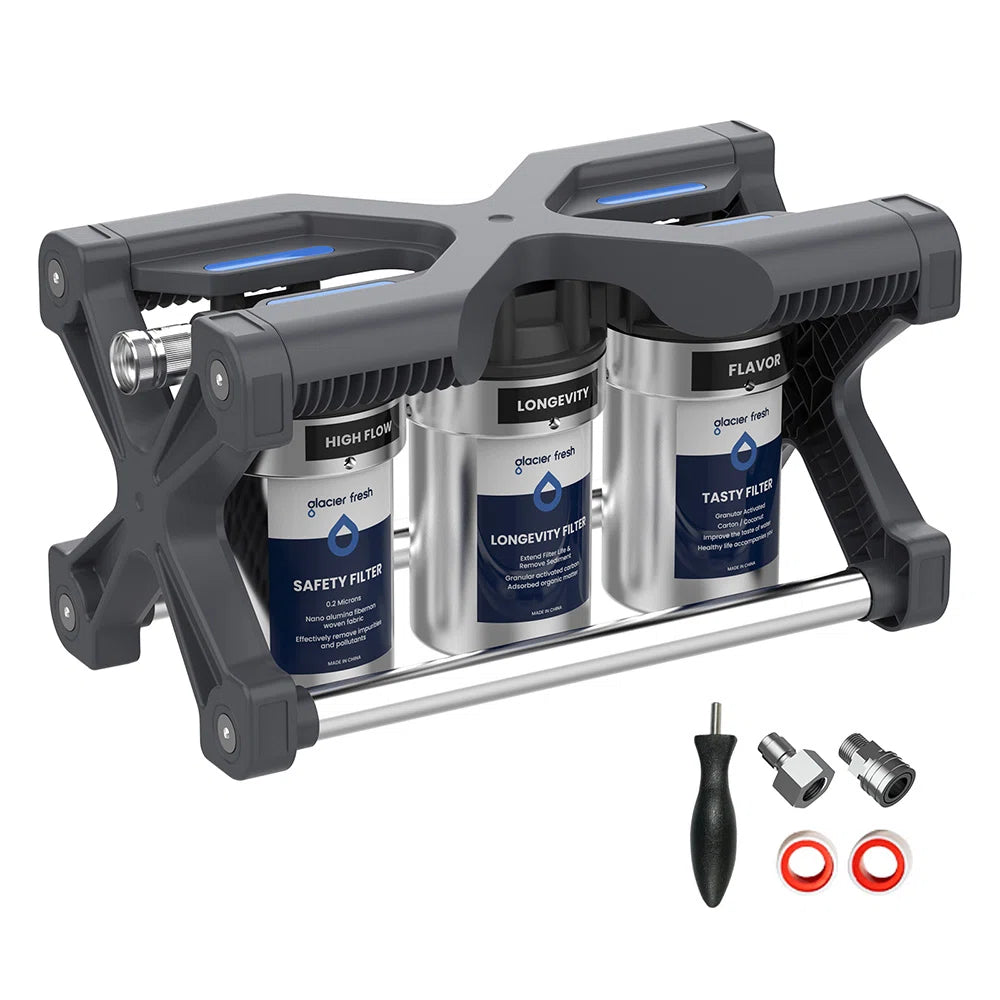
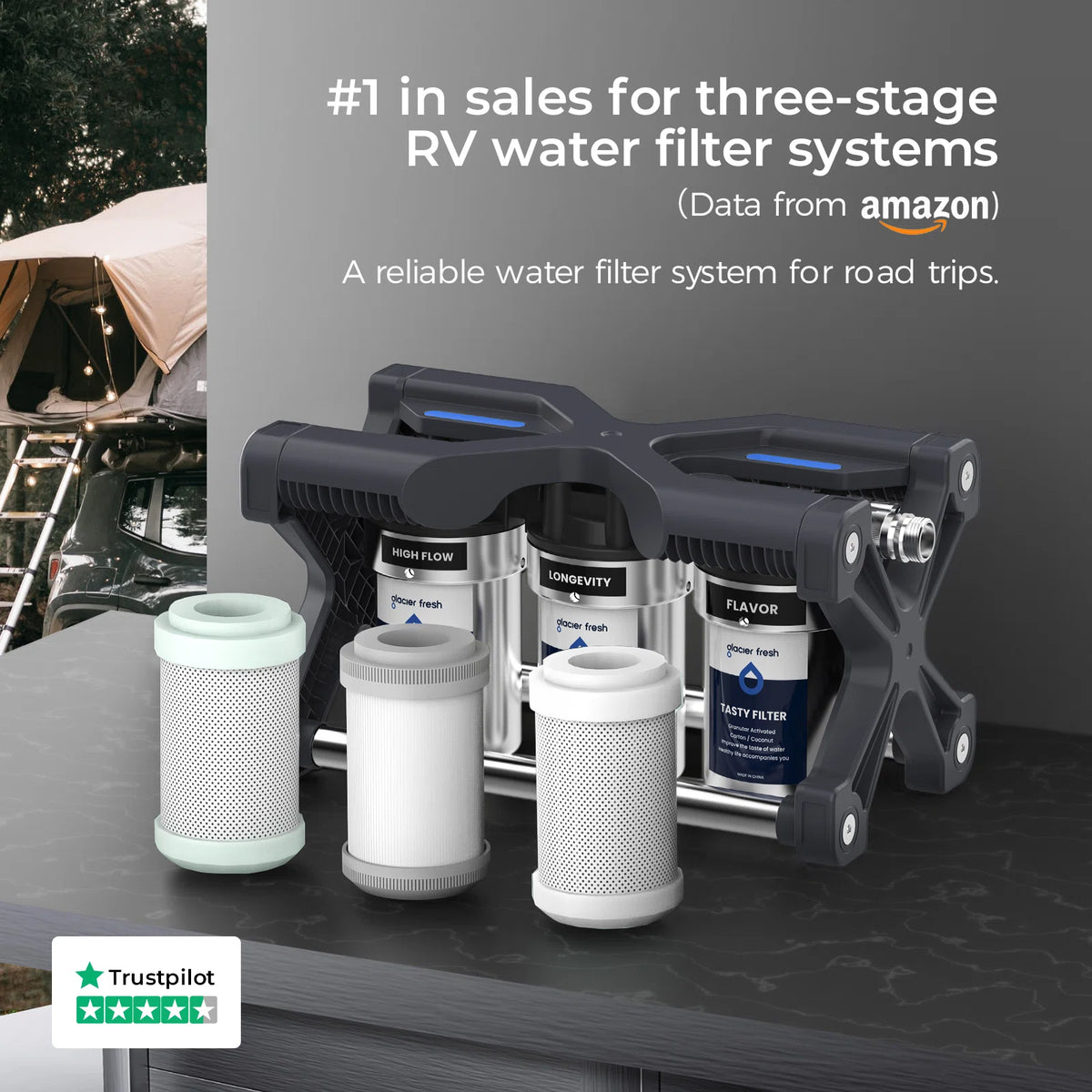
AUQAGO RV Water Filter System is a robust 3-stage water filter with a 0.2-micron high-flow filter, a carbon filter, and a sediment filter. This configuration helps reduce chlorine, odors, dirt, and microscopic particles while maintaining practical flow for daily RV use. It connects easily with quick-connect stainless steel fittings and does not require electricity.
The system provides about 500 gallons per filter set and delivers clean, crisp-tasting water without noticeably slowing flow. Its compact frame fits RV storage well, making it a strong choice for full-time RVers, families, and travelers who need dependable water filtration beyond a basic inline cartridge.
2. Glacier Fresh 2-Stage RV Water Filtration System
A lighter, smaller alternative is the Glacier Fresh 2-Stage RV Filter. It uses a pleated sediment filter followed by a coconut shell carbon filter so that dirt, sediment, chlorine taste, and odor are reduced before water reaches your RV taps.
At about 8.35 pounds, it is one of the more space-efficient systems for travelers who want better filtration than a disposable inline filter but do not need a full RO setup. Its stainless steel hose fittings support fast installation, while the cartridge life of about six months makes maintenance simple for seasonal campers.
3. Glacierfresh RV Reverse Osmosis System

The Glacierfresh RV Reverse Osmosis System is ideal when RVers require the deepest purification. Its 0.0001-micron RO membrane is designed to reduce up to 99.9% of contaminants such as bacteria, viruses, heavy metals, PFAS, and pesticides.
It generates an average of 12 oz of purified water per minute and can filter up to 2,000 gallons in one filter cycle. With FDA, FCC, and CA65 certification references, it is positioned for serious travelers, boondockers, and families who prioritize safety over lowest upfront price. It requires a 24V power source, while the Elite version includes a power bank for off-grid use.
4. Shurflo 9400950 Waterguard Universal In-Line RV Drinking Water Filter
Shurflo 9400950 is a simple inline filter that attaches directly to an RV water system and reduces chlorine, smells, and silt. It does not provide the same contaminant reduction as a multi-stage system, but it is portable, inexpensive, widely compatible with RV hoses, and useful for campers who want a no-nonsense hookup solution.
5. Camco Tastepure Kdf/Carbon RV Water Filter 40043
A long-time RVer favorite, the Camco Tastepure 40043 uses KDF and carbon filtration to reduce chlorine, odors, and sediment. It is compact and budget-friendly, making it suitable for casual RVers who mainly want better-tasting campground water. It also includes a flexible hose protector to reduce stress on connections, though it is less advanced than Glacier Fresh multi-stage or RO systems.
Installation Tips for RV Water Filters
Correct installation protects water quality, pressure, and RV plumbing. Most RV systems install between the campground spigot and the RV inlet, but the order of filtration stages matters: place sediment filtration first, then carbon, and then RO if using a multi-stage setup.
- Flush every new cartridge for several minutes before drinking to remove carbon dust and loose media.
- Use drinking-water-safe hoses and verify that arrows on the housing match the water-flow direction.
- Use plumber's tape carefully on threaded fittings, but avoid overtightening plastic components.
- For multi-stage setups, install sediment filtration before carbon or RO to extend cartridge and membrane life.
- Check for leaks under pressure before leaving the system unattended at a campground.
Proper installation and regular maintenance are both key - do not forget the essential aspects of water filter care that many RVers miss.
How to Maintain Your RV Water Filter
RV filter maintenance should be treated as part of trip planning, not an afterthought. Water quality changes by campground, season, and source, so cartridge life may shorten when water contains heavy sediment, strong chlorine, iron, or mineral scale.
|
Maintenance task |
Why it matters |
Recommended cadence |
|
Flush new filters |
Removes loose carbon dust and primes media |
Before first use and after storage |
|
Inspect O-rings and fittings |
Prevents leaks, bypass, and pressure loss |
Each setup or monthly during travel |
|
Replace cartridges |
Maintains contaminant reduction and flow |
Every 3–6 months or by gallon rating |
|
Sanitize housings and hoses |
Reduces biofilm and odor risk |
At season start/end or after questionable water |
|
Store filters dry and cool |
Prevents stagnant water and cartridge damage |
During long storage or winterization |
Your RV water filters will provide safer, cleaner water with a routine cleanup plan. If water pressure drops, taste changes, or sediment appears, replace or inspect the filter immediately rather than waiting for the calendar interval.
FAQs
1. How often should I replace my RV water filter?
Most RV water filters should be replaced every 3 to 6 months, but the real schedule depends on gallons filtered, source-water quality, sediment load, and how often you travel. Replace sooner if flow slows, water tastes different, or odor returns.
2. What are the top 10 RV water filters people buy in the US and how do they compare on price and performance?
Most US shoppers compare budget inline filters, mid-range canister systems, and premium RO units. Inline options such as Camco and Shurflo win on price and quick setup; multi-stage options such as Glacier Fresh AUQAGO improve sediment, chlorine, taste, and fine-particle performance; RO systems cost more but offer the strongest contaminant reduction.
3. What are the best RV water filters and how do they compare for campground hookups?
For campground hookups, inline filters are the easiest to connect, canister filters give better cartridge capacity, and RO systems provide the most advanced purification when water quality is uncertain. A casual camper may prefer Camco or Shurflo, while families and frequent travelers may benefit more from Glacier Fresh 2-stage, AUQAGO, or RV RO systems.
4. What are the best RV water filter systems for families with kids and how do they compare on safety certifications?
Families with kids should prioritize multi-stage or RO systems, transparent contaminant-reduction claims, and certification references. AUQAGO offers strong multi-stage performance for daily RV use, while Glacierfresh RV Reverse Osmosis provides a higher level of purification and lists FDA, FCC, and CA65 certification references for added buyer confidence.
5. What are the top RV water filters that are certified by testing labs and how do they compare in contaminant removal?
Certified or test-backed RV filters should be compared by what they claim to remove. Carbon and KDF filters mainly target taste, odor, chlorine, and sediment; 0.2-micron systems improve fine-particle reduction; RO systems can reduce dissolved solids, heavy metals, PFAS, pesticides, bacteria, and viruses more comprehensively.
Conclusion
Safe and enjoyable RV travel depends on clean water, and choosing the right filter provides peace of mind on the road. Inline options such as Camco Tastepure are basic, inexpensive, and fast to use, while advanced systems such as Glacierfresh Reverse Osmosis offer maximum protection for travelers facing uncertain water sources.
When you review your needs, budget, storage space, and water quality risks, you can choose a system that keeps your water fresh wherever you go. The best water filtration for rv travel is not the same for every camper: weekend travelers may value speed and simplicity, while families, full-time RVers, and boondockers may need stronger contaminant reduction. Reverse osmosis water is not only clean but also healthy to drink, providing peace of mind for long-term RV travel.
Recommended Related Reading
For readers who want to continue researching RV water safety, system design, and real-world camping use cases, these related Glacier Fresh resources are natural next steps.
- Water Filters for RV & Camping - learn how portable, multi-stage filtration systems support campground and off-grid travel.
- Multi-Stage Water Filters - compare how sediment, carbon, membrane, and post-filter stages work together.
- How OSMOGO RV Water Purifier Enhances Your Camping Experience - explore a related outdoor purification use case for RV and camping trips.