
Table of Contents:
What Contaminants Are Commonly Found in U.S. Tap Water?
1. Newark, New Jersey — Lead in Drinking Water
2. Benton Harbor, Michigan — Repeated Lead Action-Level Exceedances
3. Jackson, Mississippi — When a Filter Is Not Enough
4. Lower Cape Fear, North Carolina — GenX and PFAS
5. Red Hill, Hawai'i — Petroleum in the Drinking-Water System
How Effective Are Water Filters at Removing Lead, PFAS and Microplastics?
How Can I Tell If the Tap Water in My Area Is Safe to Drink?
Conclusion
FAQs

Flint became shorthand for American drinking-water failure, and that shorthand has done some damage. It compressed a complicated national problem into one city and one metal, which makes every other case look like an exception.
It isn't. In the years since, federal and state agencies have documented lead action-level exceedances in Newark and Benton Harbor, an industrial PFAS compound in the Cape Fear River, jet fuel in a Navy drinking-water well in Hawai'i, and a municipal system in Jackson that stopped delivering water at all.
No household filter prevents a citywide contamination crisis. What a contaminant-specific point-of-use filter can sometimes do is reduce exposure at the tap while source control and infrastructure repair are underway — and in two of the five cases below, it couldn't even do that. Knowing which case you're in is the whole exercise.
What Contaminants Are Commonly Found in U.S. Tap Water?
There is no single national answer, because risk is assembled locally. Source water, treatment process, nearby industrial activity and the plumbing between the treatment plant and your faucet each contribute, and the last of those is entirely outside the utility's control.
Broadly, the contaminants that drive U.S. drinking-water response fall into groups that behave very differently:
- Lead, which almost always enters after treatment, from service lines, solder and brass fixtures.
- PFAS, a large family of synthetic fluorinated compounds that are mobile in water and resistant to conventional treatment.
- Microbial contamination, which is what boil-water notices exist to address.
- Petroleum compounds, typically the result of a discrete release rather than a chronic condition.
- Emerging particles such as microplastics, where measurement methods are still being standardized.
Those groups do not respond to one universal filter. A carbon block that reduces chlorine taste and odor is not a lead filter, and a lead filter is not a PFAS filter unless it has been certified for that claim specifically.
A starting point for local data is your utility's annual Consumer Confidence Report. It reports regulated contaminants in finished water — useful, but it samples the system, not your kitchen. For anything entering downstream of the plant, our guide to testing your home's water quality covers what a household test adds.
1. Newark, New Jersey — Lead in Drinking Water
Newark's case is the clearest example in the country of a home filter being formally evaluated as a public-health measure.
Beginning in July 2019, EPA worked with the City of Newark and NJDEP to determine whether the point-of-use filters the city had distributed were reducing lead in tap water to 10 ppb or below under Newark's conditions — explicitly qualified as applying "when the filters are properly installed and maintained." The city released its Point-of-Use Filter Study for August–September 2019 that November.
The conclusion is worth reading closely: a combination of flushing and filtering was the appropriate approach for reducing lead in Newark's Pequannock service area until corrosion control treatment was optimized. Two qualifiers carry the weight. Filtering alone was not the recommendation — flushing was paired with it. And the measure was interim, bounded by the timeline for fixing treatment chemistry. The permanent fix was never the filter.
Benton Harbor, Michigan — Repeated Lead Action-Level Exceedances
Benton Harbor exceeded the federal lead action level for three consecutive years. Michigan EGLE's record shows six Action Level Exceedance letters issued between October 2018 and August 2021, following elevated lead first identified in 2018.
The response ran on three tracks at once: state-funded bottled water distribution, certified filters made available to all residents through the Berrien County Health Department, and $18.6 million secured to replace 100% of the city's lead service lines — a commitment set at 18 months following an October 2021 executive directive from Gov. Whitmer.
One detail deserves more attention than it usually gets. The state continued bottled-water distribution specifically while EPA conducted a further review of how effective certified filters were under Benton Harbor's particular water chemistry. Certification is tested under defined laboratory conditions; a real distribution system with its own pH, alkalinity and corrosion profile is not those conditions. The agencies treated that gap as real rather than assuming certification transferred automatically.
A lead-certified filter functions as a household barrier. Removing lead-bearing pipe removes the source. Benton Harbor pursued both because neither was sufficient alone.
Jackson, Mississippi — When a Filter Is Not Enough
Jackson is the case that defines the limit of point-of-use filtration.
In a September 2022 statement, EPA Administrator Michael Regan described a system whose problems went back decades and which "finally reached a breaking point this summer, leaving tens of thousands of people without any running water for weeks." The same statement cites roughly 300 boil-water notices issued over the preceding two years.
A cartridge cannot help here, and the reasons are mechanical rather than a matter of certification scope. Point-of-use filtration assumes water arriving at adequate pressure and assumes upstream disinfection is functioning. Neither assumption held. A boil-water notice exists because microbial control has failed, and a carbon filter is not a disinfection device — under a boil advisory, the public-health instruction supersedes normal filtration entirely.
The practical lesson is about sequencing. During a system-wide failure, follow the utility's and health department's emergency instructions first; stored water and non-powered backup capacity matter more than filtration performance in that window, as our guide to water filtration during emergencies covers.
Lower Cape Fear, North Carolina — GenX and PFAS
North Carolina DEQ and DHHS began investigating GenX in the Cape Fear River in June 2017 and identified the Chemours facility in Fayetteville as the producer of the compound. A Consent Order signed in February 2019 required Chemours to stop discharging process wastewater, sharply reduce emissions, and provide alternate water to thousands of households whose private wells had been contaminated. Well sampling extended across Bladen, Cumberland, Robeson and Sampson counties near the facility, and into four more counties downriver.
On the household side, EPA's guidance on reducing PFAS with a home filter identifies granular activated carbon, reverse osmosis and ion exchange resins as technologies that can reduce PFAS, and directs consumers to check packaging for certification to NSF/ANSI 53 or NSF/ANSI 58.
EPA attaches two caveats that matter more than the technology list. As of April 2024, filter certifications for PFAS focus on PFOA and PFOS specifically — two compounds within a very large family. And more pointedly, the certification standards in place as of April 2024 "do not yet indicate that a filter will remove PFAS down to the levels EPA has now set for a drinking water standard," with EPA stating it is working with standard-setting bodies to close that gap.
So "certified for PFAS" is a real claim, and also a narrower one than most buyers assume. Our overview of whether water filters remove PFAS works through what the current claims cover.
Red Hill, Hawai'i — Petroleum in the Drinking-Water System
In late November 2021, a petroleum release from the Red Hill Bulk Fuel Storage Facility contaminated the Red Hill drinking-water well. Hundreds of families on Joint Base Pearl Harbor-Hickam and at the Army's Aliamanu Military Reservation and Red Hill Housing reported petroleum odors coming from residential taps, along with health symptoms. EPA puts the number of affected Navy water system users at approximately 93,000, many of whom relocated to temporary housing.
The mechanism is instructive. A May 2021 pipeline joint failure released over 19,000 gallons of JP-5 jet fuel onto a tunnel floor; that fuel entered a drain pipeline and stayed there until the pipeline ruptured on November 20, 2021, spilling into the tunnel system near the drinking-water shaft. An interagency team including EPA, the Navy, the Army and Hawai'i DOH stood up in December 2021 and completed system restoration in March 2022.
Nothing about a lead-and-PFAS cartridge addresses this. Free-phase petroleum in a distribution system is an emergency contamination event with its own response protocol, sampling regime and clearance criteria. A household filter marketed for taste, lead or PFAS carries no claim covering fuel hydrocarbons at release concentrations, and treating one as though it did would be actively unsafe. Red Hill draws the cleanest available line between routine home filtration and emergency contamination response.
How Effective Are Water Filters at Removing Lead, PFAS and Microplastics?

Effectiveness is a property of a specific certified claim on a specific model, not of the category "water filter." That distinction is the single most useful thing to carry out of these five cases.
Lead. Reduction depends on a tested, contaminant-specific claim and on correct installation and maintenance. Newark's finding pairs filtering with flushing; Benton Harbor's response treated local water chemistry as a variable to be checked rather than assumed.
PFAS. Look for NSF/ANSI 53 or NSF/ANSI 58 claims rather than a generic "water filter" label, and read EPA's April 2024 caveats on PFOA/PFOS scope and certification levels. EPA also notes filters only work if maintained on the manufacturer's schedule — skipping a replacement raises PFAS exposure risk rather than holding it flat.
Microplastics. Removal is governed by particle size and treatment technology. WHO's assessment notes that conventional drinking-water treatment can remove particles smaller than a micrometre, with tertiary processes such as filtration delivering the highest removal rates; particles larger than 150 micrometres are unlikely to be absorbed in the human body, while data on very small particles remains extremely limited. Our guide on avoiding microplastics in drinking water goes further into membrane behaviour.
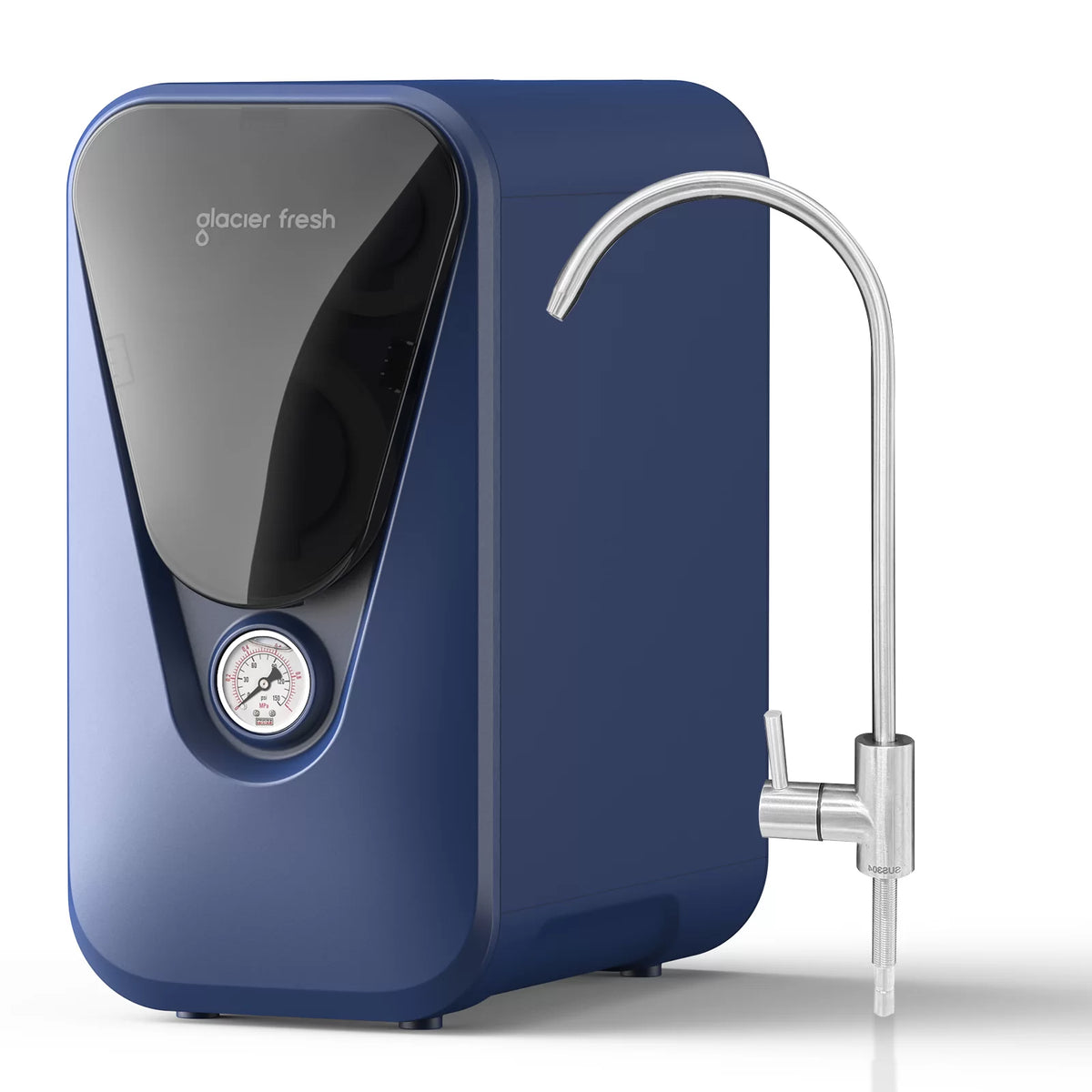
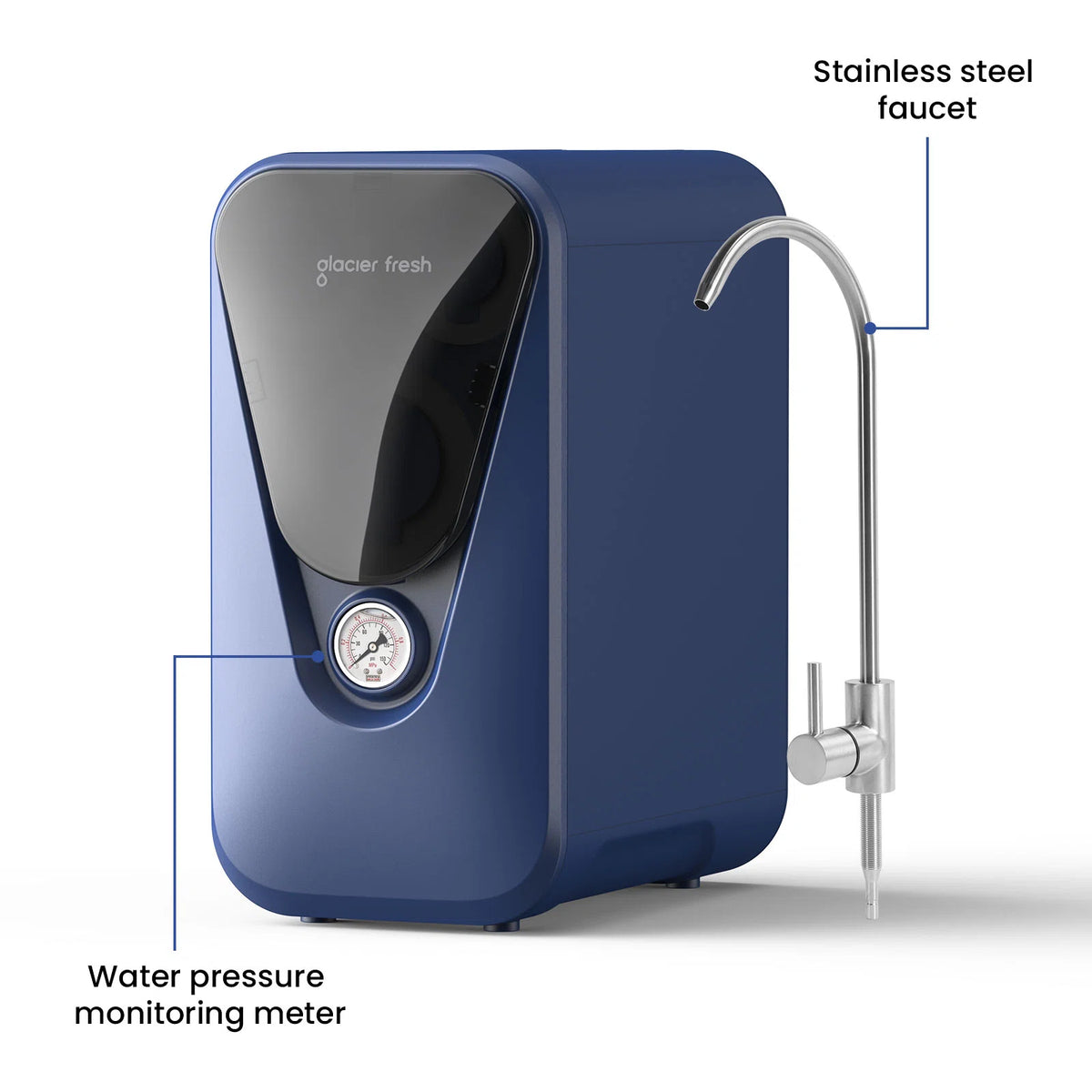
Three GlacierFresh formats illustrate that different households need different answers rather than one product:
| System | Format | Technology | Documented Specs |
|---|---|---|---|
| U03 Reverse Osmosis | Under-sink, tankless | 5-stage with 0.0001-micron RO membrane | 800 GPD, 0.6 GPM, 3:1 pure-to-drain, non-electric; components meeting NSF 42/53/58/401/372 with CSA and SGS testing |
| Coolon Countertop Nanofiltration | Countertop, no plumbing | Nanofiber membrane, 0.001–0.01 micron pore size | Meets NSF 372 (CSA); tested to NSF/ANSI 42 and 53; retains minerals, does not reduce TDS; 6 months / 200 gallons |
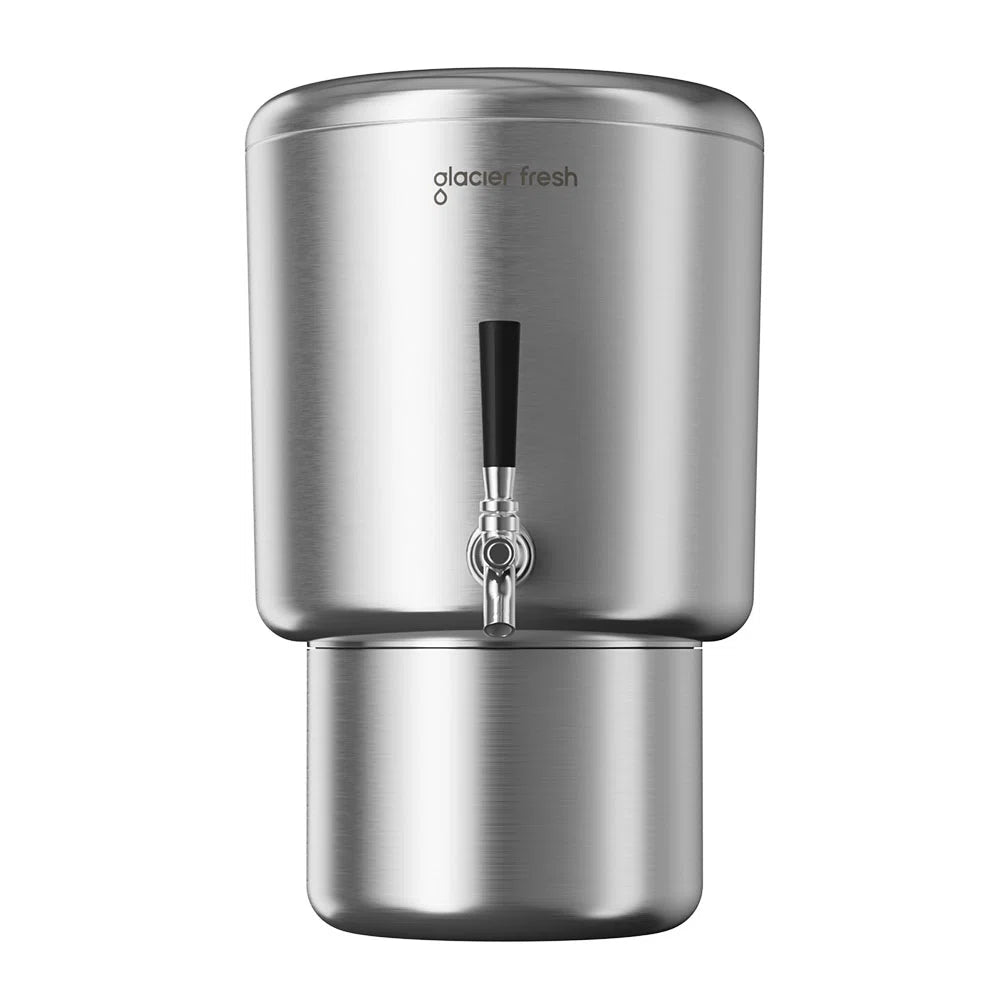
| PC04 Stainless Steel Gravity | Countertop, gravity-fed | Positively charged nanofiber membrane plus multi-stage carbon | 2.25-gallon upper tank; no electricity or plumbing; SGS lab results include lead ≈99.87% and PFOS+PFOA ≈99.62% reduction under lab conditions |
The U03 suits households wanting broad contaminant reduction at a plumbed kitchen tap. Coolon fits renters and anyone who can't modify the plumbing. PC04 runs with no electricity at all, which is why it belongs in the outage-preparedness conversation and not only the daily-filtration one.
How Can I Tell If the Tap Water in My Area Is Safe to Drink?
Three sources, answering three different questions.
Your Consumer Confidence Report tells you what the utility measured in finished water for regulated contaminants over the past year. EPA maintains the CCR hub where local reports can be located. It's the baseline.
State and local utility alerts tell you what is happening right now. During a contamination event or boil-water notice, this is the only source operating on the correct timescale — a CCR published last spring says nothing about a main break last night.
A household test tells you what is coming out of your tap, which is a different measurement from what left the plant. Lead is the clearest example: it typically enters from service lines and fixtures after treatment, so a utility sample can be clean while an individual kitchen is not. For regional patterns, our U.S. water quality map breaks it down by state.
Conclusion
These five crises look similar from a distance and diverge completely up close. Newark and Benton Harbor were lead problems where certified point-of-use filtration had a documented interim role alongside flushing and pipe replacement. Cape Fear was an industrial PFAS discharge where household treatment exists but carries real certification limits. Jackson was infrastructure collapse, and Red Hill an emergency petroleum release — neither a filtration problem in any useful sense.
Home filtration works best understood as a contaminant-specific exposure-control layer. It sits downstream of source control, functioning municipal treatment and infrastructure repair, and substitutes for none of them. What it can do, when the claim matches the contaminant and the maintenance schedule is actually followed, is reduce what arrives in the glass. Match the technology to the documented problem in your own water and that layer earns its place. Browse GlacierFresh under-sink and countertop systems to compare formats.
FAQs
How effective are water filters at removing lead from drinking water?
Effective when the specific model carries a tested lead-reduction claim and is installed and maintained correctly. EPA's Newark work evaluated whether distributed filters brought tap lead to 10 ppb or below and concluded that flushing combined with filtering was the appropriate interim approach until corrosion control was optimized. In Benton Harbor, EPA went further and reviewed filter effectiveness against that city's specific water chemistry.
Can water filters remove PFAS from tap water?
Some can. EPA identifies granular activated carbon, reverse osmosis and ion exchange resins as effective technologies and tells consumers to look for NSF/ANSI 53 or 58 certification. Two caveats apply: as of April 2024 those certifications focus on PFOA and PFOS specifically, and EPA states they do not yet indicate removal down to the levels in its new drinking-water standard.
How effective are water filters at removing microplastics?
That depends on particle size and technology rather than on the word "filter." WHO's assessment notes conventional drinking-water treatment can remove particles smaller than a micrometre, with tertiary filtration achieving the highest removal rates. Membrane processes such as reverse osmosis and nanofiltration operate at the smallest pore sizes.
What filter certifications matter for lead and PFAS?
NSF/ANSI 53 covers health-related contaminant reduction including lead, and NSF/ANSI 58 covers reverse osmosis systems — both are the standards EPA names for PFAS reduction. NSF/ANSI 42 covers aesthetic effects such as chlorine taste and odor and is not a health-contaminant claim. Certification is always model-specific and contaminant-specific, so the standard number alone isn't enough; check which contaminants that model was tested for.