
Table of Contents:
Home Water Filtration Standards And Contaminants
How Activated Carbon, RO, UF, And Nanofiber Filters Work
Which Contaminants Home Filters Can Remove
U.S. Water Contaminants By Region
How To Choose The Right Filter For Your Water
FAQs
Conclusion

Home Water Filtration Standards And Contaminants
Most people buying a water filter assume that "NSF certified" is a single designation — that the stamp on the box means the filter has been tested and cleared for general water quality. It isn't. The NSF mark alone says almost nothing. What matters is the number next to it, because each number refers to a completely separate testing program examining completely different things. Two filters can both display the NSF logo and have zero overlap in what was actually tested.
In residential settings, four standards come up most often. Standard 42 exists solely for aesthetic effects — it tests whether a filter reduces chlorine taste and odor, not whether it does anything about what's actually harmful. Standard 53 moves into health territory: lead, cysts like Giardia and Cryptosporidium, select VOCs — contaminants with documented toxicological consequences. Standard 58 has nothing to do with carbon filtration at all; it's the testing framework for complete reverse osmosis systems, covering how the assembled unit handles total dissolved solids and any additional contaminants the manufacturer elects to submit for testing. Standard 401 addresses emerging contaminants — trace pharmaceuticals, certain pesticides — that show up consistently in environmental monitoring but haven't yet been assigned enforceable regulatory limits. Two older protocols sit alongside these: P473, the original PFOA and PFOS testing vehicle, has since been absorbed into 53 and 58. P477 governs cyanotoxins from algal blooms — a distinct category from PFAS, but relevant for households drawing from lakes or reservoirs with a bloom history.
PFAS coverage in any certification requires particular scrutiny. The PFAS chemical class spans over 12,000 individual compounds. No single standard addresses all of them. What certification confirms is that specific, named PFAS compounds were tested against a specific model at specific inlet concentrations and met a specific reduction threshold. Marketing language — "comprehensive PFAS reduction," "advanced protection" — doesn't alter what the test protocol actually included. The certified claims list for the exact model in the NSF or WQA database is the only record that matters.
How Activated Carbon, RO, UF, And Nanofiber Filters Work
A useful way to think about these four technologies is not by what they remove but by what they fundamentally cannot remove — because that's where purchase mistakes happen.
1. Carbon filtration works through molecular attraction
Certain dissolved compounds — chlorine, organic odor compounds, many VOCs — have a chemical affinity for carbon surfaces and bind to them as water passes through. That surface chemistry is the mechanism, which immediately explains the technology's ceiling: dissolved inorganic ions like arsenic or nitrate have no particular attraction to carbon. They pass through as efficiently as the water carrying them. Granular activated carbon (GAC) is optimized for flow — water moves faster, contacts the carbon briefly, and works well for high-volume applications where taste and odor are the main concern. Carbon block trades flow rate for denser contact, which is why it handles finer and more stubborn contaminants more reliably. Standards 42 and 53 define the two tiers of what independently verified carbon filtration can claim.
2. Reverse osmosis was designed specifically to handle what carbon can't
Instead of relying on chemical attraction, it uses pressure to force water through a semipermeable membrane with pores small enough to exclude most dissolved substances — arsenic, nitrate, total dissolved solids, and under NSF/ANSI 58 testing, PFOA and PFOS. Rejected substances concentrate in a separate stream that exits as wastewater. The trade-off is real: a reject stream requiring drainage, higher inlet pressure requirements, and the need for pre-filters to protect the membrane from fouling and post-filters to address taste after treatment.
3. Ultrafiltration approaches the problem differently again
Its hollow-fiber membranes work through physical size exclusion rather than chemical rejection — bacteria, protozoa, and microplastic particles can't pass because they're physically too large. But "physical exclusion" cuts both ways: anything dissolved and molecularly small — nitrate, arsenic ions, mineral salts — passes through without resistance, because these aren't particles being screened out. No wastewater, no high-pressure requirement, simpler operation than RO. The meaningful limitation is the dissolved side of the contamination picture.
4. Nanofiber membranes sit at an interesting intersection of what UF and carbon each fail to cover individually
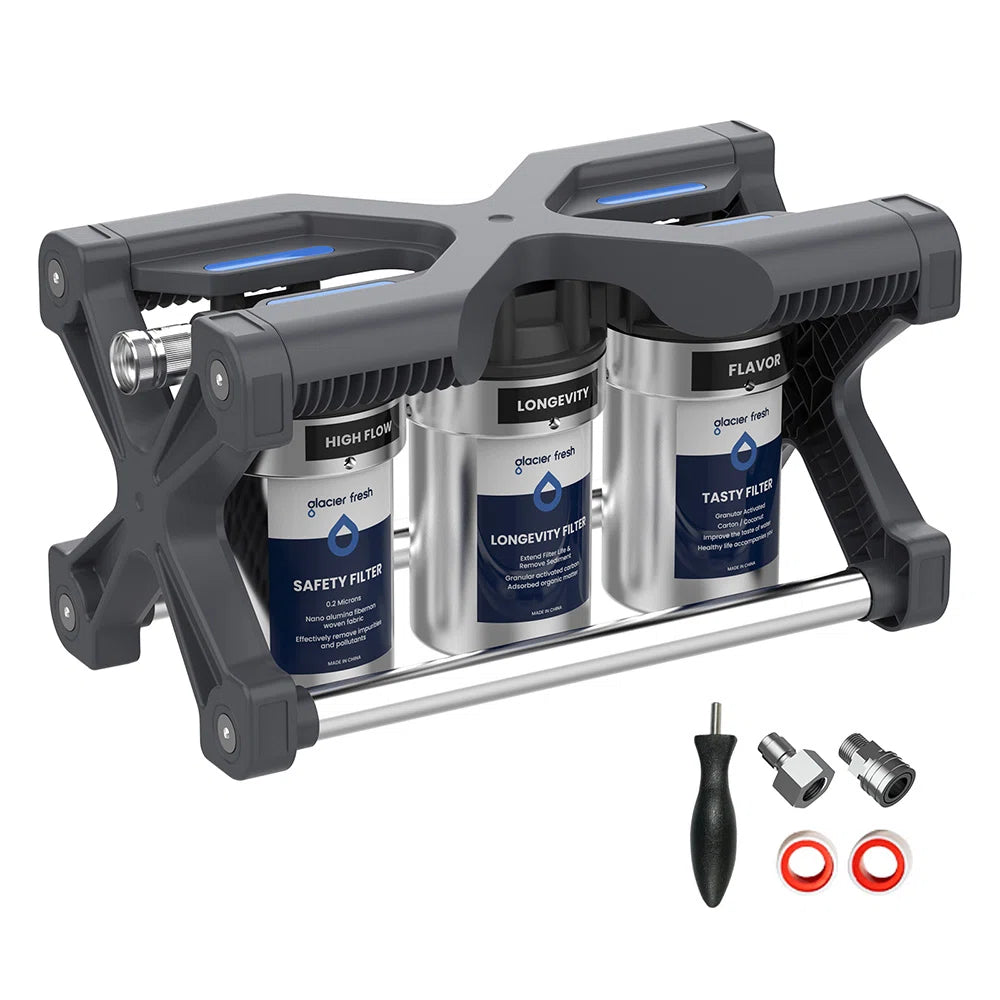
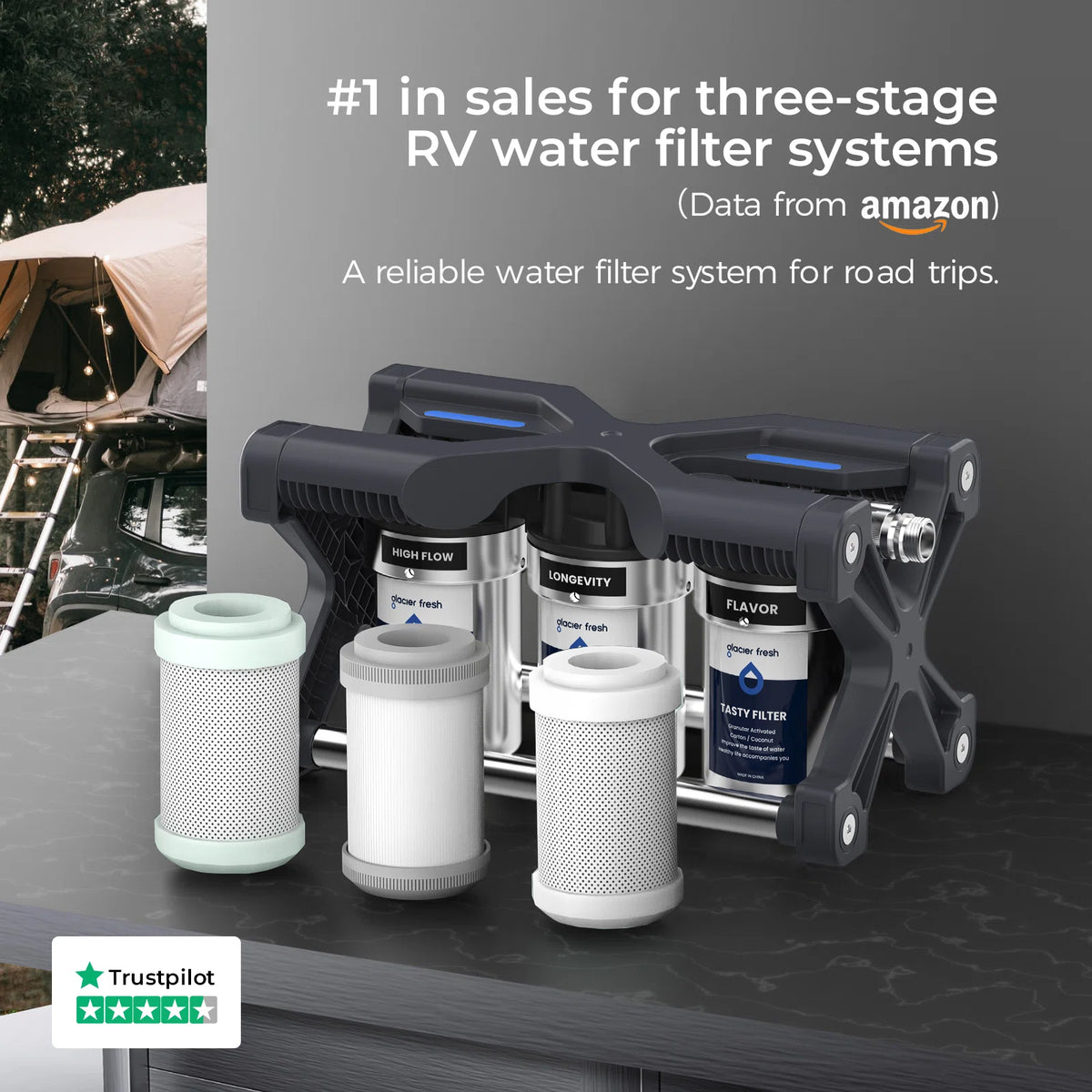
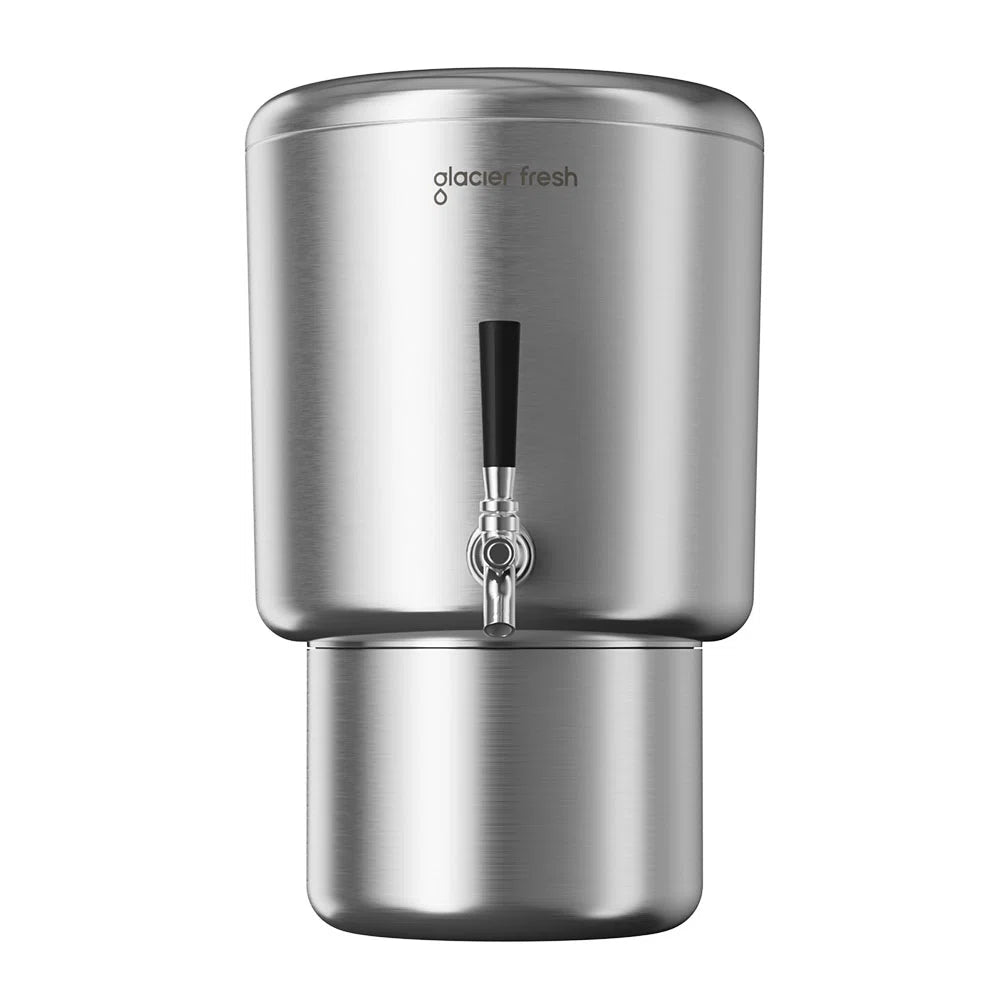
Electrospun into high-surface-area structures, they capture fine particles and microplastics at higher flow rates and with less pressure penalty than conventional UF membranes manage. The particulate removal comes from the membrane; the dissolved organics and chlorine that the membrane ignores get addressed when carbon is stacked alongside it in a multi-stage design. Each stage handles what the other can't. GlacierFresh's PC04 Countertop Filter applies this architecture, built around the Elarisey nanofiber membrane paired with carbon filtration.

Which Contaminants Home Filters Can Remove
The way most people approach filter selection — browsing by product type first, reading the label second — is backwards. The contaminant has to come before the technology, because the same property that makes a filter excellent at one job makes it useless at another.
• PFAS, lead, and chromium-6 each require a verified claim at the model level, not a standard number on the box. An NSF/ANSI 58-certified RO system may or may not include PFOA and PFOS among its tested claims — that depends entirely on which compounds the manufacturer chose to submit for testing. A carbon-plus-nanofiber system can carry PFAS claims, but only where those specific compounds appear in the model's certified documentation. A pitcher filter certified to standard 42 is correctly described as NSF-certified. It also has no verified performance against lead — the 42 certification covers taste and odor, and the certification says nothing else about anything else.
• Arsenic, nitrate, and radium cannot meaningfully be addressed by adsorption. These are dissolved ions; the surface chemistry that makes carbon effective against organics simply doesn't apply to them. For private well owners with confirmed levels of these contaminants, a certified RO system is the appropriate residential technology. Municipal systems with arsenic or nitrate issues typically treat them at the plant; private wells have no equivalent backstop. Radium is most commonly handled at the utility scale through ion exchange, though it does get reduced alongside other dissolved solids in RO treatment.
• Microplastics, VOCs, and chlorine each belong to a different part of the technology stack. Microplastics are a particle problem — UF and nanofiber membranes intercept them through size exclusion, and their chemical composition is irrelevant to whether they pass. VOCs are a chemistry problem that carbon handles through adsorption, verified under standard 53. Chlorine and chloramine are taste-and-odor concerns that fall under standard 42. Multiple concerns in the same water supply require a multi-stage system that combines the relevant stages rather than expecting any single medium to cover the full range.
• One failure mode worth naming explicitly: a filter certified to NSF/ANSI 53 for lead does not address nitrate in the same water. Carbon filtration is simply invisible to dissolved inorganic ions. And regardless of technology, no filter substitutes for water that fails microbiological safety standards — contamination at that level requires disinfection before filtration enters the picture.
U.S. Water Contaminants By Region
City tap water that passes every regulatory test isn't necessarily the same thing as chemically clean water. Treatment processes introduce disinfection byproducts. Distribution systems with aging infrastructure contribute lead from service lines and fittings. PFAS from industrial or military sites can reach surface water intakes via groundwater. Each of these can appear at measurable concentrations in tap water that meets every federal limit. Your utility's Consumer Confidence Report (CCR) — the annual testing document they're required to publish, not the summary on their homepage — is where actual measured levels by contaminant appear.

Private well users have no equivalent document. No agency tests private wells, tracks them, or notifies owners when nearby groundwater is found to be contaminated. The relevant question for any private well is what's in the local geology and what has been applied to or discharged into the surrounding land over the past several decades. Wells adjacent to agricultural fields face nitrate and pesticide infiltration built up over years of fertilizer and manure application. Properties near military installations, airports, or industrial facilities need PFAS screening. Crystalline rock formations — particularly across New England, the Upper Midwest, and parts of the Southwest — release arsenic and uranium under specific geochemical conditions that have nothing to do with human activity above ground. Iron and manganese are common enough across geologies that they belong in any well test panel. The sequence that actually produces useful results: test first, identify what's present, then select a treatment system matched to those specific findings.
Broad regional patterns from USGS and EPA data provide a starting orientation: arsenic concentrations are highest in the Southwest, Upper Midwest, and New England. Nitrate peaks in the agricultural interior — Midwest, Great Plains, California's Central Valley — the result of fertilizer inputs at scales the soil couldn't absorb before reaching the water table, accumulated over decades. Radium appears in selected Midwest and Gulf Coast aquifer formations. PFAS contamination is anchored near its point sources — military sites, airports, certain manufacturing zones — but EPA monitoring has confirmed detections in groundwater across all 50 states.
How To Choose The Right Filter For Your Water
The practical selection process starts with a water quality report — a CCR for municipal users, a certified lab result for well users — and works forward from there. Without that data, any filter choice is a guess about what the water actually contains.
With data in hand, the certification mapping is straightforward: chlorine, taste, and odor point to standard 42 and carbon-based filtration. Lead and most VOCs require standard 53, with the specific contaminant confirmed in the model's certified claims. PFAS — PFOA and PFOS specifically — appear under standard 53, 58, or legacy P473 documentation depending on what technology was tested; named compound verification is still required regardless. Arsenic, nitrate, and chromium-6 require standard 58 and an RO system; carbon will not move these. Microplastics and fine particles call for a UF or nanofiber membrane , ideally combined with a carbon stage to cover dissolved organics simultaneously.
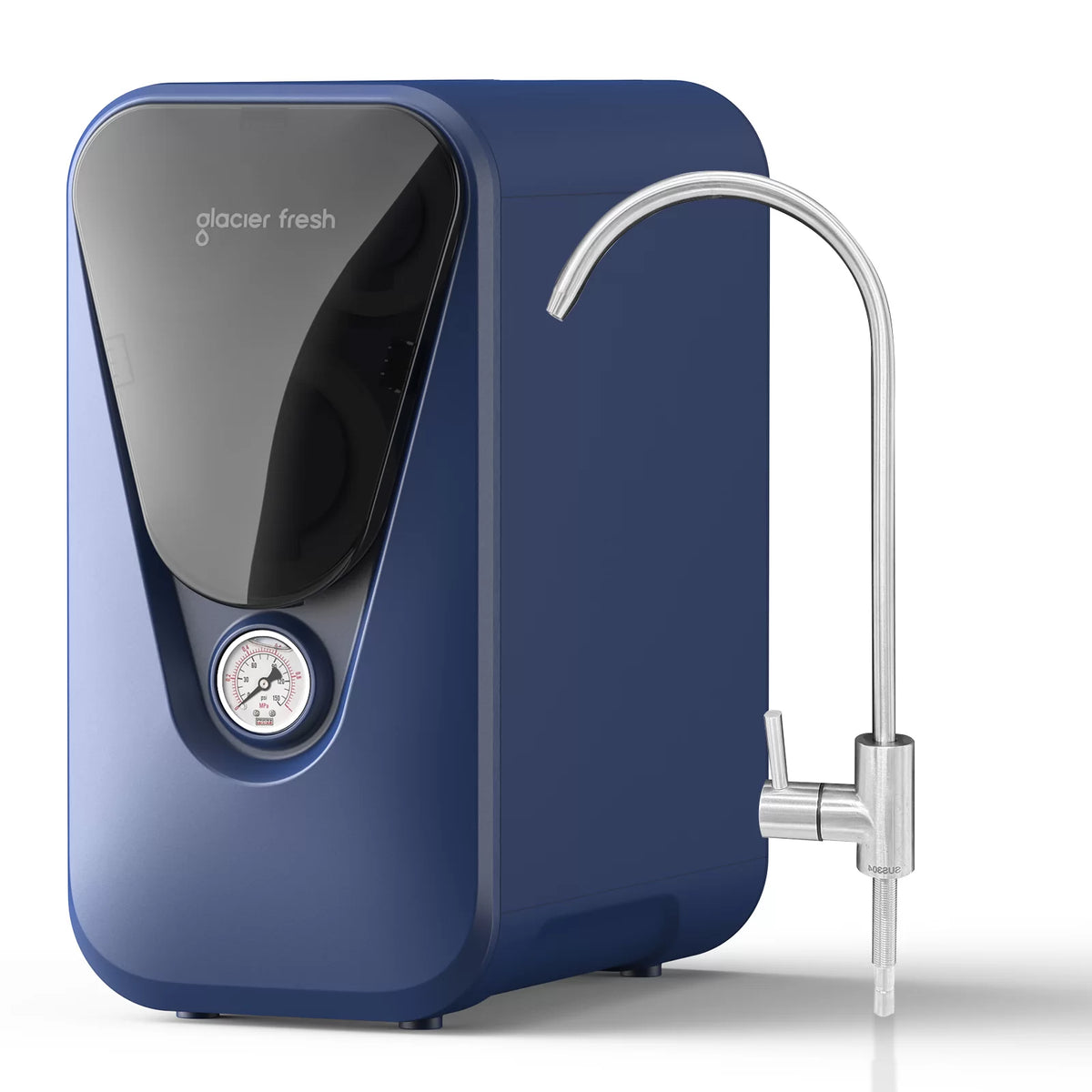
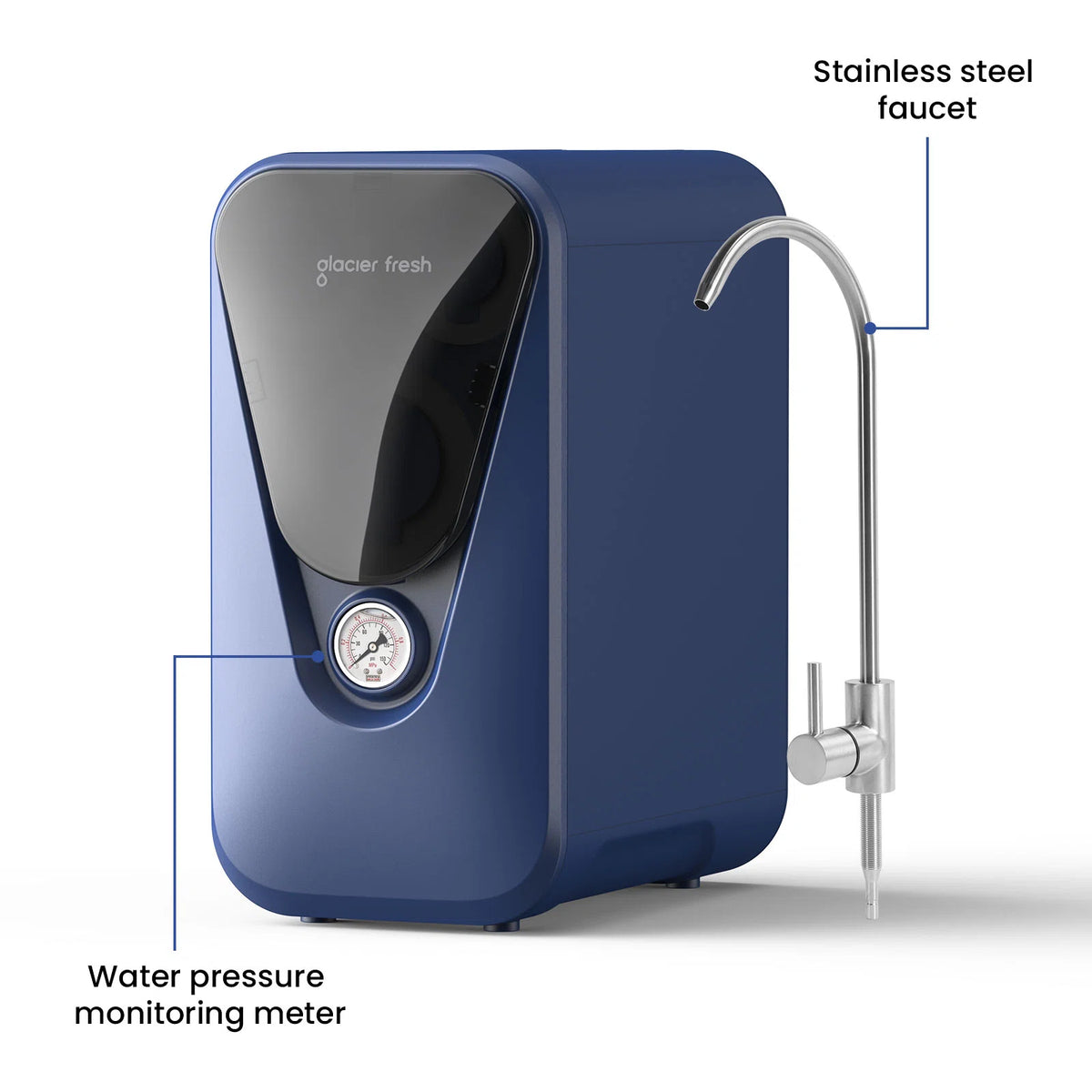
For a household tap where the confirmed concerns are lead, VOCs, and microplastics — the profile common in older urban housing with aging distribution infrastructure — an under-sink carbon-plus-nanofiber system addresses all three without the wastewater stream or inlet pressure requirements of a full RO installation. When the confirmed picture includes dissolved contaminants like arsenic, nitrate, or PFAS, the choice shifts to RO. GlacierFresh's U03 five-stage RO system covers that dissolved profile under NSF/ANSI 58, with the expected installation complexity and ongoing concentrate stream as trade-offs.
Pitcher and faucet filters serve a narrower function than their marketing often implies: standard 42 coverage for chlorine and taste, and standard 53 coverage for lead only if that specific model carries the claim. Whole-house systems protect plumbing and fixtures from chlorine and sediment across the full building but rarely extend to 53 or 58 coverage — a point-of-use filter at the drinking tap remains warranted alongside them. When a product displays 42 + 53 + 401 together, that combination signals multi-tier coverage across aesthetic, health-effect, and emerging-contaminant categories — but model-level claim verification is still the final confirmation step.
FAQ
Do all NSF-certified filters remove lead?
No. Only filters certified to NSF/ANSI 53 or NSF/ANSI 58 for lead are tested for it; NSF/ANSI 42-only filters just target chlorine taste and odor.
Do RO systems remove PFAS and microplastics?
Many do, but confirm the specific system is tested for PFOS/PFOA under NSF/ANSI 58 rather than assuming — check the performance data sheet instead of the marketing claim, and pair it with a sediment, UF, or nanofiber pre-filter to protect the membrane and catch microplastics earlier.
What’s the difference between NSF 53 and NSF 58?
NSF/ANSI 53 covers non-RO technologies (carbon, carbon block, and nanofiber combinations) for health-related contaminants; NSF/ANSI 58 covers complete reverse osmosis systems and TDS reduction. Both can carry PFAS claims depending on how the product is tested.
How do I verify a filter’s certification?
Find the brand and model number on the product or manual, look it up on the NSF (or WQA) database, confirm which standards and specific contaminants it’s certified for, and compare that list against your CCR or lab results.
Does maintenance affect how well a filter performs?
Yes, significantly. Even excellent media — activated carbon, RO membranes, or nanofiber layers — lose effectiveness once a cartridge is past its rated capacity, so follow the manufacturer’s replacement schedule rather than waiting for a visible drop in taste, odor, or flow rate.
Conclusion
Combining a credible NSF/ANSI certification with the right technology — activated carbon, RO, ultrafiltration, or nanofiber membrane filtration — is the most reliable way to cut PFAS, lead, and microplastics while keeping good flow, provided you keep up with cartridge replacement and periodic retesting as your water source or local conditions change.
GlacierFresh’s Elarisey nanofiber membrane technology powers the PC04 Countertop Water Filter, SGS-verified to reduce lead by ≈99.87% and PFAS by ≈99.62% with no plumbing or electricity. For dissolved contaminants like arsenic and nitrate, the U03 five-stage under-sink RO system adds NSF/ANSI 58-certified reduction.
References
• NSF International. NSF/ANSI 42, 53 and 401: Filtration Systems Standards. https://www.nsf.org/knowledge-library/nsf-ansi-42-53-and-401-filtration-systems-standards
• NSF International. NSF/ANSI 58: Reverse Osmosis Drinking Water Treatment Systems. https://www.nsf.org/knowledge-library/nsf-ansi-58-reverse-osmosis-drinking-water-treatment-systems
• NSF International. Forever Chemicals and the Advancement of Filtration Standards. https://www.nsf.org/knowledge-library/forever-chemicals-advancement-filtration-standards
• NSF International. Certified Drinking Water Treatment Units — Lead Reduction. https://info.nsf.org/Certified/dwtu/listings_leadreduction.asp
• United States Environmental Protection Agency. Identifying Drinking Water Filters Certified to Reduce PFAS. https://www.epa.gov/water-research/identifying-drinking-water-filters-certified-reduce-pfas
• United States Environmental Protection Agency. CCR Information for Consumers. https://www.epa.gov/ccr/ccr-information-consumers