
Table of Contents:
Best RV Water Filters For 2026–2027
Top RV Water Filter Picks For Frequent Travelers
NSF/ANSI Standards That Matter For RV Water
RV Water Filter Types Compared
Top RV Water Filter Brands Compared
RV City Water Connection And Pressure Regulator Setup
FAQs
Conclusion

Best RV Water Filters For 2026–2027
Frequent travelers need water that tastes decent and won't cause problems at every stop. The 'best' RV filter system depends entirely on your travel pattern. Weekend campers face different challenges than full-timers. Start with NSF/ANSI certification — ignore marketing language. A two-stage external canister, with sediment upfront and carbon behind it, provides the strongest baseline protection. Multi-stage systems outperform single inline filters over months of use. Smaller micron ratings catch more particles but also create pressure drop and clog faster. Around 5 microns for sediment strikes a solid balance for whole-RV filtration. Sub-micron carbon blocks work well under a kitchen sink but can feel restrictive when feeding the entire coach unless your incoming pressure is strong. RV parks deliver anywhere from 30 to over 100 psi, so a quality pressure regulator belongs upstream of every filter. Filling your fresh-water tank changes the equation: your onboard pump runs at lower pressure, and finer filters or RO units often demand higher inlet pressure to function properly. Reverse osmosis under-sink systems deliver excellent drinking water but require good pressure and produce waste water. Most frequent travelers find a solid carbon-based system handles their needs better.
Top RV Water Filter Picks For Frequent Travelers
Heading into 2026–2027, most frequent travelers in the US stick with a handful of proven RV Water Filter categories:
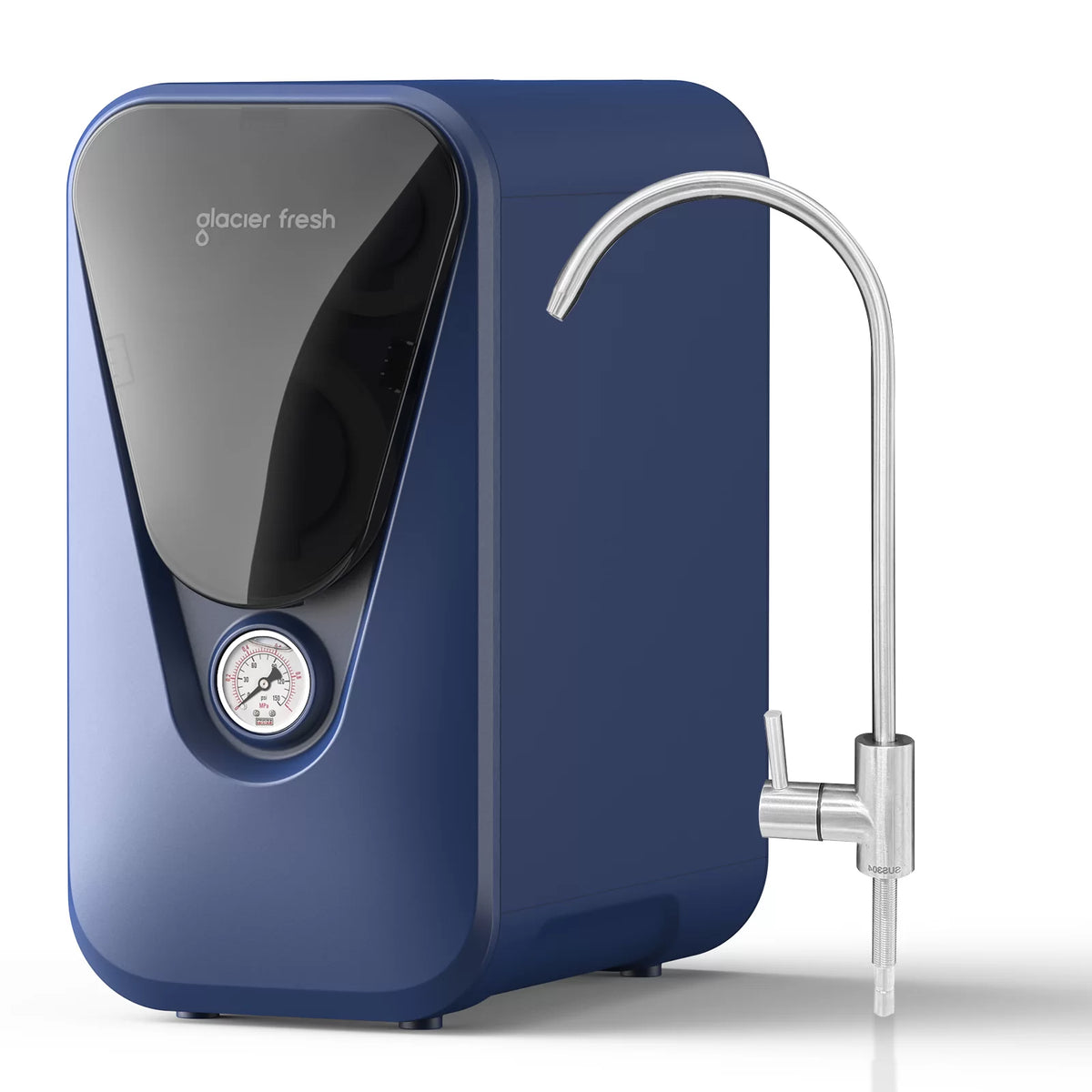
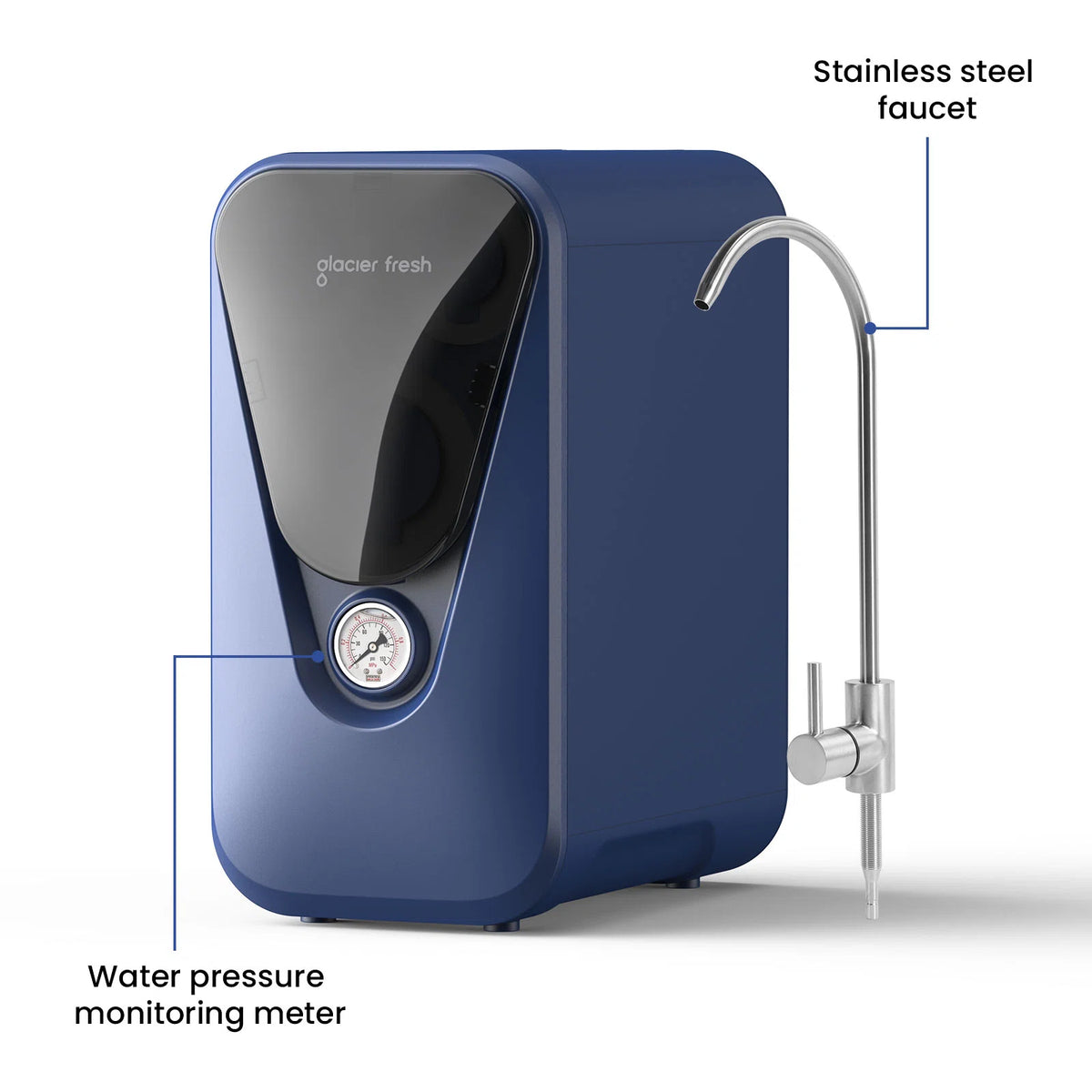
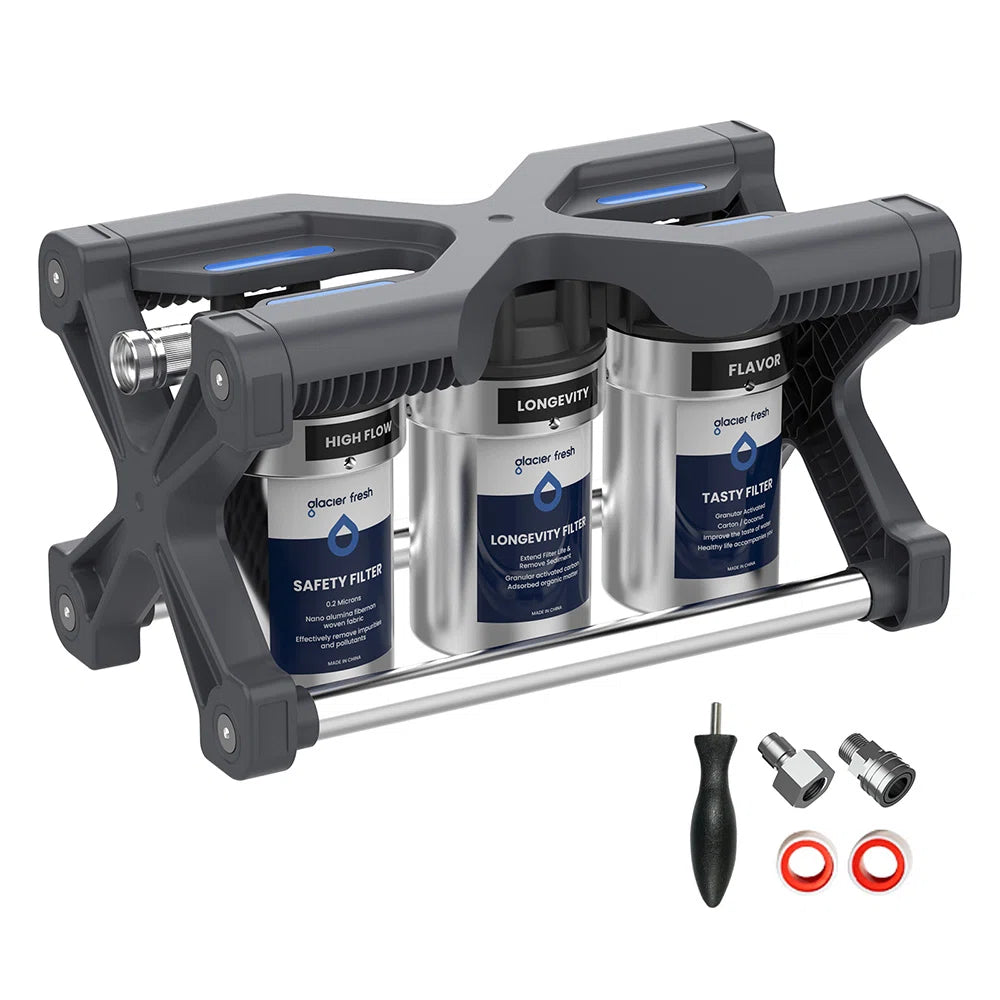
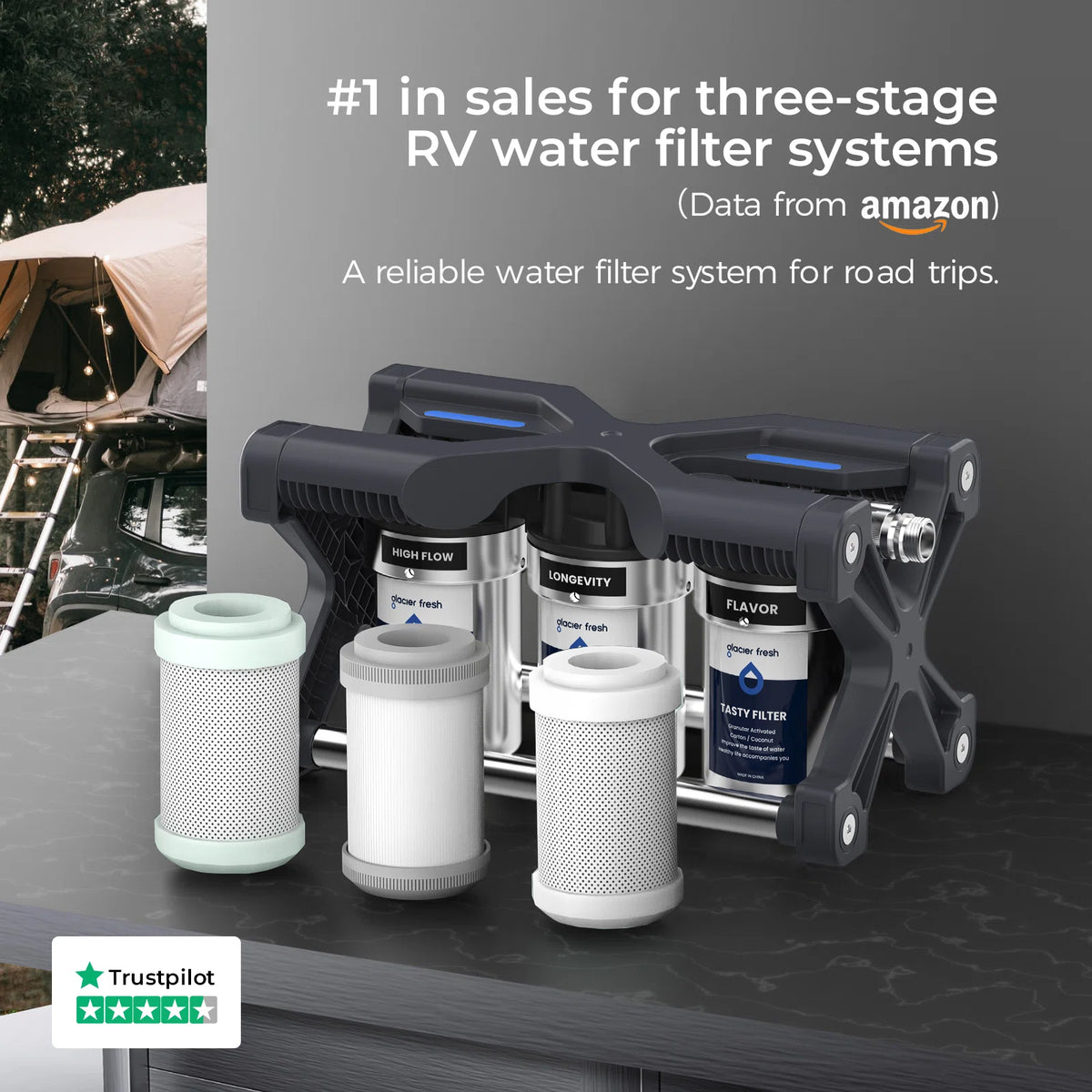
• GlacierFresh RV Lineup: A purpose-built range covering every tier in one brand — the AUQAGO 3-Stage system and 2-Stage Garden/RV option for external canister protection, an inline hose filter for backup use, and the RVRO01 portable RO system for full purification on the road — all sharing the same stainless steel quick-connect fittings.
• External Dual/Triple-Canister Systems (e.g., ClearSource, RVFilterStore): Stand-alone sediment + carbon canisters between the spigot and your city water inlet — higher flow, easy cartridge swaps, and usually the best overall choice for full-timers who want a robust, plug-and-play system without designing their own setup.
• Configurable "Big Blue" Canister Systems: Standard housings you fill with your own choice of sediment, carbon, or specialty NSF-certified cartridges — ideal if you cross very different water quality, like to upgrade over time, or want to build toward a fully customized whole-RV setup.
• Simple Inline Hose Filters (e.g., Camco TastePURE): Cheap, compact, and very easy to install and replace — fine for weekend trips or as a backup, but usually not enough on their own for frequent travel since they clog quickly on dirty water and rarely match a canister system’s capacity.
• Under-Sink Drinking Water Filters (e.g., Culligan): Treat just the kitchen tap with NSF/ANSI 42/53-certified carbon block filtration — a great upgrade layered on top of whole-RV sediment/carbon protection, and worth adding if you’re not comfortable using unfiltered water for cooking or drinking.

NSF/ANSI Standards That Matter For RV Water
NSF/ANSI certification tells you exactly what a filter has been independently tested to do. Nothing more. NSF/ANSI 42 covers aesthetic effects: chlorine taste, odor, sediment. It appears on most RV filters. NSF/ANSI 53 handles health effects like lead and cysts. NSF/ANSI 401 addresses emerging contaminants — certain pharmaceuticals and pesticides. NSF/ANSI P231 covers microbiological purifiers. You rarely see it on typical RV filters built for treated city water. A filter carries certification only for the exact contaminants listed in its documentation. Verify the model number on the NSF database. Don't trust phrases like "meets NSF standards." Some brands use standard residential cartridges that hold their own NSF/ANSI certification. The assembled RV system might not be separately certified. What matters most: the specific cartridges you rely on carry clear, documented performance data. When comparing products, match the standard and the specific contaminant claim — chlorine, lead, whatever — to what you actually care about. Be cautious of vague phrases like "up to 99% reduction" without a specific standard or lab reference. Those numbers mean nothing without context.
RV Water Filter Types Compared
• Inline Hose Filters: Cheapest and easiest to install, but limited capacity — best for weekend trips or as a backup.
• External Canister Systems (single/dual/triple): Far more filter media and NSF-certified cartridge choice, with easy individual replacement — best for full-time and frequent travelers on city water.
• Under-Sink Drinking Water Filters: Higher-level filtration (e.g., NSF/ANSI 53) right where you drink, without restricting flow to showers — doesn’t protect the rest of your RV plumbing.
• Reverse Osmosis (RO) Under-Sink Units: Excellent drinking water quality, but reverse osmosis (RO) systems need higher inlet pressure, produce waste water that fills your grey tank faster, and add maintenance — they also produce water more slowly than other types and are usually paired with a small storage tank, so they suit stationary, full-hookup stays better than frequent moves.
Usage pattern should drive the choice. Weekend trips need a simple inline filter. Extended stays at one park benefit from a dual-canister setup you can tune to that specific water source and its mineral content. Full-timers usually get the most consistency from a multi-stage system paired with a quality pressure regulator.
Top RV Water Filter Brands Compared
• GlacierFresh: Purpose-built RV lineup covering every tier — the AUQAGO 3-Stage system for full sediment+carbon protection, a 2-Stage Garden/RV option, an inline hose filter for easy backup use, and the RVRO01 portable RO system for travelers who want RO-level purification on the road. The lineup shares stainless steel quick-connect fittings across models, so upgrading from one tier to the next doesn’t mean relearning a new hookup.
• ClearSource: Premium, purpose-built external systems with rugged frames and strong flow, suitable for full‑time use and larger rigs — a plug-and-play choice for full-timers who’d rather not design their own setup, though it comes at a higher upfront cost than basic inline filters.
• RVFilterStore: Configurable canister systems using standard, NSF/ANSI certified cartridges — best for DIY-minded travelers who want to customize sediment, carbon, or specialty filters, at the cost of a slightly steeper learning curve around cartridge selection.
• Camco TastePURE: The most familiar inline hose filter — inexpensive and beginner-friendly, though most full-timers outgrow it after a season or two and move up to a canister system.
• Culligan: Long-established under-sink carbon block filters, often NSF/ANSI 42/53 certified — a strong choice for a dedicated, tested drinking-water tap, though installation in a tight RV cabinet can be trickier than a full-size kitchen.

RV City Water Connection And Pressure Regulator Setup
Best-practice hookup order goes like this: campground spigot → pressure regulator → hose → external filter system → hose → RV city water inlet. Put the regulator first. It protects your RV plumbing and the filter housings from pressure spikes. Filling your fresh-water tank instead? Route spigot → filter → tank fill. Your RV pump then provides pressure, usually lower than city hookups. Filters don't disinfect the tank interior. Sanitize it periodically anyway. Use a high-quality brass or stainless-steel regulator rated for RV use. Skip the flimsy unregulated fittings. Check your filter housing's maximum working pressure rating before connecting. Most RVers aim for roughly 40–60 psi. A sudden drop in flow at normal pressure usually means your sediment filter is clogged. Replace it. This happens most often after stays at older parks with rusty or sandy water.
FAQs
Do RV filters remove lead and PFAS?
Most basic RV filters don't meaningfully reduce lead or PFAS. For lead, look for NSF/ANSI 53 certification that specifically lists lead. For PFAS, look for NSF/ANSI 53 or 401 certifications that name the compounds. A well-designed reverse osmosis system also works.
Is NSF 42 enough for city water?
For treated US city water, NSF/ANSI 42 — chlorine taste, odor, and sediment — is usually enough. Combine it with regular tank sanitizing. It doesn't cover health-related contaminants like lead. Add an NSF/ANSI 53-certified filter if lead worries you.
Do I need a pressure regulator with a filter?
Yes. RV park pressure can exceed what your hoses, filters, and plumbing are built for. A regulator protects your filter housings and O-rings. It prevents damage to your water heater and plumbing. It keeps flow predictable. Filter performance stays stable.
Are RV water filter systems easy to install and replace?
Inline hose filters and canister cartridges are the easiest. Most swap in under a few minutes. No tools needed. Just hand-tight fittings. Under-sink and RO systems take longer to install the first time. They may call for basic plumbing skills. Cartridge changes afterward are still straightforward.
How often should I replace an RV water filter?
Most cartridges are rated by gallons filtered, often around 500 gallons, or by time, roughly 3–6 months. Whichever comes first. Check your specific model's rating. Replace sooner if flow drops noticeably. Replace if water tastes or smells off. Replace immediately after a stay at a campground with visibly dirty or rusty water.
Conclusion
For frequent RV travelers in 2026–2027, the most effective strategy is usually a multi-stage external RV Water Filter system — sediment plus carbon — plus a properly regulated city-water connection. Add an under-sink drinking-water filter for extra contaminant reduction. Sanitize your fresh-water tank at least once or twice a year. Do it immediately if water tastes or smells off after storage. Combine that with timely filter replacement. You'll get consistent, safe water across the US.
GlacierFresh carries this same approach across a dedicated RV lineup: the AUQAGO 3-Stage RV Water Filtration System, the 2-Stage Garden/RV Water Filtration System, the Inline Hose Water Filter for RV, and the RVRO01 Portable RV Reverse Osmosis System.
References
• NSF International. NSF/ANSI 42, 53 and 401: Filtration Systems Standards. https://www.nsf.org/knowledge-library/nsf-ansi-42-53-and-401-filtration-systems-standards
• NSF International. NSF Standards for Water Treatment Systems. https://www.nsf.org/consumer-resources/articles/standards-water-treatment-systems
• NSF International. Certified Drinking Water Treatment Units — Lead Reduction. https://info.nsf.org/Certified/dwtu/listings_leadreduction.asp
• United States Environmental Protection Agency. Identifying Drinking Water Filters Certified to Reduce PFAS. https://www.epa.gov/water-research/identifying-drinking-water-filters-certified-reduce-pfas
• United States Environmental Protection Agency. Point-of-Use Reverse Osmosis Systems. https://www.epa.gov/watersense/point-use-reverse-osmosis-systems
• United States Environmental Protection Agency. Ground Water and Drinking Water. https://www.epa.gov/ground-water-and-drinking-water