
Table of Contents:
Why Modern Homes Need Better Drinking Water Filtration
What Is Nanofiber Membrane Filtration?
How Nanofiber Filtration Helps Remove Microplastics
Improving Taste and Odor: Removing Chlorine and Organic Compounds
What Are the Main Differences Between Sediment and Carbon Water Filters?
How Do Different Pure Water Filtration Systems Compare in Terms of Filtration Quality?
What Is the Most Effective Water System for Removing Contaminants in Drinking Water?
GlacierFresh Countertop Water Purifiers
Maintenance: Keeping Your Countertop Water Purifier Performing Well
FAQs
Conclusion
More Americans are now paying attention to drinking water quality because of concerns about microplastics, PFAS, municipal water taste, and odor continue to grow. To ease this problem, water filter businesses have introduced nanofiber membrane filtration, an emerging technology used for modern countertop water purifiers.
Why Modern Homes Need Better Drinking Water Filtration
Modern homes need better water filtration systems as a second layer of protection, and here are the reasons why:
Common Tap Water Concerns in the U.S.
Research shows that an estimated 2.2 million Americans live in homes without running water, and tens of millions more lack sanitation facilities because of aging infrastructures and failure of septic systems. Common tap water concerns include chlorine taste and odor, lead coming from aging pipes, PFAS contamination, and microplastics. The US EPA warns that if drinking water contains unsafe contaminant amounts, it may cause gastrointestinal illnesses and even chronic diseases.
The Appeal of Point-of-Use Systems
To help solve this concern, point-of-use systems like countertop filters are becoming popular. They’re easy to install, provide targeted faucet-level protection, and compact enough for renters and RV owners who need portable water filtration solutions.
What Is Nanofiber Membrane Filtration?
Nanofiber membrane filtration is used to capture microscopic contaminants using pores that are typically 0.001 to 0.01 microns, while allowing water molecules to pass.
The way it works starts when water passes through a nano-scale fiber matrix. Then, an electrostatic attraction helps capture particles and contaminants. Lastly, the system performs selective filtration, which removes impurities while retaining beneficial minerals like calcium and magnesium.
Why Nanofiber Technology Is Ideal for Home Countertop Water Purifiers
Nanofiber technology is ideal for countertop water purifiers because of its high surface area that enables efficient filtration. Aside from that, it has a faster flow compared to traditional membranes and a compact design that can fit countertop systems. Compared with advanced and more complex systems, this requires lower energy as well.
How Nanofiber Filtration Helps Remove Microplastics
There are increasing concerns of microplastics in tap water, which can be associated with synthetic clothing fibers, packaging waste, and degraded plastic products. These often range from microns to millimeters in size, one that nanofiber filtration systems can help eliminate because of its nano-scale pores that can capture small particles effectively.
Nanofiber membranes’ electrostatic attraction captures suspended contaminants and its multi-layer filtration improves performance. Because of this, microplastics can be reduced significantly and improve water quality for consumption.
Improving Taste and Odor: Removing Chlorine and Organic Compounds
Why Tap Water Sometimes Smells or Tastes Bad
Tap water normally contains chlorine used by municipal treatment to disinfect water. While effective, this leaves an unpleasant taste and odor. Other factors like organic compounds and sediment and rust from old pipes contribute to the taste and odor of tap water too.
The Role of Carbon and Membrane Filtration
Modern filtration involves the use of activated carbon, which effectively removes chlorine and organic chemicals. With a large, porous surface area it is able to absorb chemicals, chlorine, and odors from water, in a process called adsorption.
Meanwhile, membrane filtration captures smaller particles and contaminants, which carbon may miss. Together, activated carbon and membrane filtration create a layered multi-stage filtration system which can enhance water safety and improve overall drinking experience.
What Are the Main Differences Between Sediment and Carbon Water Filters?
| Category | Sediment Filters | Carbon Filters |
|---|---|---|
| Primary function | Removes physical particles | Eliminates odors and chemicals |
| Filtration method | Mechanical | Adsorption |
| Contaminants removed | Rust, sand, dirt | VOCs, chlorine |
| Particle size removal (micron rating) | Larger particles | Smaller compounds |
| Effect on taste and odor | Minimal | Significant improvement |
| Role in multi-stage systems | First stage | Second stage |
| Typical applications | Whole-house systems and RVs | Drinking water systems |
Sediment filters are known to capture larger particles while carbon filters remove dissolved particles through adsorption. Combining these filters creates a modern system that offers complete filtration.
How Do Different Pure Water Filtration Systems Compare in Terms of Filtration Quality?
| Filtration Type | Removes | Pros | Cons |
|---|---|---|---|
| Sediment | Dirt, rust | Affordable and simple | Limited filtration |
| Carbon | VOCs, chlorine | Improves taste | Limited contaminants removed |
| Nanofiltration | Microplastics and other chemicals | Fast flow and retains minerals | Less comprehensive than reverse osmosis |
| Reverse Osmosis | PFAS, heavy metals, bacteria | Highest level of purification | Slower flow and may waste water |
Countertop filter systems often use both carbon and nanofiltration because these are more suitable for daily use with its convenience, mineral retention, and performance.
What Is the Most Effective Water System for Removing Contaminants in Drinking Water?
Not all water filters work the same way, so no single solution fits all households. The most effective one for you would be one depending on your water quality, lifestyle need, the type of contaminant present in your water.
In many cases, having a multi-stage filtration system works because it offers the highest purification level by combining several technologies. For example, using sediment filters, carbon filters, and advanced membranes can remove large particles, improve taste, and capture microscopic contaminants altogether.
It’s important that you determine the type of contaminants present, installation requirements, maintenance, filter replacement frequency, and water waste, before you get a water filter system. Some people prefer point-of-use countertop systems that deliver strong performance without complex installation needed, ideal for small spaces.
GlacierFresh Countertop Water Purifiers
If you’re looking for countertop water purifier options, here are some high-quality and highly recommended ones.
GlacierFresh 2.25 Gallon Countertop Water Filter (PC04)

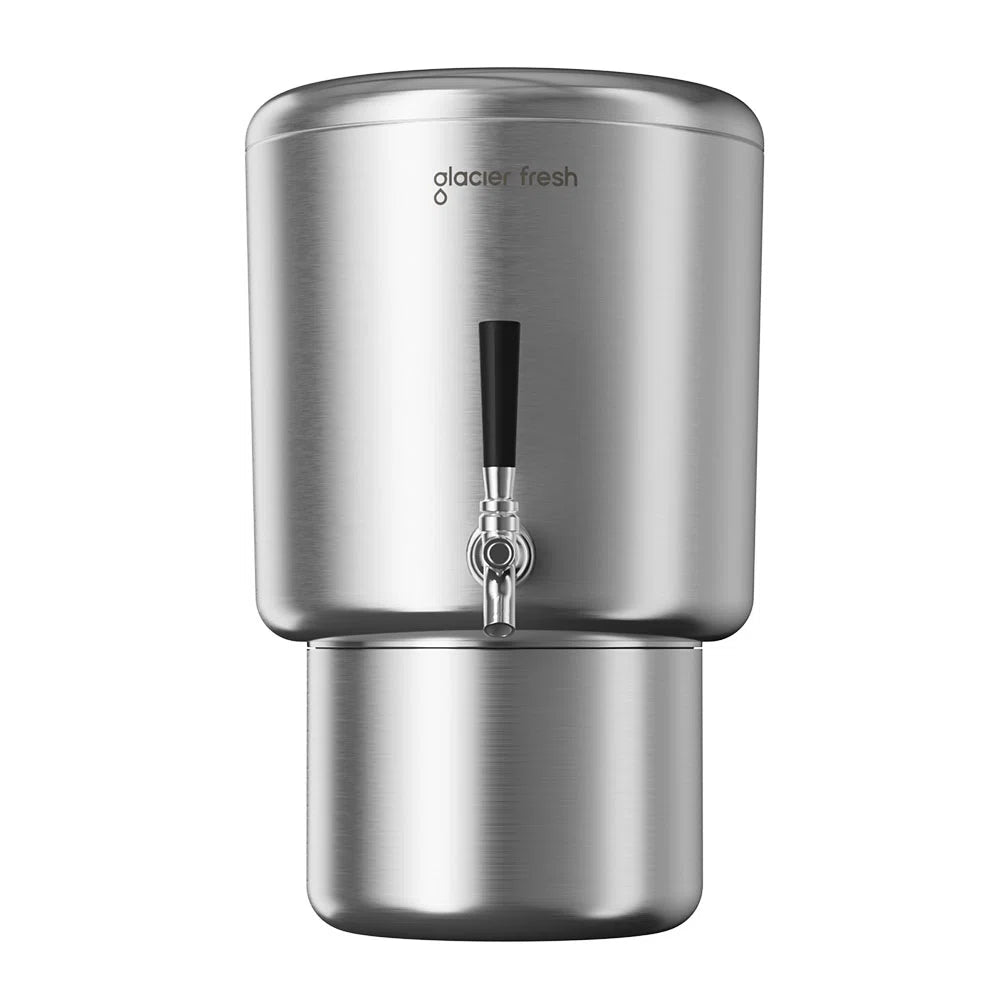
Designed for modern households, the GlacierFresh 2.25 Gallon Countertop Water Filter (PC04) makes advanced filtration available in a compact form. It’s a 2.25-gallon stainless steel countertop water purifier that uses Elarisey™ nanofiber filtration technology to remove usual contaminants such as lead, PFAS, microplastics, heavy metals, and chlorine.
Results of third-party SGS testing show that it has reduced lead to up to 99.87%, PFAS to 99.62%, and chlorine to 99.47%. This countertop water purifier needs no electricity and plumbing, making it ideal for apartments, RVs, families with young children, and even emergency power outages.
GlacierFresh Coolon Cold Water Dispenser

Among other countertop water purifiers, GlacierFresh Coolon Cold Water Dispenser is known for not only filtering your water but also delivering instant cold purified water. It uses nanofiber membrane filtration which removes heavy metals, sediment, and chlorine, while retaining beneficial minerals.
It has a one-touch operation and compact countertop design making it convenient for everyday use. No plumbing is required, and it even has a filter life indicator for ease-of-use. With this, you get cold, purified drinking water instantly.
Maintenance: Keeping Your Countertop Water Purifier Performing Well
It’s important to keep your countertop water purifier clean by following proper maintenance according to its guidelines.
Typical Filter Lifespan
Filter lifespan varies depending on usage, but most countertop systems require replacement every 3 to 6 months.
Signs It’s Time to Replace a Filter
If you’re not sure when to replace a filter, watch out for warning signs such as slower flow or change in taste. Some countertop systems have indicator lights that alert when it’s time for a filter change.
Tips to Extend Filter Life
Proper maintenance will help keep your water filter working for a long time. To extend filter life, clean your unit regularly, avoid using heavily contaminated source water, and follow manufacturer recommendations when it comes to replacements.
FAQs
What are the benefits of using nano filters in water purification?
Nanofilters can remove contaminants such as bacteria, microplastics, and chemicals, but still retain important minerals. These nano filters are great for modern countertop systems because they have a compact design and efficient filtration method.
What is the best home water filter for microplastics?
Water filters that have nano or reverse osmosis are great for filtering microplastics. Nano filters are able to trap tiny particles, while RO systems are used for a more comprehensive removal of microscopic contaminants.
What is the maintenance of a water purifier?
Proper upkeep is important because it keeps your filter running for a long time. Make sure to replace filters as instructed, clean components regularly, and check the flow rate and taste. By doing so, you can prevent bacteria buildup in your system.
What is the difference between pure water and filtered water?
Pure water is refined, but with minerals removed whereas filtered water removes harmful contaminants while still retaining beneficial minerals like magnesium and calcium, making it great for daily drinking.
What is the healthiest type of water filter?
The healthiest type of water filter is one that involves multi-stage filtration systems. Some have combined carbon and advanced membranes, which work together to improve taste, remove harmful contaminants, while keeping essential minerals.
Conclusion
Nanofiber membrane filtration is an effective way to reduce contaminants while maintaining the taste and quality of your water. Moreover, countertop water purifiers are ideal for modern homes because it’s convenient and space-saving. Just keep in mind that before choosing a water filter system, it’s better to understand filtration technologies so you can access safe, clean, and better-tasting drinking water.