
Table of Contents:
What Are the Typical Wastewater Ratios for Different RO Systems?
How Does the Wastewater Ratio Affect RO System Efficiency and Performance?
Are There Zero-Waste Reverse Osmosis Systems Available?
How Can You Reduce the Water Your RO System Wastes?
What Does This Mean for Your Water Bill?
Choosing an RO System With a Lower Wastewater Ratio
Conclusion
FAQs

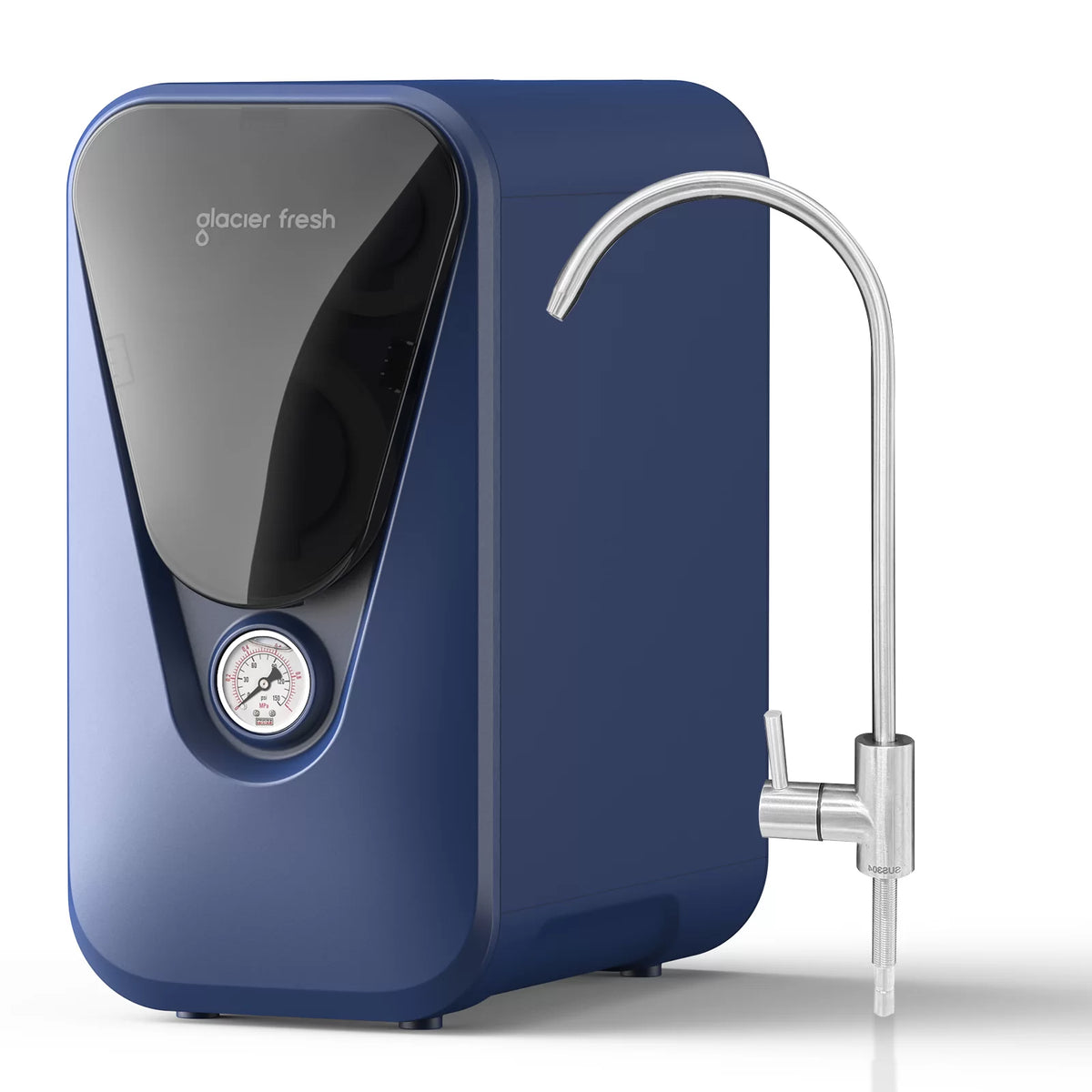
Picture yourself shopping for an under-sink RO system. One product page lists a “3:1 ratio” without specifying whether that means three gallons produced per one wasted or three wasted per one produced. Neither the listing nor the comparison chart clarifies the direction — an odd gap for a spec that quietly decides how many gallons go down the drain every time the tap runs. This article defines the RO wastewater ratio precisely, covers what’s typical versus efficient today, and translates the number into real dollars, using GlacierFresh’s own U03 tankinside RO system (3:1 pure-to-drain, 75% recovery, NSF/ANSI 58 certified) as a concrete example along the way.
What Are the Typical Wastewater Ratios for Different RO Systems?
Most conventional under-sink RO systems run somewhere between 3:1 and 5:1 waste-to-pure(roughly 20–25% recovery), while modern efficient tankinside designs commonly land between 1:1 and 3:1 pure-to-waste.
| Ratio (waste : pure) | Approx. Recovery Rate | Typical Tier |
|---|---|---|
| 5:1 | ~17% | Older / conventional |
| 4:1 | ~20% | Conventional |
| 3:1 | ~25% | Efficient |
| 1:1 | ~50% | High-efficiency / recirculating |
Note the direction: the table above uses the waste:pure convention, where a smaller first number is better. GlacierFresh states its own ratios the opposite way — as pure-to-drain, where a larger first number is better:U03 800GPD — rated 3:1 pure-to-drain (75% recovery), NSF/ANSI 58 certified — among the most efficient point-of-use ratios sold today. That 75% recovery means only one cup of water goes to drain for every three cups produced, a sharp improvement over the 20–25% recovery typical of older tank-based systems.
The EPA notes that a typical point-of-use RO system sends 5 gallons of water — sometimes more — down the drain for every gallon of treated water it produces, and less efficient units can send up to 10. Systems carrying the EPA WaterSense label are held to a tighter standard: no more than 2.3 gallons to drain per gallon treated, with a minimum recovery rate around 40% under the referenced ASSE 1086 criteria.
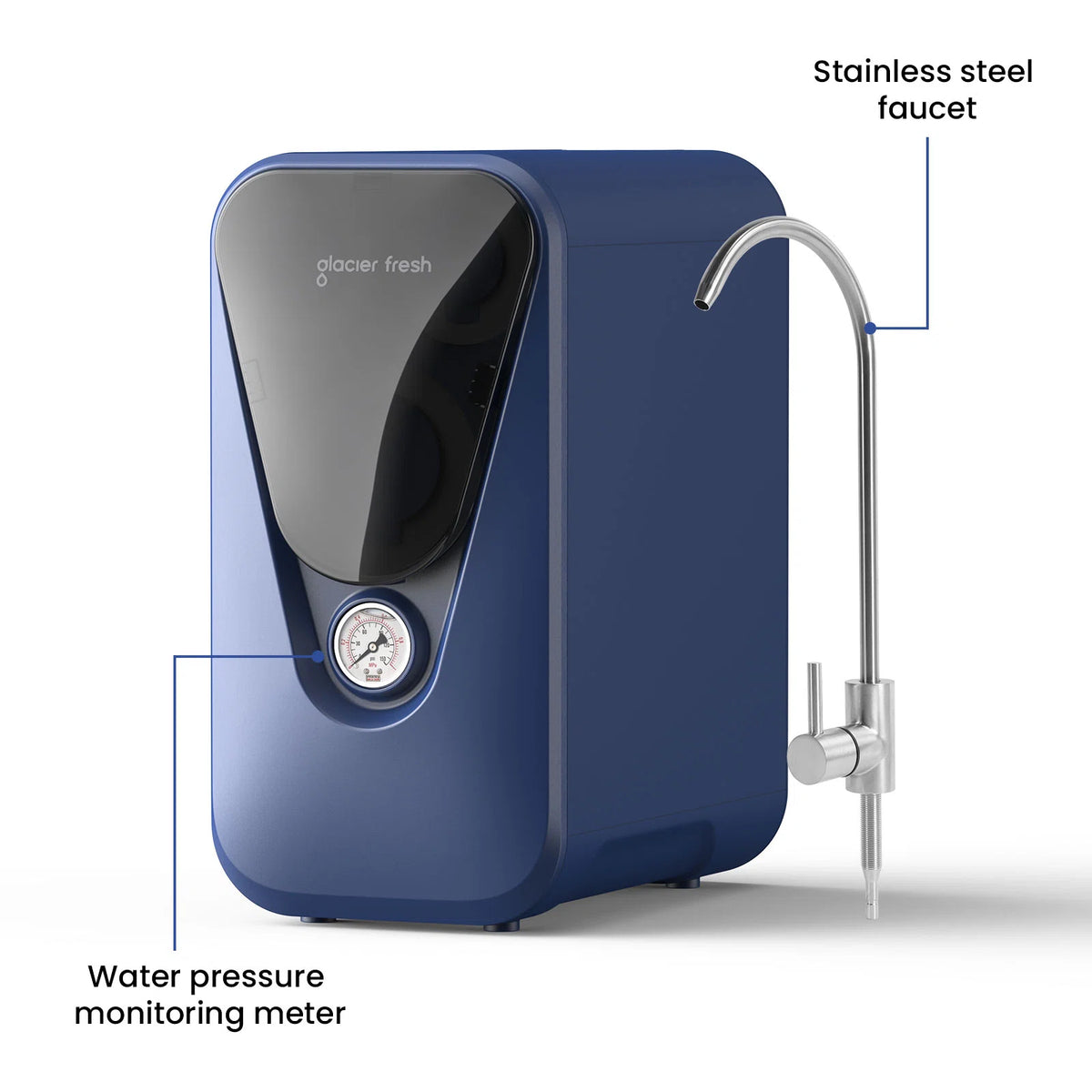
Within that range, GlacierFresh's U03 800GPD RO systemsits toward the efficient end, running a 3:1 pure-to-drain ratio per current product specifications — well inside the modern efficient band rather than the older 4:1–5:1 baseline. Its non-electric, tankinside design achieves that ratio through engineering rather than power-hungry pumps, which also means it keeps working during power outages and poses no electrical risk near plumbing.
How Does the Wastewater Ratio Affect RO System Efficiency and Performance?
The reject stream isn’t simply wasted water. It continuously flushes concentrated minerals and contaminants off the membrane surface, which is what keeps the membrane from scaling and fouling in the first place.
Pushing the ratio too low on a system not engineered for it can backfire: membrane life can shorten, and dissolved solids reach the permeate. Real-world ratios also shift with pressure, temperature, and source-water TDS, so a spec-sheet number reflects lab conditions, not a guarantee for every home.
The bottom line: a genuinely efficient system balances a low ratio with stable water quality and membrane longevity. Chasing the single lowest number on the box, without checking how the manufacturer achieved it, can trade one problem for another.
Are There Zero-Waste Reverse Osmosis Systems Available?
Not in the way the marketing sometimes implies. True zero-waste RO — 100% recovery, with no reject stream at all — isn't realistic for a standard point-of-use system, because the membrane needs some continuous flush to avoid fouling.
What’s marketed as "zero waste" or "low waste" usually relies on a permeate pump or recirculation design that routes reject water back into the feed line instead of the drain — smarter routing of the waste, not an elimination of it.
Today's best-in-class point-of-use ratios land around 1:1 to 3:1 pure-to-waste. GlacierFresh's U03 RO system, at 3:1, is a practical example of how far efficient tankinside design has moved from the 4:1–5:1 baseline that was standard not long ago.
How Can You Reduce the Water Your RO System Wastes?
Keep feed pressure at or above roughly 40 psi — low pressure slows production and worsens the ratio, and a small booster pump can correct that.
Pre-filters need to stay on schedule too. A clogged sediment or carbon pre-filter forces the RO membrane to work harder, which drags the ratio in the wrong direction even if the membrane itself is fine.
Resist DIY-swapping the drain flow restrictor to force a lower number on paper — too little concentrate flow raises scaling risk and can shorten membrane life. If a lower ratio matters, look for a system engineered for it at the factory rather than retrofitting an older one.
What Does This Mean for Your Water Bill?
Translating the ratio into dollars starts with typical US water and sewer rates. A broad household water-only estimate lands around $43 a month, and a family-of-four benchmark runs closer to $78 in average water bills, though a combined water-and-sewer bill often runs higher once other charges are added.
Rough comparison: an older RO system near 4:1 waste-to-pure sends noticeably more water down the drain for the same drinking water than a modern 1:1–3:1 system. Over a year, that difference adds up to a real, if modest, number of gallons — and in metered or tiered-rate areas it can matter more than the sticker price suggests.
Kept honest rather than oversold: for most households the monthly swing from ratio alone is modest, but it compounds over a system’s multi-year life, and it’s one of the few RO specs that keeps costing — or saving — something every day.

Choosing an RO System With a Lower Wastewater Ratio
U03 tankinside RO system (GlacierFresh U03 800GPD): 3:1 pure-to-drain ratio, non-electric, NSF/ANSI 58 certified, 7-stage filtration — built for households that want verified efficiency without guesswork.
| Feature | Specification | U03 800GPD |
|---|---|---|
| Daily capacity | 800 GPD handles cooking, drinking, bottle-filling | 800 GPD |
| Pure-to-drain ratio | 75% recovery — 1 cup waste per 3 cups produced | 3:1 |
| Flow rate | Fills a standard glass in ~5 seconds | 0.6 GPM |
| Filtration | Reduces fluoride, lead, PFAS, PFOS, arsenic 99.99% | 5-stage, NSF/ANSI 58 certified |
| Power | Works during outages, no electrical risk near plumbing | Non-electric |
| Best for | 3+ people, heavy daily use, metered water districts | Larger households |
The U03 is an easy-install, no-electricity system that lands toward the efficient end of today's point-of-use ratio range. Its tankinside design saves cabinet space under the sink, and the pull-out cartridge system means filter changes take seconds rather than a service call. With a rated total capacity of 1,427 gallons per filter set, replacement frequency stays low — which matters for long-term cost of ownership on top of the water savings the ratio provides. The system's 7-stage filtration reduces contaminants including fluoride, lead, PFAS, PFOS, and arsenic at a rate up to 99.99%, and its 0.6 GPM flow rate fills a standard glass in about five seconds.
Which one fits you?
-
3+ people or heavy daily use — U03 800GPD — higher output, 0.6 GPM.
-
Households in metered or tiered-rate water districts — the 3:1 pure-to-drain ratio (75% recovery) keeps waste low where every gallon shows up on the bill.
-
Want NSF/ANSI 58 certification specifically → U03, which carries that certification.
-
Lowest drain loss per gallon produced — U03’s 3:1 (75% recovery) sits at the efficient end of current point-of-use systems, well ahead of the older 4:1–5:1 standard.
Conclusion
The ratio number by itself doesn't tell you whether a system is efficient. You need to know which direction it’s measured in, and weigh it against membrane life and water quality — not just chase the lowest digit on the box. For shoppers who want a documented, efficient ratio without the guesswork, GlacierFresh's U03 RO systemstates it plainly: 3:1 pure-to-drain, 75% recovery, NSF/ANSI 58 certified — verified on current spec sheets rather than left to marketing language. That combination of third-party certification, non-electric safety, and a concrete recovery percentage gives buyers a clear benchmark to compare against any other system on the market.
FAQs
What are the typical wastewater ratios for different RO systems?
Most conventional under-sink RO systems run 3:1 to 5:1 waste-to-pure (about 20–25% recovery). Modern efficient tankless/tankinside systems, including GlacierFresh’s U01 and U03, commonly land between 1:1 and 3:1 pure-to-waste instead.
How does the wastewater ratio affect the efficiency of an RO system?
A lower ratio generally means less water wasted, but the reject stream also protects the membrane from scaling. A ratio pushed too low on a system not built for it can shorten membrane life and let more dissolved solids into the drinking water side, so ratio and water quality need to be weighed together.
Are there zero-waste reverse osmosis systems available?
Not truly. Standard point-of-use RO always needs some reject flow to keep the membrane from fouling. Systems marketed as "zero waste" typically recirculate the reject water back into the feed line instead of sending it to the drain, which reduces net waste without eliminating the underlying reject stream.
How can I reduce the amount of water wasted in my reverse osmosis system?
Keep feed pressure at or above roughly 40 psi, replace sediment and carbon pre-filters on schedule, and avoid modifying the drain flow restrictor yourself. If a lower ratio matters to you, choose a system engineered for it at the factory.
References
• United States Environmental Protection Agency. Point-of-Use Reverse Osmosis Systems.https://www.epa.gov/watersense/point-use-reverse-osmosis-systems
• Water Quality Association. Getting Smart With Reverse Osmosis Systems.https://wqa.org/resources/getting-smart-with-reverse-osmosis-systems/
• Water Quality Association. POU RO Performance and Sizing.https://wqa.org/wp-content/uploads/2022/09/Article-4-POU-RO-Performance-and-Sizing.pdf
• UMass Amherst Center for Agriculture, Food & the Environment. Reverse Osmosis Treatment of Drinking Water Supplies.https://www.umass.edu/agriculture-food-environment/cafe/fact-sheets/reverse-osmosis-treatment-of-drinking-water-supplies
• US Water Bill Guide. Average Water Bill.https://uswaterbillguide.org/average-water-bill/