
Table of Contents:
Why Can a New Filter Reduce Water Flow?
How Can You Locate the Restriction With a Pressure Gauge?
Is the Problem on City Water or the Onboard Pump?
When Does Low Flow Need Further Service?
How to Choose the Right RV Water Filter Without Sacrificing Pressure
What Maintenance Does an External RV Filter Need?
Conclusion
FAQs

A shower can lose force after a filter change, which makes the new cartridge an easy suspect. It may be restricting flow, but the campground supply, a partly closed valve, a kinked hose, or the RV plumbing can create the same symptom. First distinguish low flow from low pressure: flow is the volume reaching a fixture, while a gauge measures pressure at one point in the line. Repeatable checks can narrow down the location before you replace parts or adjust a regulator.
Note which fixtures are affected and when the change began. If both are available, run the same fixture first on city water and then from the onboard tank. Keep the faucet setting and hose layout as consistent as you can. When several outlets weaken at once, look for a restriction they share; a single slow faucet points more toward its aerator, showerhead, or local valve.
Why Can a New Filter Reduce Water Flow?
Water has to pass through the filter media and its fittings, so some resistance is expected while water is flowing. The effect is more noticeable when campground pressure is already modest, several hoses or adapters are connected, or a cartridge is designed for finer filtration. A new setup can also be restricted by packaging left on a connection, a hose bent behind a compartment door, a valve that is not fully open, or a cartridge installed against the marked flow direction.
A new cartridge is not necessarily clogged. If flow drops immediately, check the installation and supply first. If it slows gradually over time, sediment loading or a cartridge nearing its service limit becomes more plausible. The filter label and RV manual should determine the allowed flow and pressure range; no single figure applies to every vehicle.
How Can You Locate the Restriction With a Pressure Gauge?

Static Pressure vs Pressure While Water Is Flowing
Gauge readings depend on whether water is moving. With every fixture closed, a gauge records static pressure in the line; it does not show what remains when a shower is drawing water. For diagnosis, compare the same gauge with the same fixture running at the same setting. A closed-line reading and a shower reading describe different conditions, so they should not be compared as if they were equivalent.
Comparing the Supply and Filter Outlet
Where the setup allows a gauge to be installed safely, take readings on the supply side and after the filter while the same fixture is running. A clear drop across that path points to the cartridge, fittings, or hose; similar readings with weak flow make an upstream supply issue or a fixture restriction more likely. You can also collect water for a fixed time and measure the volume, repeating the test in the same way. That is a useful comparison for your RV, not a universal flow standard.
Record where the gauge is fitted, which fixture is open, and whether the reading is static or under flow. When possible, test before and after the filter with the same gauge and demand. A small difference can fall within the gauge’s resolution or reflect changing campground supply, so repeat the comparison before diagnosing a fault.
- Weak flow before and after the filter: check campground supply, regulator, and hose.
- Strong supply but a pronounced loss after the filter: inspect cartridge seating, flow direction, connectors, and cartridge condition.
- One weak faucet while other fixtures work normally: check that fixture’s aerator, showerhead, or local valve.
Do not loosen pressurized fittings to take a reading. Shut off the supply and relieve line pressure before changing connections, and follow the filter and gauge instructions.
Is the Problem on City Water or the Onboard Pump?
City water and the onboard fresh-water pump feed the RV through separate paths. If the problem appears only on the campground hookup, check the supply hose, inlet regulator, external filter, and city-water plumbing. If flow is weak in both modes, the cause is more likely on the pump side or in a line the two paths share. Test each source separately before deciding that the filter is responsible.
Give the line a moment to stabilize after switching sources. The city-water inlet has its own regulator and check valve, while the pump draws from the fresh-water tank; the paths meet farther along the plumbing. A change that follows one source suggests checking that branch. If both modes behave the same way, inspect the plumbing they share or the affected fixture.
Debris at the pump inlet strainer can restrict flow. Clean it only if the RV or pump manual lists it as a serviceable part, and follow those instructions. Clearing a blockage may restore lost flow, but it will not raise the pump’s rated capacity. Shut off city water and relieve line pressure before changing hose connections; switch off the pump before opening its strainer. A leak, damaged fitting, or repeated pump cycling calls for service.
When Does Low Flow Need Further Service?
If flow remains weak after the basic checks, the restriction may be at an inlet screen, regulator, check valve, fixture, pump, or another part of the plumbing. Keep the regulator within its stated range. Increasing its setting will not clear a blocked cartridge or correct a failing pump, and the lowest-rated connected component determines the system’s safe limit.
Stop testing if a hose begins to swell, a fitting shifts, a leak appears, the pump cycles repeatedly, or the regulator becomes unusually hot. Turn off the supply and consult the RV or component manual before checking any pressurized connection. When several outlets are affected and the supply checks reveal nothing, have an RV technician inspect the pump and plumbing.
How to Choose the Right RV Water Filter Without Sacrificing Pressure

Look at the filter’s rated flow, cartridge condition, fittings and hose size, and the treatment the source water actually needs. A finer rating is not automatically the best fit if it creates more restriction than the RV’s supply can comfortably handle. Check the product documentation for the exact version and operating limits before connecting it.
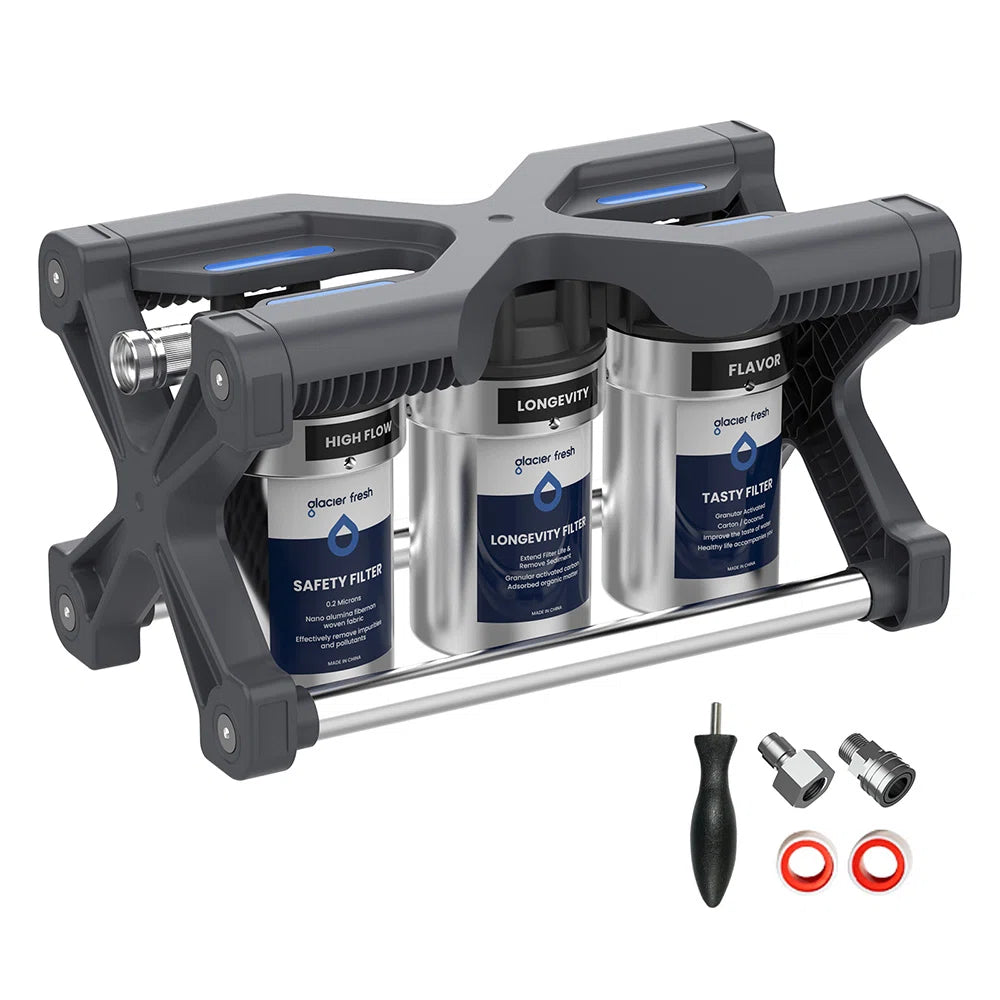
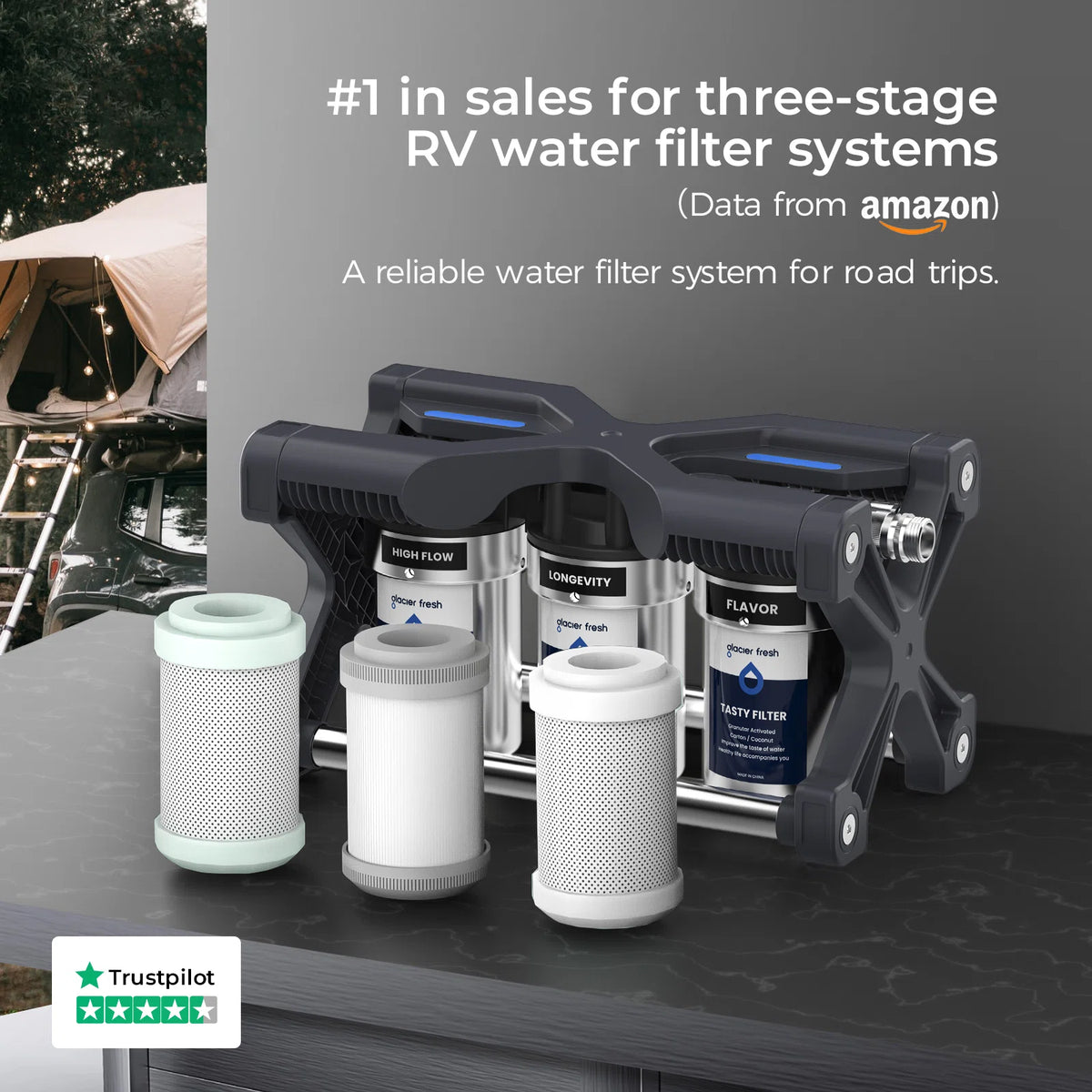
For owners looking for an external multi-stage option, the GlacierFresh AUQAGO 3-Stage RV Water Filter System uses replaceable cartridges and RV-oriented connections. Confirm the version, supplied fittings, and flow specifications against your hookup. It is a treatment filter, not a pressure booster: no filter can raise pressure above what the campground supply or onboard pump provides. A correctly sized, maintained system can help avoid unnecessary restriction while performing its intended filtration job.
Use the startup flush and replacement steps provided for the installed cartridge. Before reopening the supply, make sure the cartridge sits in the correct direction, the seals are in place, and the hoses are not pinched or sharply bent. Check each connection for leaks, then compare flow with the same fixture and setup used before service.
Record the replacement date, any change in source water, and when flow begins to fall. A gradual decline differs from a sudden change after a fitting has been disturbed. At replacement, choose the cartridge listed for that filter and check the seals for debris or twisting. Once the system is running, inspect every joint and repeat the original flow check.
Cartridge life varies with its rated capacity, source-water quality, usage, and the manufacturer’s schedule. A date alone cannot show whether a restriction is present. Keep the regulator within the limits set for the RV and filter; raising it is not a substitute for finding the cause of reduced flow.
Start with the same fixture and operating conditions, then compare city water with the onboard pump. The results can help separate a campground supply problem from a restriction in the filter path or RV plumbing. Select a filter for the treatment needed and the flow your setup supports, and service it according to its instructions.
Can an RV water filter freeze if it is left outside?
Water retained in a housing or cartridge can expand when frozen and damage components. Storage and winterization depend on the specific filter instructions; disconnecting or draining the visible housing does not prove that every internal part is protected.
Do I need both an RV water softener and a filter?
They address different water conditions. A softener reduces hardness through ion exchange, while sediment or carbon filtration targets other concerns. The right combination depends on the source-water test and treatment goal.
Is an RV water filter enough to make well water safe to drink?
Not automatically. Suitability depends on the well-water risks and the contaminants the filter documentation says it reduces. Have the water tested and match treatment to the results; a taste or sediment filter is not a blanket substitute for testing.
References
North Dakota State University Extension — Filtration: Sediment, Activated Carbon, and Mixed Media
Winnebago — Manuals and Diagrams
https://www.winnebago.com/owners/owner-resources/manuals-and-diagrams
Centers for Disease Control and Prevention — About Choosing Home Water Filters
https://www.cdc.gov/drinking-water/prevention/about-choosing-home-water-filters.html
NSF — Product Label and Literature Claims
https://www.nsf.org/consumer-resources/articles/product-label-literature-claims