
Table of Contents:
5 Types of Water Filters and How They Work
Difference Between 5 Types of Water Filters
The Importance of Regularly Replacing Water Filters
Verdict

There are many different types of water purifiers on the market, and they differ primarily in their filter cartridges and filtration technologies. For kitchen, household, and outdoor water use, there are five common types of filter cartridges. Each type addresses different issues. For example, activated carbon can only adsorb residual chlorine and impurities, but it cannot filter out heavy metals.
Therefore, choosing the right water purifier is essential to ensuring that your household water is truly safe and pure.
5 Types of Water Filters and How They Work

Water filtration technologies are primarily categorized into four types: physical filtration, chemical adsorption, electrostatic interactions, and reverse osmosis membranes. These methods exhibit significant differences in their ability to purify water of varying qualities.
Type 1. Activated Carbon Filters
Products such as Glacier Fresh and Brita glass water pitchers, refrigerator filters, and faucet-mounted water purifiers all utilize activated carbon filtration technology.
How It Works
Activated carbon is made from materials such as charcoal and coconut shells. After undergoing high-temperature and oxidation treatments, these materials develop millions of tiny pores. When water flows through activated carbon, it adsorbs certain chemical contaminants—such as chlorine, volatile organic compounds (VOCs), pesticides, and insecticides—as well as unpleasant odors, thereby purifying the water.
If your kitchen water has a strong chlorine odor, or if there is agricultural irrigation near your home, a water filter with an activated carbon filter cartridge is an excellent choice for you.
Recommended Products: Glacier Fresh Purela P04 Glass Water Pitcher, Brita Denali Water Pitcher
However, activated carbon cannot filter out heavy metals (such as lead and fluoride), bacteria, or hard minerals.
Also Read: How to Check Your Home’s Water Quality in 4 Steps
Type 2. Reverse Osmosis System
Reverse osmosis systems are generally the top choice for households because they can filter out up to 99.9% of harmful substances. Whether it’s heavy metals or PFAS, they effectively block these contaminants.
How It Works
Natural osmosis causes water to flow from an area of lower solute concentration to an area of higher solute concentration; reverse osmosis works in the opposite way. It uses a high-pressure pump to force water through a semi-permeable membrane with a pore size of approximately 0.0001, filtering out dissolved solids—including arsenic, fluoride, lead, PFAS, bacteria, and unpleasant odors.
If water pollution is severe in your city or community, or if you use well water, a reverse osmosis (RO) water purifier is definitely your best choice. It allows you to enjoy pure water at home with peace of mind, ensuring the safety of your daily drinking water.
However, RO systems do produce some wastewater. This means that when you filter a certain amount of water, some water is wasted. The purified water to wastewater ratio for reverse osmosis water purifiers on the market is typically 2:2, but Glacier Fresh’s innovative technology achieves a wastewater ratio of 3:1. This significantly reduces water waste in your home.
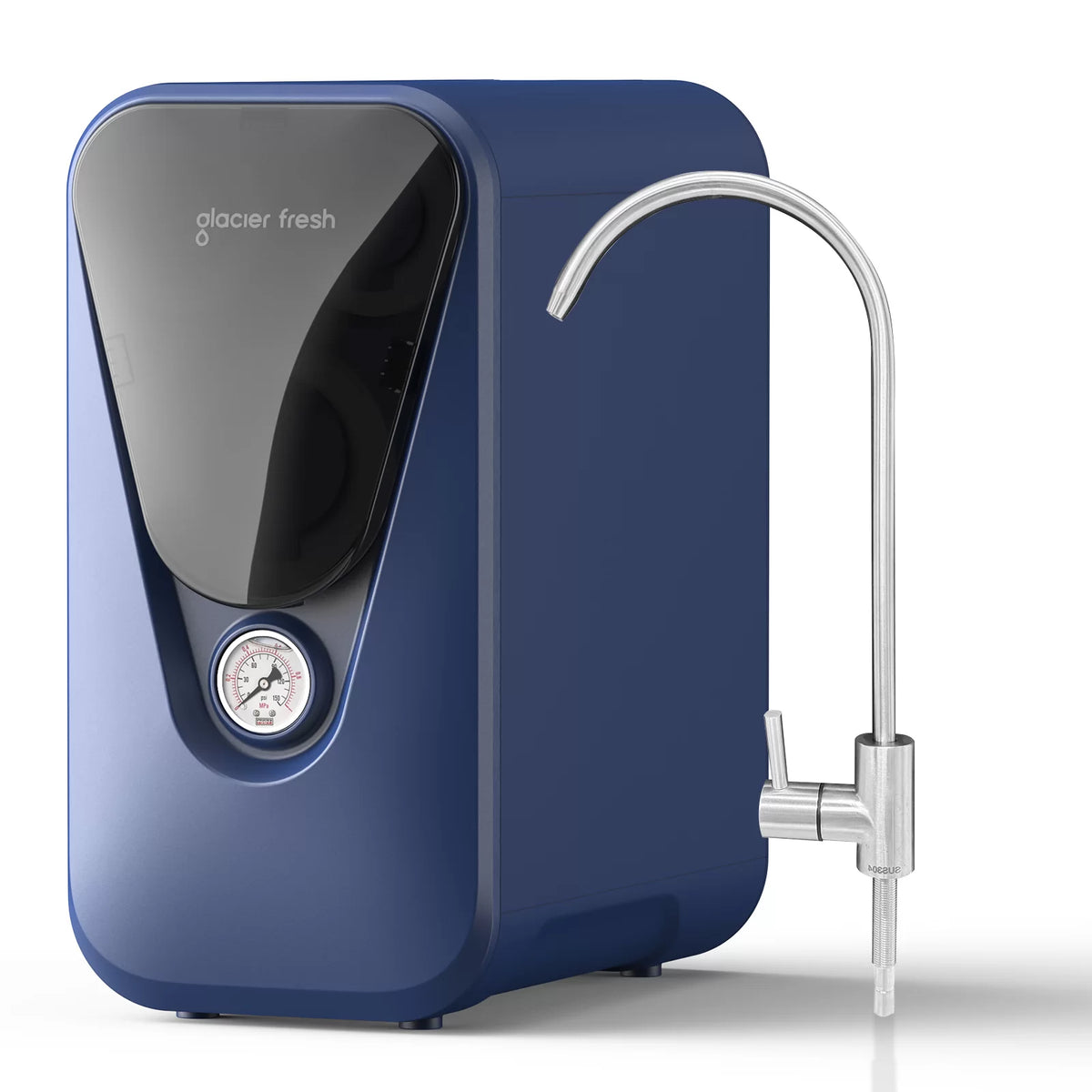
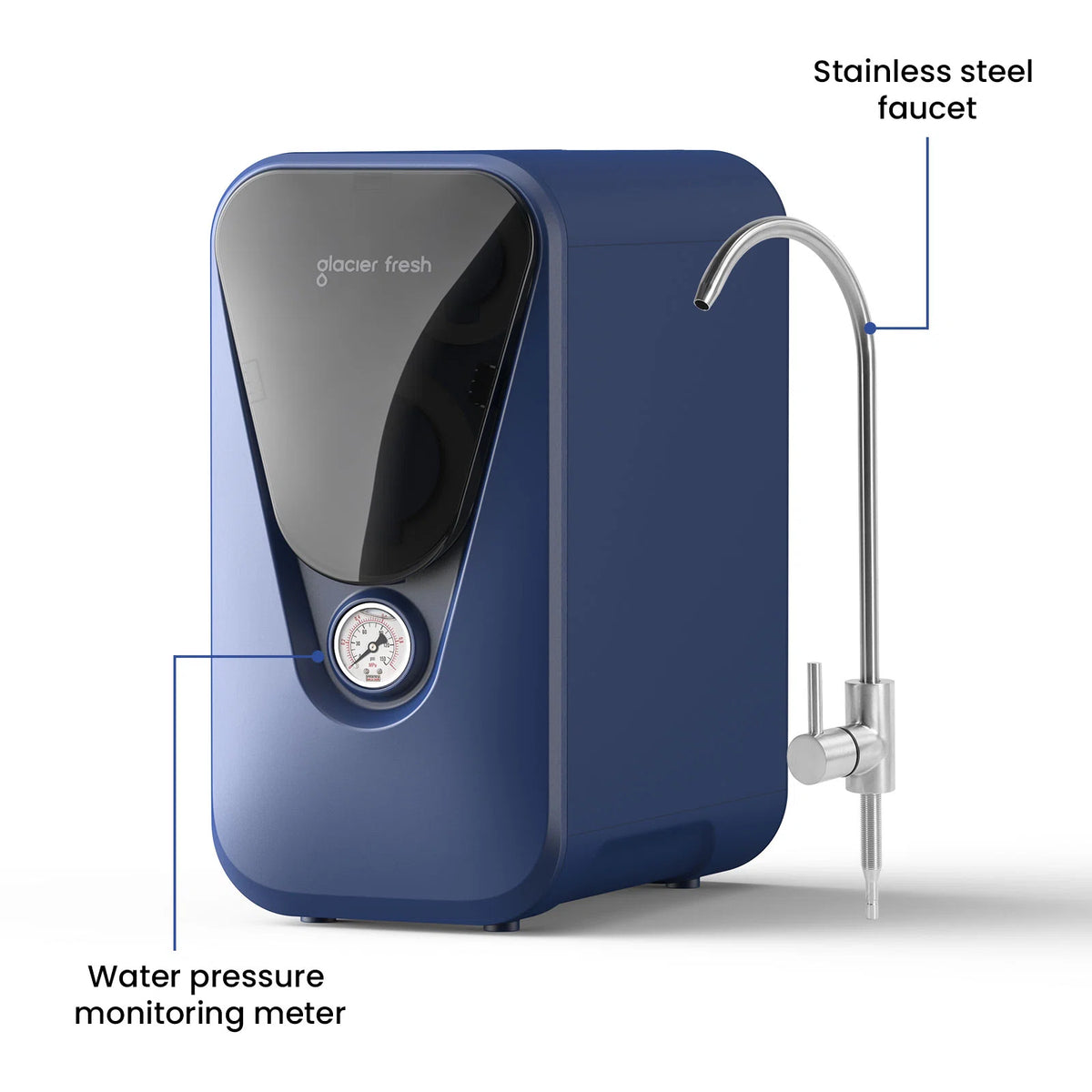
Additionally, the Glacier Fresh U03 RO water filter features a built-in water tank, which means you don’t need to plug it in or clean the tank, unlike traditional reverse osmosis systems.
💡Note: Reverse osmosis systems remove trace minerals from the water. However, many products now come equipped with remineralization features, so there’s no need to worry.
Also Read: Filtered Water vs Bottled Water: Which Is Better for Drinking at Home?
Type 3. Ultrafiltration
Ultrafiltration (UF) operates on a similar principle to Reverse Osmosis, but uses slightly larger hollow-fiber membrane pores (typically around 0.01 to 0.1 microns).
How It Works
This system uses normal household water pressure to force tap water through a UF membrane, filtering out impurities and contaminants. It requires no electricity or storage tank. Because the membrane pores are small enough, it can filter out up to 99.9% of bacteria and suspended particles; however, since the pores are larger than mineral ions, it does not remove beneficial minerals from the water.
The main difference between ultrafiltration and RO systems is that ultrafiltration does not produce wastewater and does not filter out minerals. However, it cannot reduce the total dissolved solids (TDS) content.
Recommend Water Filter: Glacier Fresh U06 Under-Sink Ultrafiltration Water Filter
Type 4. Ion Exchange
High concentrations of calcium and magnesium ions in water cause it to become “hard.” Although hard water is not harmful to humans, it forms a hard scale inside water pipes, which can lead to equipment malfunctions. Additionally, items washed with hard water are often left with stains. An ion-exchange filter softens hard water using sodium or potassium ions.
How It Works
Small resin beads coated with sodium ions are used as the filter media. When hard water passes through the resin, a chemical reaction occurs. The resin adsorbs and binds calcium and magnesium ions while releasing harmless sodium ions into the water.
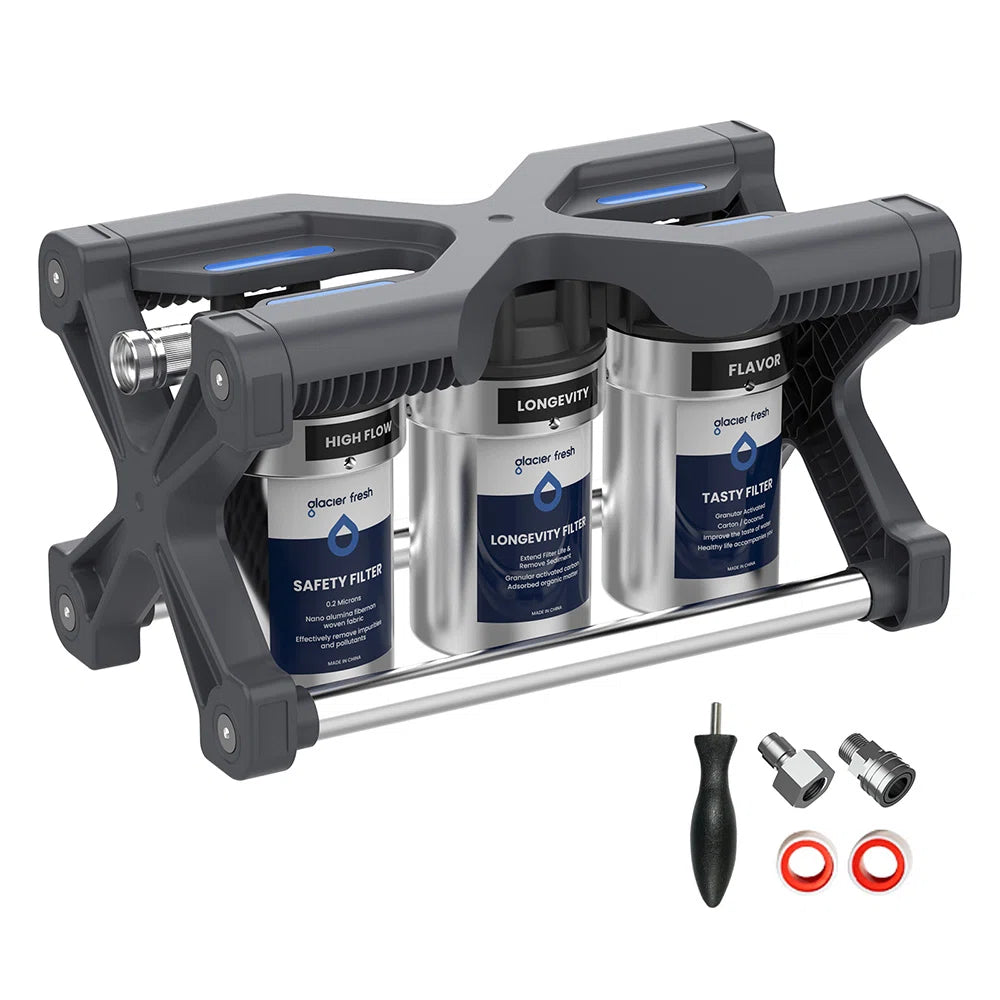
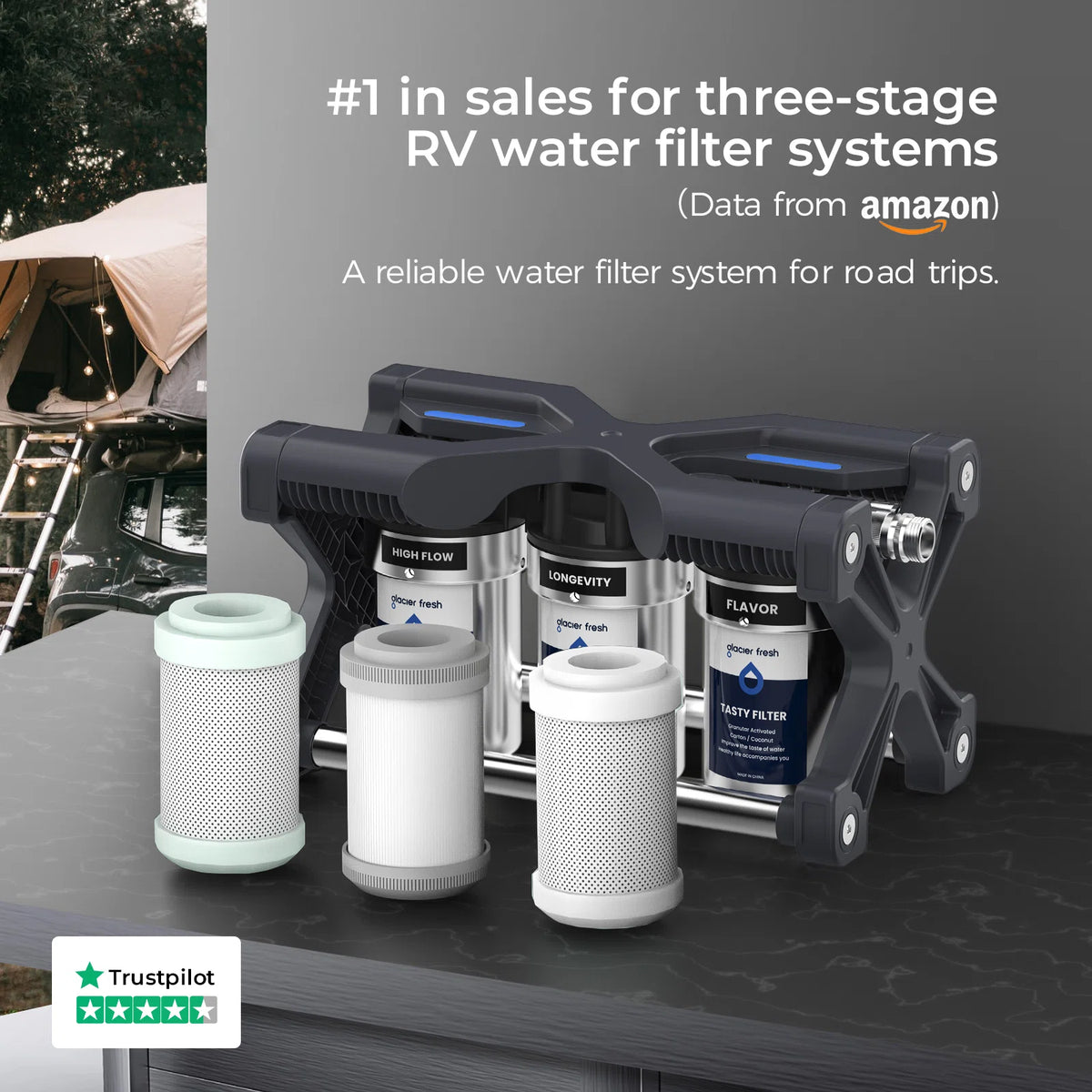
Typically, much of the water used in car washes is filtered through ion-exchange filters. If you don’t want to have to clean water spots after washing your car, the Glacier Fresh RV06 Spotless Water Car Wash System is the right choice for you.
Additionally, choosing a whole-house water filtration system with ion exchange is essential. It extends the lifespan of your appliances, effectively eliminates the need for secondary cleaning, and saves you time.
Type 5. UV Disinfection
Unlike the four filtration methods described above, UV water filtration can only disinfect water; it cannot remove particles or chemicals from the water.
How It Works
Water passes through a glass tube and is exposed to a high-intensity UV-C light beam. This specific wavelength of light penetrates the cell membranes of microorganisms (such as E. coli and various viruses), altering their DNA structure and preventing them from reproducing, thereby eliminating any harm to humans.
Generally, this filtration method is not well-suited for household use and is typically employed to treat well water. Furthermore, this method is particularly susceptible to interference; if the water source is turbid, the disinfection effectiveness will be significantly reduced.
Difference Between 5 Types of Water Filters

The table below compares five common types of water filtration systems to help you choose the right water purifier more quickly.
| Technology | Target Contaminants | Advantages | Disadvantages |
|---|---|---|---|
| Activated Carbon | Chlorine, bad taste, VOCs, pesticides | Inexpensive, improves taste instantly | Does not remove heavy metals or bacteria |
| Reverse Osmosis (RO) | Heavy metals, lead, fluoride, salts, microplastics | Highly thorough purification (99.9% removal) | Produces wastewater; Does not retain minerals |
| Ultrafiltration (UF) | Bacteria, sediment, suspended solids | Retains minerals; no wastewater produced | Cannot remove dissolved chemicals/salts |
| Ion Exchange | Calcium, magnesium | Prevents limescale buildup in plumbing | Adds small amounts of sodium; no chemical filtering |
| UV Disinfection | Viruses, bacteria, parasites, mold | Chemical-free biological sterilization | Does not remove physical or chemical impurities |
The Importance of Regularly Replacing Water Filters
Water filters need to be replaced regularly. Many people mistakenly believe that not replacing the filter cartridges will not cause any problems, but in fact, failing to replace them regularly will cause the cartridges to fail, allowing accumulated contaminants to re-enter the water and thereby affect your health.
Water filters need to be replaced regularly. Many people mistakenly believe that not replacing the filter cartridges will not cause any problems, but in fact, failing to replace them regularly will cause the cartridges to fail, allowing accumulated contaminants to re-enter the water and thereby affect your health.
You can consult the user manual for your specific water purifier brand to determine the optimal replacement schedule. Generally, you should replace the activated carbon filter every 2 months, the RO membrane every 1–2 years, and the ultrafiltration membrane every 6 months.
If any of the following situations occur, you may need to consider replacing the filters even before the scheduled replacement time:
- A noticeable drop in water pressure: If you have a kitchen water purifier installed and the water pressure drops significantly only in the kitchen, this may be caused by filter saturation.
- Water taste and clarity: If the filtered water begins to exhibit changes that did not occur before—such as a noticeable change in taste or the water becoming cloudy—your filter may have failed.
Verdict
In short, water filters use physical and chemical principles to improve water quality. However, whether it’s a carbon filter that removes harmful chlorine or a reverse osmosis membrane that blocks invisible lead ions, choosing the right filter hinges on understanding the composition of your source water. Therefore, you’ll also need to understand your local or community water supply to make a final decision on which water filter to choose.