
Table of Contents:
What Is TDS and Why Your RO Water TDS Is Still High
What TDS Reading Should an RO System Produce?
How Can You Obtain a Reliable Before-and-After Reading?
Why Might the First Glass Read Higher?
Could Remineralization Explain the Result?
Which Operating Problems Can Reduce RO Performance?
What Can TDS Tell You About Taste and Safety?
Conclusion
FAQs
A higher-than-expected TDS reading narrows the question, but it does not identify the cause. Source-water concentration, sample timing, a post-RO mineral stage, or the way the measurement was taken can all affect the result; membrane performance is another possibility. Compare feed and treated samples under consistent conditions, then check the difference against the system’s specifications. TDS is useful for troubleshooting, but a low reading cannot prove that every contaminant has been removed.
What Is TDS and Why Your RO Water TDS Is Still High

Total dissolved solids, or TDS, describes dissolved material such as mineral ions and salts. A handheld TDS meter estimates the amount from electrical conductivity and usually displays a value in parts per million. Because the meter uses a conductivity-to-TDS conversion, the displayed number is an estimate rather than a direct identification of each substance.
An RO system is not expected to produce zero TDS in every installation. Its result depends on the incoming water and operating conditions. A mineral stage after the membrane can raise the final-faucet reading by design; a first draw after a long idle period, inconsistent sampling, or declining membrane performance can also explain a higher value. Because each cause calls for a different check, do not adjust pressure or replace a cartridge on the strength of one reading.
What TDS Reading Should an RO System Produce?
There is no single normal TDS number for every RO system or water supply. Start with the feed-water reading and the manufacturer’s stated performance conditions, then compare with treated water from the appropriate sample point. If you calculate apparent reduction, use:
Apparent TDS reduction (%) = (feed TDS − treated TDS) ÷ feed TDS × 100
For example, a feed reading of 400 ppm and treated reading of 40 ppm produce an apparent reduction of 90%. That arithmetic illustrates the formula; it is not a performance claim for a GlacierFresh product. Use samples collected under comparable conditions, and do not compare the membrane outlet with a final tap that passes through a remineralization stage.
A lower TDS number is not, by itself, a better health outcome. What matters is whether the system is performing as specified for the substances it is designed to reduce.
How Can You Obtain a Reliable Before-and-After Reading?
Use the same meter and clean containers for both samples. Follow its instructions for calibration, temperature compensation, units, and probe care. Let each reading stabilize as directed, and note whether the RO system had just started or had been idle. If results vary, take another sample instead of relying on whichever number is lowest.
Rinse the container between measurements and handle the probe as the meter instructions recommend; residue can affect a small sample. Record the meter model, units, temperature if available, and whether the system was running or had been idle. Take repeat readings from fresh portions of water and wait for each display to stabilize. Consistent paired results are more useful than one unusually high or low value.
Collect feed and treated water at the sample points specified in the manual. Some systems provide a service point before post-treatment; others do not. Do not disconnect tubing or open a pressurized part to create one. The final faucet tells you about the water you drink, but its reading may include minerals added after the membrane. Record where and when each sample was taken so later readings can be compared fairly.
Why Might the First Glass Read Higher?

After a system sits idle, its first permeate sample may read higher than water produced during continued operation. This temporary increase is often called TDS creep and is associated with dissolved ions moving across the membrane while water is stagnant. Treat a first-draw result separately from a reading taken after the system has run.
Use the same sequence each time: record the first draw, operate the unit as directed, then take another sample from the same point. A sample collected after a long idle period is not directly comparable with one taken during steady production. If the later reading remains high after the recommended run time, check pressure, pretreatment, and service history.
Use the flush or wait period specified for your unit. If the first value settles and later paired samples fall within the expected performance range, the initial reading may have been temporary. Repeatedly high results under the same conditions warrant a closer performance check.
Could Remineralization Explain the Result?
A post-RO mineral stage is designed to add dissolved minerals back into the water. A sample from the final faucet can therefore read higher than one taken directly after the membrane. That difference alone does not show that the membrane has failed.
Carbon filtration and ultrafiltration do not work like RO. Depending on its design, a carbon filter may improve taste or reduce specified compounds without changing TDS much. An unchanged reading is not enough to conclude that these filters are ineffective.
Which Operating Problems Can Reduce RO Performance?
When repeat measurements fall outside the system’s expected range, review how it is operating before replacing parts. Low feed pressure, a clogged prefilter, an aging membrane, changed source water, or an installation problem can all affect rejection. Check the manual for that model’s pressure and temperature limits, and keep every connected component within its rating.
Begin with simple checks. Make sure the feed valve is open, inspect for a kink or leak, and see whether a prefilter is due under the manufacturer’s schedule. Confirm that inlet pressure and water temperature meet the limits for the installed model. A change in source water can affect both the feed reading and membrane performance. If you use a pressure gauge, compare it under the manual’s test conditions rather than borrowing a target from another RO system.
- Feed and treated readings are both higher than before, with a similar calculated reduction: check whether source water changed.
- The first sample is high but later readings stabilize: review the required startup or sampling procedure.
- The final faucet reads higher than a membrane sample: confirm whether a mineral stage is present.
- Reduction remains poor across repeat paired tests: check pretreatment, installation, and membrane service needs.
Do not alter a flow restrictor or bypass a safety component to chase a lower number. If measurements are repeatable and outside manufacturer guidance, contact the system provider or a qualified water-treatment professional.
When to Upgrade Your RO System?

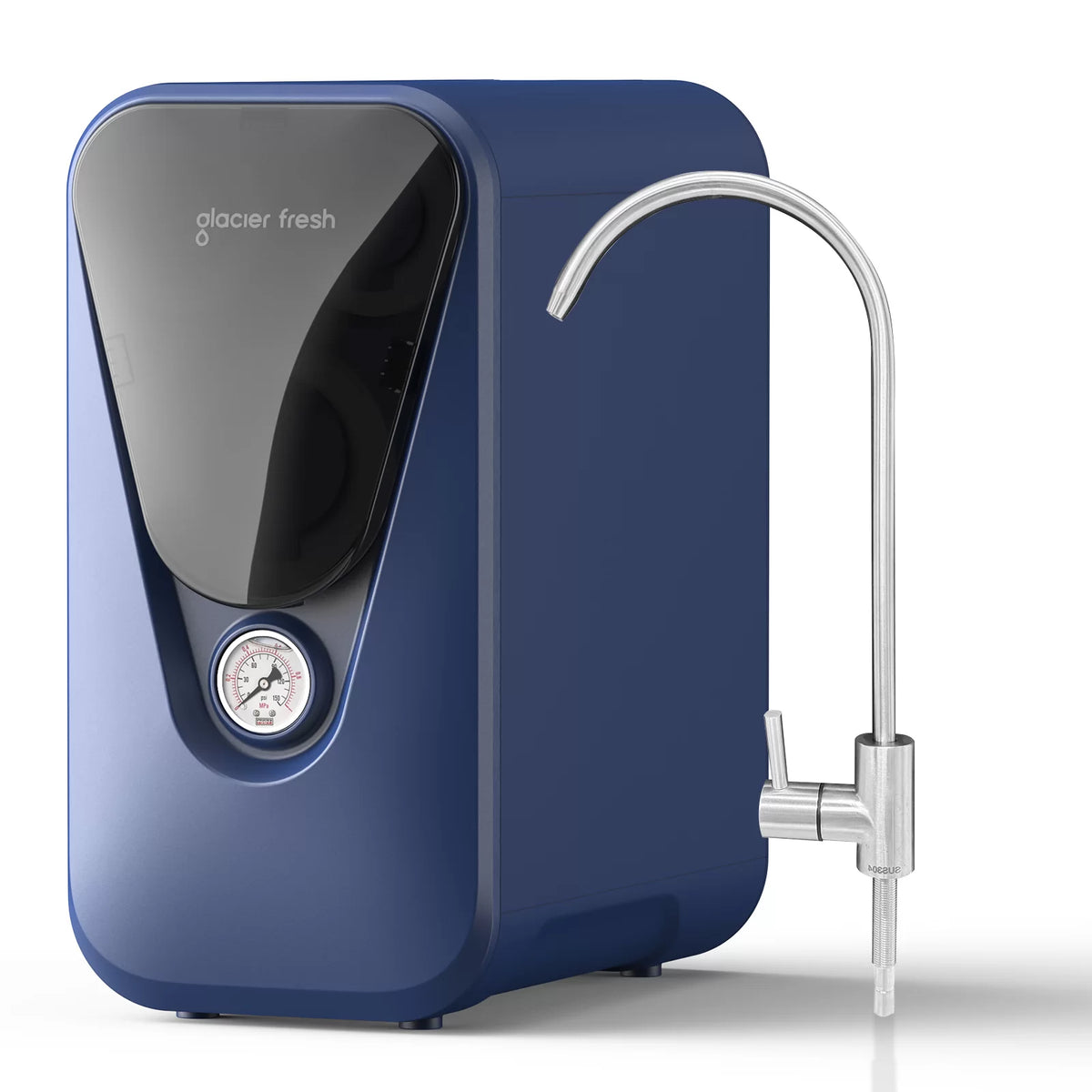
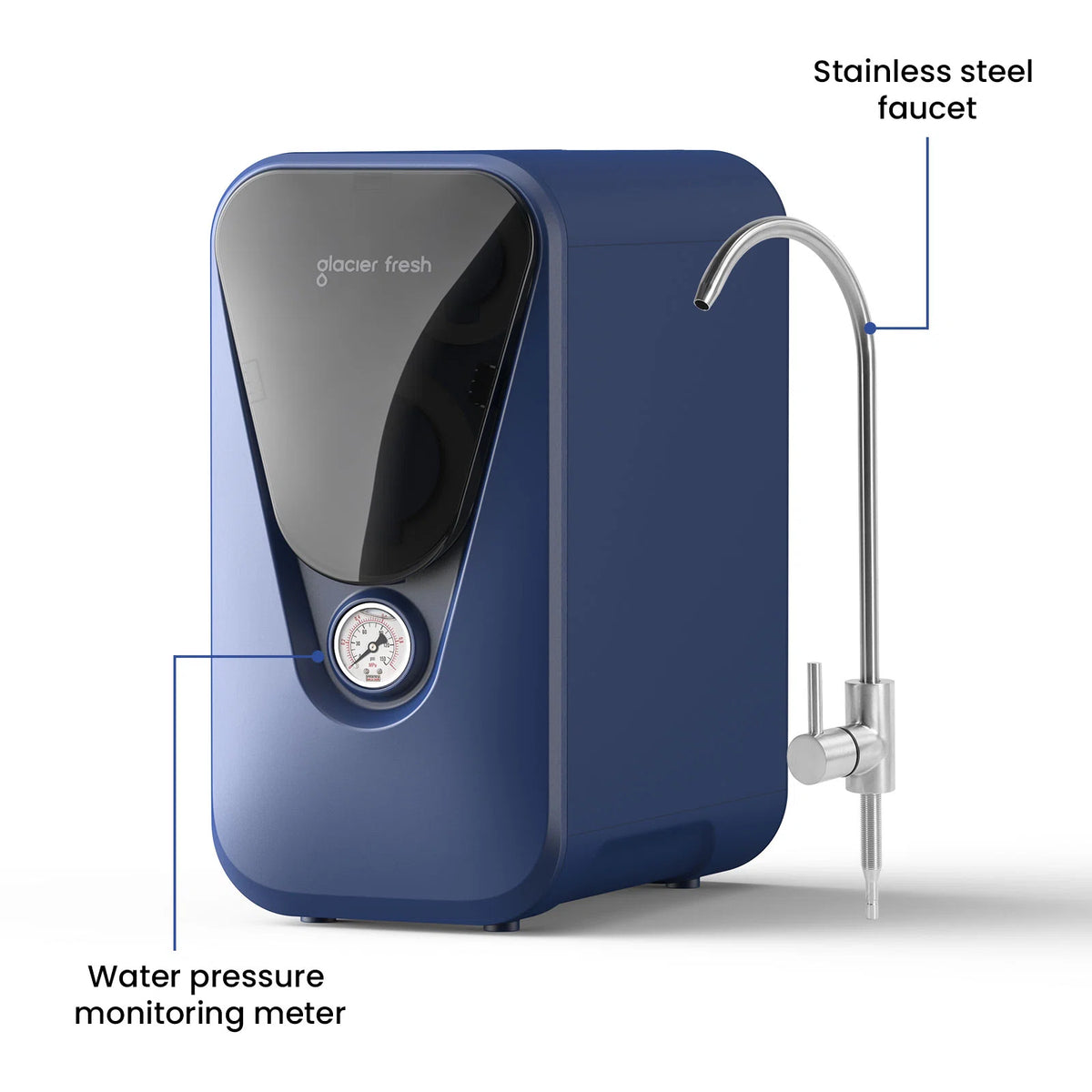
An upgrade may be more practical when an older system has recurring performance issues despite correct maintenance, a membrane that is due for replacement, or an under-sink layout that no longer suits the household. The GlacierFresh U03 TankInside RO System is an option for people comparing compact designs with an integrated internal tank. Its actual outlet TDS still depends on feed-water quality, pressure, membrane condition, and operating conditions. Check current model specifications and installation requirements rather than expecting a fixed low reading from any RO system.
What Can TDS Tell You About Taste and Safety?
Dissolved minerals can affect taste, but TDS does not reveal which substances are present. EPA’s 500 mg/L secondary guideline for TDS addresses aesthetic and nuisance effects; it is not a universal health-based threshold for RO water. A low reading cannot establish that lead, PFAS, or microorganisms are absent. If a specific contaminant is a concern, use appropriate source-water testing and treatment documented for that contaminant.
Taste is subjective and can change with mineral composition even when two samples have similar TDS values. Conversely, a low conductivity estimate cannot rule out substances that the meter does not detect or distinguish. Use the meter to follow a consistent trend in a particular system, and use a contaminant-specific test or certified treatment claim when the question is about a named health concern. That keeps a convenient measurement from being asked to answer a question it was not designed to answer.
Conclusion
TDS is most useful as a paired record: note the feed and treated readings, sample points, and timing. Compare those results with the exact system’s instructions and operating conditions. The aim is to confirm the treatment is working as specified, not to chase the lowest number on the meter.
FAQs
Does a water softener lower TDS?
A conventional ion-exchange softener changes which ions are in the water but does not remove all dissolved solids. Water can become less hard and still show substantial TDS, so a conductivity meter alone cannot confirm softening performance.
Can a TDS meter measure water pH?
No. A conductivity-based TDS meter estimates dissolved solids, while pH describes acidity or alkalinity. Use an instrument or test intended for pH when that measurement is needed.
Does boiling water reduce TDS?
Ordinary boiling does not remove dissolved salts. As water evaporates, the remaining liquid can have a higher concentration. Distillation is a separate process in which vapor is collected and condensed.
Can a TDS meter tell me whether my water is hard?
Not reliably. TDS includes many dissolved substances beyond calcium and magnesium. A water-hardness test is needed to measure hardness specifically.
References
U.S. Environmental Protection Agency — Secondary Drinking Water Standards: Guidance for Nuisance Chemicals
https://www.epa.gov/sdwa/secondary-drinking-water-standards-guidance-nuisance-chemicals
U.S. Geological Survey — Groundwater Salinity: Applying the Specific Conductance and Water Type Proxy
Water Quality Association — POU RO Performance and Sizing
https://wqa.org/wp-content/uploads/2022/09/Article-4-POU-RO-Performance-and-Sizing.pdf
NSF — NSF/ANSI 58: Reverse Osmosis Drinking Water Treatment Systems
https://www.nsf.org/knowledge-library/nsf-ansi-58-reverse-osmosis-drinking-water-treatment-systems
CDC — About Home Water Treatment Systems
https://www.cdc.gov/drinking-water/about/about-home-water-treatment-systems.html
U.S. EPA — WaterSense Product Search: Point-of-Use Reverse Osmosis Systems
https://lookforwatersense.epa.gov/Product-Search-Results-ReverseOsmosisSystems.html