

Table of Contents:
What are nanofiber membranes?
What does hydrophilic vs. hydrophobic mean?
Hydrophilic nanofiber membranes: key features & benefits
Hydrophobic nanofiber membranes: key features & benefits
Hydrophilic vs. hydrophobic nanofiber membranes: what are the differences?
How to choose the right nanofiber membrane filters?
Emerging trends in nanofiber surface engineering
Conclusion
Nanofiber membrane technology has rapidly transformed water filtration, air purification, biomedical engineering, and energy applications. Among the most important performance‐defining characteristics of these membranes is their surface wettability —specifically, whether the membrane is hydropgilic(water-loving) or hydrophobic (water-repelling).
Understanding the differences between these two types is crucial if you want to choose the right nanofiber membrane for your project, filtration system, or product design. This guide breaks down what nanofiber membranes are, how wettability affects their performance, and how to choose the best membrane for your needs—supported by findings from leading research in material science and filtration engineering.
What are nanofiber membranes?

Nanofiber membranes are thin, porous materials made from fibers with diameters typically between 50–500 nanometers. Because these fibers are incredibly small, they create a membrane with:
- High surface area-to-volume ratio.
- Excellent porosity (up to 80–90%).
- Low pressure drop.
- Superior filtration efficiency.
They are commonly fabricated via electrospinning, a technique in which an electrical charge draws polymer solutions into ultrafine fibers. According to research published in Separation and Purification Technology, electrospun nanofiber membranes can remove particles as small as 0.02 microns, making them ideal for microfiltration and ultrafiltration applications.
What does hydrophilic vs. hydrophobic mean?
“Wettability” describes how a material interacts with water, and it is typically measured by water contact angle (WCA):
-
Hydrophilic materials: WCA < 90°
Water spreads easily across the surface. -
Hydrophobic materials: WCA > 90°
Water beads up and resists spreading.
Surface chemistry and fiber structure both influence this property. In nanofiber membranes, engineers often tune wettability by modifying the polymer composition or applying surface coatings.
Hydrophilic nanofiber membranes: key features & benefits
Hydrophilic nanofiber membranes are engineered to attract and absorb water. They are typically made from polymers such as polyvinyl alcohol (PVA), polyacrylonitrile (PAN), cellulose acetate, or modified polyethersulfone.
Key Features
- A low water contact angle (<90°) enables fast wetting.
- Higher water permeability due to a strong affinity with water molecules.
- Better anti-fouling performance, especially against oil or organic matter.
- High flux rates—ideal for microfiltration and ultrafiltration.
- Can be modified with hydrophilic agents like TiO₂, graphene oxide (GO), or polyethylene glycol (PEG).
Benefits
- Faster filtration start-up (minimal pre-wetting required).
- Reduced clogging and extended membrane lifespan.
- Improved filtration accuracy for dissolved contaminants.
- Ideal for water-based applications.
Common Applications
- Drinking water purification systems.
- Wastewater treatment.
- Medical wound dressings.
- Hemodialysis membranes.
- Oil–water separation (oil removal).
Hydrophobic nanofiber membranes: key features & benefits
Hydrophobic nanofiber membranes repel water due to their surface chemistry or microstructure. Polymers like PVDF (polyvinylidene fluoride), PTFE, and polystyrene naturally exhibit hydrophobicity.
Key Features
- High water contact angle (>90°).
- Excellent resistance to wetting under pressure.
- Strong chemical resistance and thermal stability.
- Suitable for filtering non-aqueous fluids (oil, air, solvents).
Benefits
- Prevents pore wetting and maintains consistent airflow.
- Resistant to moisture-induced degradation.
- Ideal for capturing aerosols and airborne particles.
- It can be engineered to be superhydrophobic through micro- and nano-texturing.
Common Applications
- Air filtration (HVAC, industrial filters, N95 masks).
- Membrane distillation.
- Oil filtration.
- Waterproof and breathable fabrics.
- Gas separation.
Hydrophilic vs. hydrophobic nanofiber membranes: what are the differences?

In short:
Hydrophilic = best for water contact
Hydrophobic = best for water avoidance
How to choose the right nanofiber membrane filters?

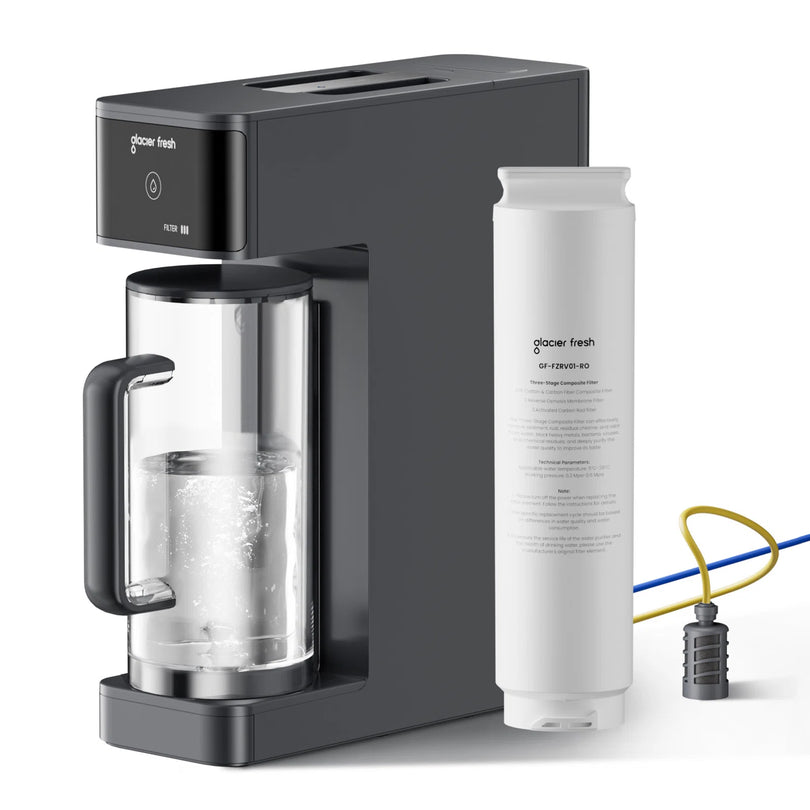
When selecting a nanofiber membrane filter like countertop water filter system,consider:
1. The type of liquid or gas being filtered
- Water-based → Hydrophilic
- Air, vapor, oil, solvents → Hydrophobic
2. Required filtration size
Nanofibers offer tunable pore sizes ranging from 0.02 to 1 µm, depending on the polymer and spinning conditions.
3. Fouling resistance
If your system handles oily wastewater or organic-rich water, a surface-modified hydrophilic membrane offers better durability.
4. Pressure & operating environment
Hydrophobic membranes (e.g., PTFE) withstand high temperatures and harsh chemicals better.
5. Cost & longevity
Hydrophilic membranes may require more frequent replacement if used in environments with heavy microbial loads.
Emerging trends in nanofiber surface engineering
Nanofiber membrane technology is advancing quickly, with research focusing on multifunctional and adaptive surfaces.
1. Janus membranes
Dual-sided membranes with one hydrophilic side and one hydrophobic side—excellent for oil–water separation and selective filtration.
2. Smart wettability control
Using stimuli-responsive polymers that change wettability with:
- Temperature
- pH
- Light
- Electrical fields
3. Superhydrophobic and superhydrophilic surfaces
Engineered via nano-patterning or chemical grafting to create extreme contact angles (>150° or <10°).
4. Antimicrobial & anti-fouling coatings
Silver nanoparticles, copper oxide, quaternary ammonium compounds, and graphene-based coatings are being used to reduce fouling and biofilm formation.
5. Sustainable, biodegradable nanofibers
Researchers are exploring eco-friendly polymers such as:
- Chitosan
- Cellulose nanofibers
- PLA (polylactic acid)
These offer high performance while supporting green manufacturing.
Conclusion
Hydrophilic and hydrophobic nanofiber membranes each solve different problems. Choose hydrophilic when you need fast wetting, aqueous compatibility, and high liquid flux. Choose hydrophobic when you must prevent wetting, transfer vapor (membrane distillation), or create water-repellent functional layers. Choosing the right one isn't about which is better, but about which is right for the specific task at hand.